
On this page10
- What Are B2B Marketing Attribution Models?
- Why Is Marketing Attribution Important for B2B Businesses?
- 7 Common B2B Marketing Attribution Models
- Single-Touch vs. Multi-Touch Attribution
- B2B Marketing Attribution Example
- How to Choose the Right B2B Marketing Attribution Model
- How to Implement B2B Marketing Attribution
- Best Tools for B2B Marketing Attribution
- Common B2B Marketing Attribution Mistakes to Avoid
- Frequently Asked Questions
B2B marketing rarely generates a sale through a single interaction. A potential customer might discover your business through Google, read a blog post, download a whitepaper, attend a webinar, and eventually book a sales demo. Without a reliable way to connect these interactions to business outcomes, it becomes difficult to identify which marketing activities contribute to qualified leads, pipeline growth, and revenue. B2B marketing attribution models help businesses assign credit to tracked customer touchpoints, evaluate campaign performance, and make more informed budget decisions. Understanding how these models work can help your team measure marketing effectiveness and build a more accountable growth strategy.
What Are B2B Marketing Attribution Models?

B2B marketing attribution models are frameworks used to assign credit to marketing touchpoints throughout a buyer's journey. These touchpoints can include organic search, paid advertising, email campaigns, social media, webinars, content downloads, and interactions with sales representatives.
Unlike many consumer purchases, B2B buying decisions often involve longer sales cycles, multiple stakeholders, and repeated interactions. Attribution models help marketers understand how tracked channels participate in lead generation, conversion, and revenue.
For example, a prospect might discover your company through organic search, return through a LinkedIn advertisement, and later request a product demonstration after receiving an email. A first-touch model credits the initial discovery, while a last-touch model credits the final tracked interaction before the defined conversion. A multi-touch model distributes credit across several interactions according to its rules.
No single model tells the complete story of a customer's decision. The right approach depends on your business objectives, tracking capabilities, sales cycle, and reporting requirements.
Why Is Marketing Attribution Important for B2B Businesses?
Marketing attribution helps businesses evaluate how marketing activities relate to lead generation, sales opportunities, and revenue. Combining attribution with effective B2B lead generation strategies helps teams understand how campaigns contribute to qualified prospects and pipeline growth. Rather than relying exclusively on impressions, clicks, or website traffic, marketers can examine how campaigns contribute to different stages of the buying journey.
Measure Marketing's Contribution to Revenue
Attribution connects tracked marketing interactions with outcomes such as qualified leads, opportunities, and closed deals. A campaign generating fewer leads may still be associated with more valuable sales opportunities. Reviewing attribution alongside CRM and revenue data helps teams evaluate performance beyond lead volume.
Identify High-Performing Marketing Channels
B2B businesses invest in organic search, paid advertising, email marketing, social media, and webinars. Attribution helps reveal how these channels participate in the customer journey. Organic search might introduce prospects to a company, while email campaigns nurture their interest and sales demonstrations support evaluation.
Improve Budget Allocation and Campaign ROI
Attribution data can help identify campaigns associated with qualified leads, pipeline value, and revenue. Marketers can use these insights to investigate underperforming campaigns and test alternative strategies. However, budget decisions should also consider campaign costs, conversion rates, sales-cycle length, and customer acquisition cost.
Align Marketing and Sales Teams
Marketing teams often focus on leads and engagement, while sales teams prioritize opportunities and closed revenue. A shared attribution framework helps both teams examine how marketing interactions relate to sales outcomes. Connecting campaign data with CRM records also helps identify gaps in lead nurturing and opportunity development.
7 Common B2B Marketing Attribution Models
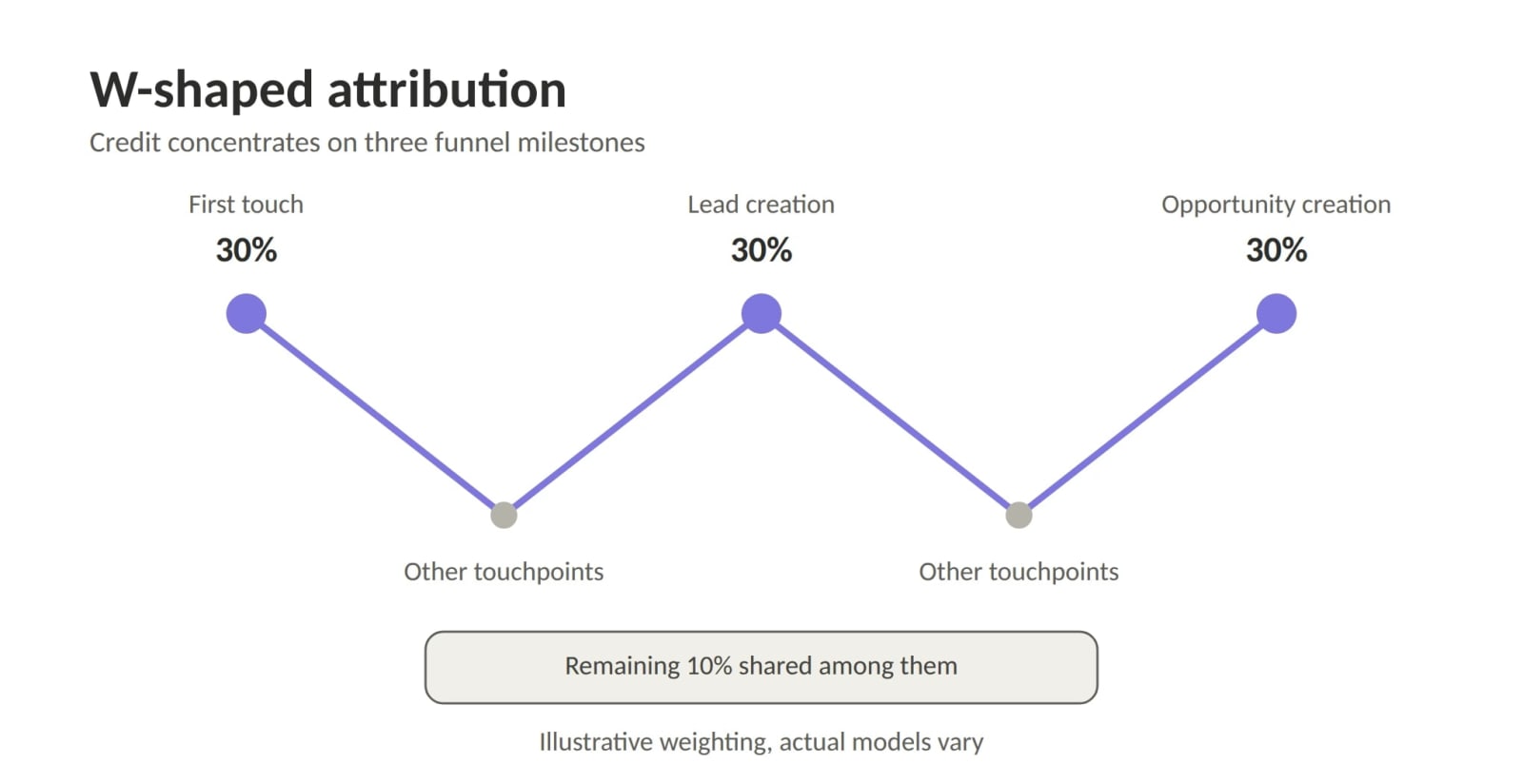
Each attribution model assigns credit differently. Some prioritize a single interaction, while others distribute credit across several touchpoints.
1. First-Touch Attribution
First-touch attribution assigns all conversion credit to the first tracked marketing interaction.
For example, a prospect discovers your company through an organic Google search, later attends a webinar, and eventually books a demo. First-touch attribution credits organic search with the conversion.
Advantages: It is straightforward to understand and helps identify channels associated with initial brand discovery.
Limitations: It ignores subsequent interactions that may have helped the prospect make a decision.
Best for: Businesses measuring brand awareness and new audience acquisition.
2. Last-Touch Attribution
Last-touch attribution assigns all credit to the final tracked interaction before a defined conversion.
Suppose a prospect discovers your business through SEO, reads several articles, and eventually requests a demo after clicking an email. If the email click is the final eligible interaction, it receives the credit.
Advantages: It is simple to interpret and helps identify the interactions immediately preceding conversion.
Limitations: It overlooks earlier touchpoints and may overvalue channels that capture existing demand.
Best for: Businesses evaluating final interactions before form submissions, demo requests, or other conversions.
3. Lead-Creation Attribution
Lead-creation attribution assigns credit to the interaction associated with converting a visitor into a known lead. This might be a whitepaper download, webinar registration, newsletter subscription, or contact form submission.
For example, organic search may introduce a prospect to your website, but a whitepaper download may be the interaction that turns the prospect into a recorded lead.
Advantages: It connects marketing activities with lead generation and helps evaluate lead acquisition campaigns.
Limitations: It does not necessarily identify the original discovery channel or the interactions associated with eventual revenue.
Best for: Demand generation teams measuring the conversion from anonymous visitor to known lead.
4. Linear Attribution
Linear attribution distributes conversion credit equally across all included touchpoints.
If a prospect interacts with organic search, a blog article, a whitepaper, a webinar, and an email campaign before requesting a demo, each receives 20% of the credit.
Advantages: It recognizes multiple interactions and provides a straightforward multi-touch approach.
Limitations: It assumes all interactions contribute equally, which may not reflect their actual influence.
Best for: B2B companies seeking a simple way to recognize several interactions during a long buying journey.
5. Time-Decay Attribution
Time-decay attribution gives greater credit to interactions closer to the conversion event. Earlier interactions receive progressively less credit according to the model's rules.
For example, a prospect might discover your company through search, read a guide two weeks later, attend a webinar, and request a demo the following day. A time-decay model generally gives more weight to the recent interactions.
Advantages: It emphasizes recent engagement and can help evaluate conversion-focused campaigns.
Limitations: It may undervalue early awareness activities, and recent interactions are not necessarily the most influential.
Best for: Businesses that want to prioritize recent interactions when evaluating longer conversion journeys.
6. U-Shaped Attribution
U-shaped attribution, also called position-based attribution, emphasizes the first touchpoint and the lead-creation interaction. A common configuration assigns 40% of the credit to each milestone and distributes the remaining 20% among other tracked touchpoints.
Advantages: It recognizes initial discovery and lead generation while accounting for intermediate interactions.
Limitations: Its predefined weighting may not accurately represent the influence of every interaction.
Best for: Marketing teams that want to understand which channels introduce prospects and which help turn them into known leads.
7. W-Shaped Attribution
W-shaped attribution emphasizes three milestones: first touch, lead creation, and opportunity creation. A common configuration assigns 30% of the credit to each milestone and distributes the remaining 10% among other tracked interactions.
Advantages: It connects marketing activity with important stages of the B2B funnel, including opportunity creation.
Limitations: It requires reliable CRM data and may oversimplify buying journeys involving several stakeholders.
Best for: B2B organizations with established CRM processes that want to evaluate marketing's relationship with pipeline development.
These weighting percentages are illustrative conventions, not universal rules. Actual implementations can vary.
Single-Touch vs. Multi-Touch Attribution
Single-touch attribution assigns all credit to one interaction, usually the first or last tracked touchpoint. Multi-touch attribution distributes credit across several interactions according to the selected model.
Factor | Single-touch attribution | Multi-touch attribution |
|---|---|---|
Credit assignment | One interaction receives all credit | Credit is distributed across multiple interactions |
Complexity | Relatively simple | Varies by model and implementation |
Main insight | Initial discovery or final interaction | Multiple stages of the buyer journey |
Data requirements | Often lower | Generally higher |
Main limitation | Overlooks other touchpoints | Depends on tracking quality and model assumptions |
For many B2B companies with long sales cycles, multi-touch attribution offers a broader view of the tracked customer journey. However, single-touch models remain useful for answering focused questions, such as which channel introduced a prospect or which interaction preceded a demo request.
The best approach depends on the question you want to answer. Where practical, compare multiple attribution views and combine them with CRM data, pipeline metrics, and sales feedback.
B2B Marketing Attribution Example
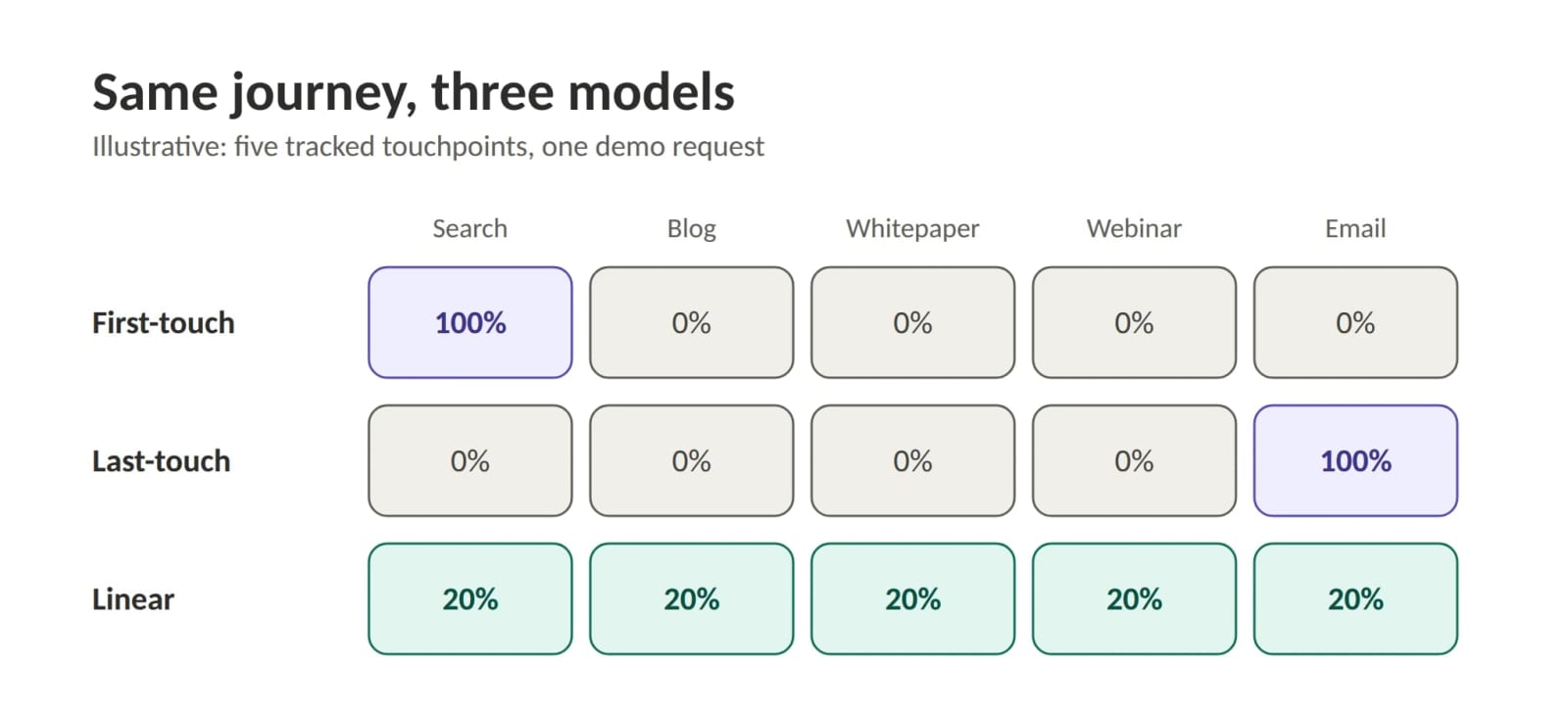
Consider a B2B software company that tracks five interactions before a prospect requests a demo: an organic search visit, a blog article, a whitepaper download, a webinar, and an email click.
The following example shows how three attribution models assign credit to the same conversion.
Customer touchpoint | First-touch | Last-touch | Linear |
|---|---|---|---|
Organic search | 100% | 0% | 20% |
Blog article | 0% | 0% | 20% |
Whitepaper download | 0% | 0% | 20% |
Webinar | 0% | 0% | 20% |
Email click | 0% | 100% | 20% |
Total | 100% | 100% | 100% |
Illustrative example assuming five tracked touchpoints and one demo-request conversion.
First-touch attribution highlights organic search as the channel associated with initial discovery. Last-touch attribution emphasizes the email click immediately before the demo request. Linear attribution distributes credit equally across the five interactions.
Each model provides a different perspective. None independently proves which interaction caused the conversion. For revenue-focused reporting, connect attribution data with CRM opportunities, closed deals, campaign costs, and sales-cycle information.
How to Choose the Right B2B Marketing Attribution Model
Choosing a model starts with understanding what your business needs to measure.
Businesses selling complex software can also explore B2B SaaS content marketing strategies to understand how content supports buyers throughout the decision-making process.
Consider Your Sales Cycle Length
Shorter buying journeys may be easier to evaluate using first-touch or last-touch attribution. Enterprise B2B companies with extended sales cycles may benefit from multi-touch approaches that recognize several tracked interactions.
Define Your Attribution Goals
Choose the model based on your objective. First-touch attribution can help evaluate initial discovery, lead-creation attribution focuses on lead generation, and W-shaped attribution emphasizes first touch, lead creation, and opportunity creation.
Evaluate Your Data Quality
Missing UTM parameters, duplicate CRM records, and disconnected analytics platforms can distort reporting. Check whether your systems consistently capture campaign sources, conversion events, lead records, and opportunity stages before implementing a complex model.
Match the Model to Your Marketing Maturity
Businesses with limited tracking infrastructure may need to start with a straightforward approach. As tracking, CRM integration, and reporting improve, they can evaluate more advanced attribution models.
Test Models Before Changing Budgets
Compare how different models affect reported channel performance. A first-touch model may emphasize organic search, while a last-touch model may favor email or paid search. Consider these differences alongside conversion rates, pipeline value, campaign costs, and sales feedback.
How to Implement B2B Marketing Attribution

A practical implementation process helps businesses connect marketing interactions with measurable outcomes.
Step 1: Map the B2B Customer Journey
Identify key stages such as awareness, engagement, lead creation, qualification, opportunity creation, and closed-won business. List the touchpoints associated with each stage, including search visits, content downloads, webinars, sales meetings, and product demonstrations.
Step 2: Set Up UTM Parameters
Use consistent UTM parameters such as utm_source, utm_medium, and utm_campaign to identify campaign traffic. Establish naming conventions and apply them consistently across marketing channels.
Step 3: Connect Your CRM and Analytics
Connect marketing analytics with CRM records where possible. This helps teams relate campaign interactions to leads, opportunities, and customer outcomes. Review integrations regularly to reduce duplicate records and missing information.
Step 4: Define Conversion and Revenue Events
Decide which outcomes matter, including form submissions, qualified leads, opportunity creation, and closed-won deals. Define each event clearly so marketing and sales teams use consistent criteria.
Step 5: Review Reports Regularly
Examine channel contribution, conversion rates, pipeline value, and campaign costs. Compare attribution models where practical, investigate missing data, and use the findings to guide campaign experiments.
Best Tools for B2B Marketing Attribution
The right tool depends on your existing marketing stack, reporting requirements, and budget.
Google Analytics 4: Useful for website analytics, traffic acquisition, and key-event attribution. Its available attribution settings include data-driven and last-click approaches, depending on the reporting context and configuration.
HubSpot: Offers attribution reporting that connects tracked interactions with contacts, deals, and other conversion outcomes. Availability depends on the products and subscription tier.
Salesforce Marketing Cloud Account Engagement: Supports B2B marketing automation and prospect engagement tracking. Its usefulness for attribution depends on the Salesforce products, CRM configuration, and reporting capabilities in use.
Dreamdata: Focuses on B2B revenue attribution and buyer journey analytics, helping teams investigate how go-to-market activities relate to pipeline and revenue.
HockeyStack: Offers B2B go-to-market analytics, buyer journey analysis, and attribution capabilities for teams seeking a broader view of marketing and sales performance.
Before selecting a platform, verify its current features, integrations, pricing, and data requirements. A tool that fits your existing CRM and measurement process may be more useful than one with more features but a difficult implementation.
Common B2B Marketing Attribution Mistakes to Avoid

Treating attribution as proof of causation: Attribution assigns credit according to model rules. It does not prove that a marketing interaction caused a purchase.
Ignoring offline interactions: Sales conversations, referrals, and industry events may influence buying decisions. Record these interactions where reliable data is available.
Relying on incomplete tracking: Missing UTM parameters, duplicate records, and disconnected platforms can distort results. Maintain consistent tracking standards and audit data regularly.
Overlooking buying groups: B2B purchases often involve multiple stakeholders. Where possible, evaluate both individual-contact and account-level engagement.
Depending on one model: Different models emphasize different interactions. Compare attribution views when practical and understand their assumptions.
Ignoring privacy requirements: Review tracking, consent, data retention, and data-sharing practices against applicable legal and organizational requirements.
Frequently Asked Questions
What Is the Best Attribution Model for B2B Marketing?
The best model depends on your objectives, sales cycle, and data quality. First-touch helps evaluate initial discovery, while multi-touch approaches provide a broader view of tracked interactions. Comparing models alongside CRM and revenue data can support more informed decisions.
What Is the Difference Between First-Touch and Last-Touch Attribution?
First-touch assigns credit to the first tracked interaction, while last-touch assigns credit to the final eligible interaction before a defined conversion. The former emphasizes discovery, and the latter emphasizes the interaction closest to conversion.
Is Multi-Touch Attribution Better for B2B Companies?
It can be useful for companies with complex buying journeys because it recognizes multiple tracked interactions. However, its value depends on data quality and model assumptions. More detailed reporting does not automatically mean more accurate measurement.
How Do You Measure B2B Marketing Attribution?
Track campaign interactions, define conversion events, and connect marketing analytics with CRM records. Evaluate leads, opportunities, closed deals, and campaign costs using a model suited to your objectives.
What Tools Are Used for B2B Marketing Attribution?
Common options include Google Analytics 4, HubSpot, Salesforce products, Dreamdata, and HockeyStack. Their capabilities differ, so evaluate i