
What Is SEO for ChatGPT?
SEO for ChatGPT is the practice of making your website and brand easy for ChatGPT to find, understand, and cite when it answers a question. It combines crawler access, answer-first content, original data, consistent brand facts, and third-party mentions. It builds on traditional SEO, but you measure it in citations and brand mentions, not just rankings.
The short version:
ChatGPT can only cite pages its search crawler can reach.
It runs several follow-up searches per question, so cover the whole topic.
Pages that open with a clear, quotable answer are easier for it to use.
Original data gives it a reason to cite you.
Mentions on other sites strongly influence which brands it names.
You track visibility by testing a fixed set of prompts, not with a rank tracker.
For B2B brands this matters because buyers now ask ChatGPT to shortlist vendors before they open Google. If it doesn't name you, you aren't on the shortlist. If you're newer to the foundations, start with our guide to what link building is and our SEO management service.
How Does ChatGPT Choose Which Sources to Cite?
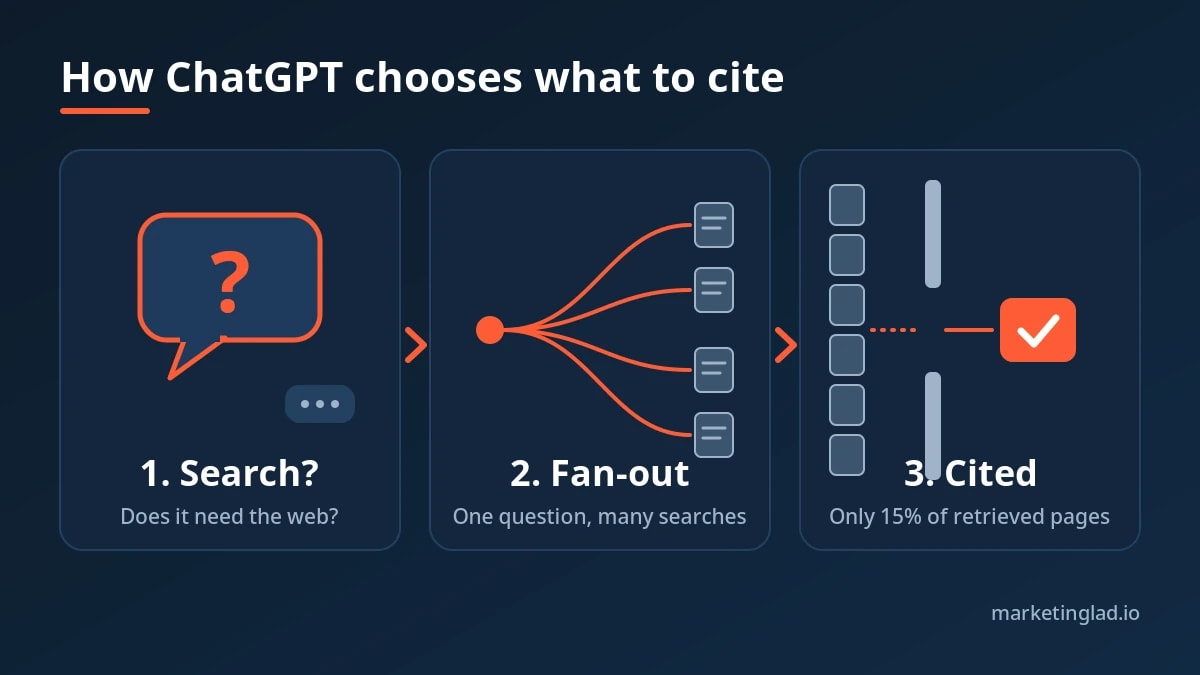
ChatGPT cites sources in three stages: it decides whether to search, expands the question into several searches, and then cites only a fraction of what it retrieved. Your content has to survive all three.
Stage 1: It doesn't always search. In a study of entity-comparison prompts collected from 31 July to 5 August 2026, 58% of logged-out ChatGPT responses showed evidence of web search. Grow and Convert found it searched for more than 80% of product-related prompts. Rates vary by topic and method, so you need two kinds of visibility: being known from training, which comes from being widely mentioned, and being retrievable when it searches.
Stage 2: One question becomes many searches. An AirOps study of 15,000 prompts found that ChatGPT generated two or more follow-up (fan-out) queries on 89.6% of searches, and 32.9% of citations came only from those follow-ups. About 95% of fan-out queries had zero tracked search volume. So a page can be cited for a question it never targeted, as long as it answers that question clearly.
Stage 3: Most retrieved pages are never cited. In the same AirOps study, ChatGPT retrieved 548,534 pages and only 15% appeared as citations. Grow and Convert found that only 27% of cited sources ranked on Google for ChatGPT's follow-up queries. Cited pages aren't necessarily new either: one analysis found a median cited-page age of about 500 days, so refreshing a strong older page often beats publishing a new one.
What this means for you:
Give each page one question to answer well, and cover related questions in linked pages.
Make each section quotable on its own.
Refresh pages that already perform.
Build presence on third-party sites, not only your own.
Is SEO for ChatGPT Different From Google SEO?
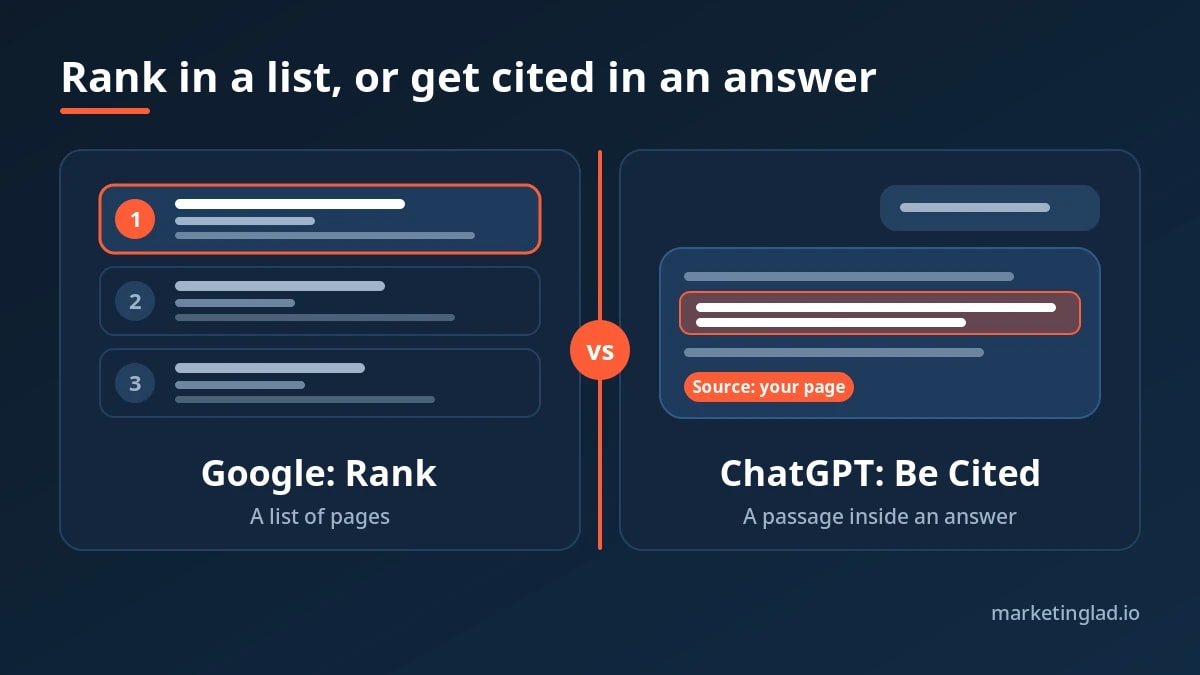
The foundations are shared, but the goal differs: Google ranks pages in a list, while ChatGPT picks passages and brands for a written answer. Ranking helps, but it doesn't guarantee a citation.
Google SEO | SEO for ChatGPT | |
|---|---|---|
Goal | Rank a page | Be cited or named in an answer |
Unit that wins | The page | The passage and the brand |
Keyword research | Volume and difficulty | Related questions and follow-up queries |
Crawlers | Googlebot, which renders JavaScript | OAI-SearchBot and ChatGPT-User; assume HTML only |
Authority | Backlinks, on-page relevance | Backlinks plus brand mentions |
Measurement | Rank trackers, Search Console | Prompt testing, citations, referrals |
Crawlability, speed, structure, depth and quality backlinks still matter. If your technical base is weak, fix it first with SEO management or an SEO-first website build. What changes is that ChatGPT often reaches for what others say about brands, so brand mentions and editorial links do double duty: they build search authority and shape which brands an AI names.
Step 1: Let the Right Crawlers In
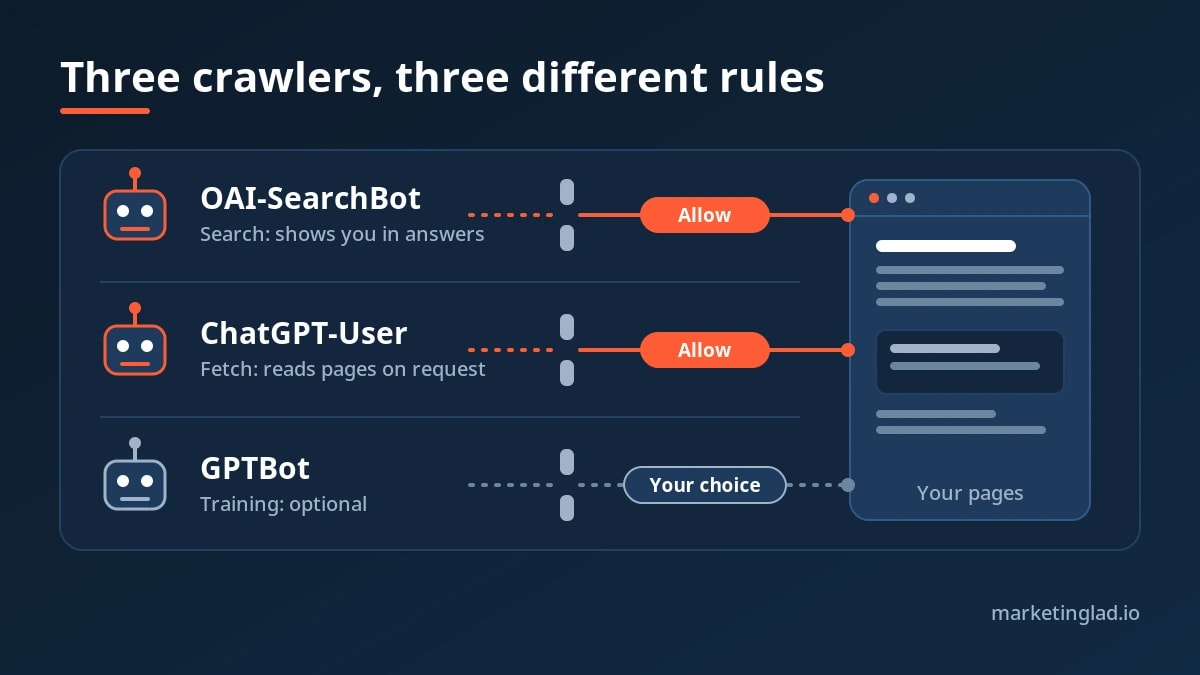
ChatGPT can only cite pages its crawlers can reach, so check your robots.txt, firewall and rendering first. It's the cheapest fix in this guide and the one most often missed.
OpenAI runs three separate crawlers:
Crawler | What it does | If you block it |
|---|---|---|
OAI-SearchBot | Surfaces sites in ChatGPT search | You won't be shown in ChatGPT search answers |
ChatGPT-User | Fetches pages for user actions in ChatGPT | On-demand fetches can fail |
GPTBot | May collect content for model training | Excluded from training; search visibility is separate |
Blocking GPTBot does not remove you from ChatGPT search. A starting robots.txt for most B2B brands:
User-agent: OAI-SearchBot
Allow: /

User-agent: ChatGPT-User
Allow: /

# Your choice: allow or block training use
User-agent: GPTBot
Allow: /
Switch the GPTBot rule to Disallow: / if you don't want training use, and make sure no blanket Disallow: / elsewhere catches these bots.
Check your firewall and CDN. Security tools sometimes block AI crawlers by default. Allowlist the IP ranges OpenAI publishes in its crawler documentation, which also lets you confirm a visit is genuine.
Put key content in the initial HTML. Assume these crawlers don't run JavaScript. A Vercel and MERJ analysis found no evidence that major AI crawlers render it, though one developer reported otherwise in late September without confirmation from OpenAI. In practice:
Render headings, body copy, FAQs and key stats on the server.
Keep FAQ answers in the page source even when they're collapsed in an accordion.
Avoid animated counters that load a number after the page renders.
Quick test: open your page, choose View page source, and search for a sentence from your FAQ. If it isn't there, these crawlers can't see it.
Step 2: Write Answer-First Pages
An answer-first page opens every section with a short, direct answer, then adds detail. It gives the model a self-contained passage to quote.
The top of the page gets most citations. Kevin Indig's analysis of 18,012 verified citations found that 44.2% came from the first 30% of the page.
Answer capsules are the most common trait. A Search Engine Land audit of 15 sites found that 72.4% of cited posts had a short, self-contained block that answers one question.
Headings act like prompts. In Indig's data, 78.4% of citations tied to questions came from headings.
Matching the query matters. AirOps found that pages with the strongest heading-to-query match were cited 41.0% of the time, versus roughly 30% for weaker matches, and that narrow pages beat broad guides.
Many get-cited-X%-more figures online come from vendor posts with no stated method, so we've used only studies that describe how they were run.
The pattern: a question heading in your buyer's words, a first sentence that answers it starting with the topic itself, one or two sentences of support, then the detail.
Before: Over the years, the digital landscape has changed, and links have always played a role in how search engines evaluate sites...
After: Do backlinks still matter for ChatGPT visibility? Yes. Backlinks help your pages rank in the search indexes AI tools draw from and signal authority, but they work alongside brand mentions, not instead of them.
Checklist: question-style H2s, a direct first sentence under each, key points in the top third, one main question per page, paragraphs that make sense when quoted alone, no filler introductions. Our expert-answered SEO questions page is a good model of the format.
Step 3: Add Information Gain
Information gain means giving ChatGPT something it can't find on every other page, and for B2B brands that usually means original data. In the Search Engine Land audit, 52.2% of cited posts contained original or owned data, and 34.3% combined an answer capsule with original insight, the strongest configuration. SE Ranking's 129,000-domain study found content with 19 or more data points averaged 5.4 ChatGPT citations versus 2.8 for content with minimal data.
For an agency, the data you already have counts:
Campaign results: DR movement across client campaigns, with time frame and tool
Operational benchmarks: link removal rates, outreach reply rates, average placement DR
Cost benchmarks: typical price ranges, with sample size
Experiments: how often ChatGPT cited a page before and after a change
Present each number with four things: what was measured, how many, when, and how it was verified. For example: Across [N] campaigns between [start] and [end], average domain rating rose from [X] to [Y] in [Z] months, measured in Ahrefs. Never invent or round up figures; one false stat can sink the whole post. Our case studies are the kind of verified source material to draw from.
Step 4: Build Entity Consistency and Authorship
For ChatGPT to describe you accurately, your name, description, services and numbers should read the same everywhere. Inconsistent facts make a model less likely to repeat you, or more likely to repeat the wrong version.
One description, used everywhere: [Company] is a [type] that helps [audience] with [services]. Reuse it on your About page, author bios, LinkedIn and review profiles.
Matching numbers: if client counts or links built differ between pages, pick the correct figure and update every place.
Audit third-party profiles: Seer Interactive found AI surfacing a single 24-year-old bad review in answers about their brand. Update LinkedIn, Clutch and directory listings, and respond to old reviews.
Real authors: give every post a named author with a verifiable bio, a LinkedIn link, and a visible updated date. AirOps found pages over two years old were cited less often.
Structured data: add Organization, Person, Article and FAQPage schema with sameAs links. We haven't found strong evidence that schema alone raises citations, so treat it as housekeeping, not a growth lever.
Step 5: Earn Third-Party Mentions
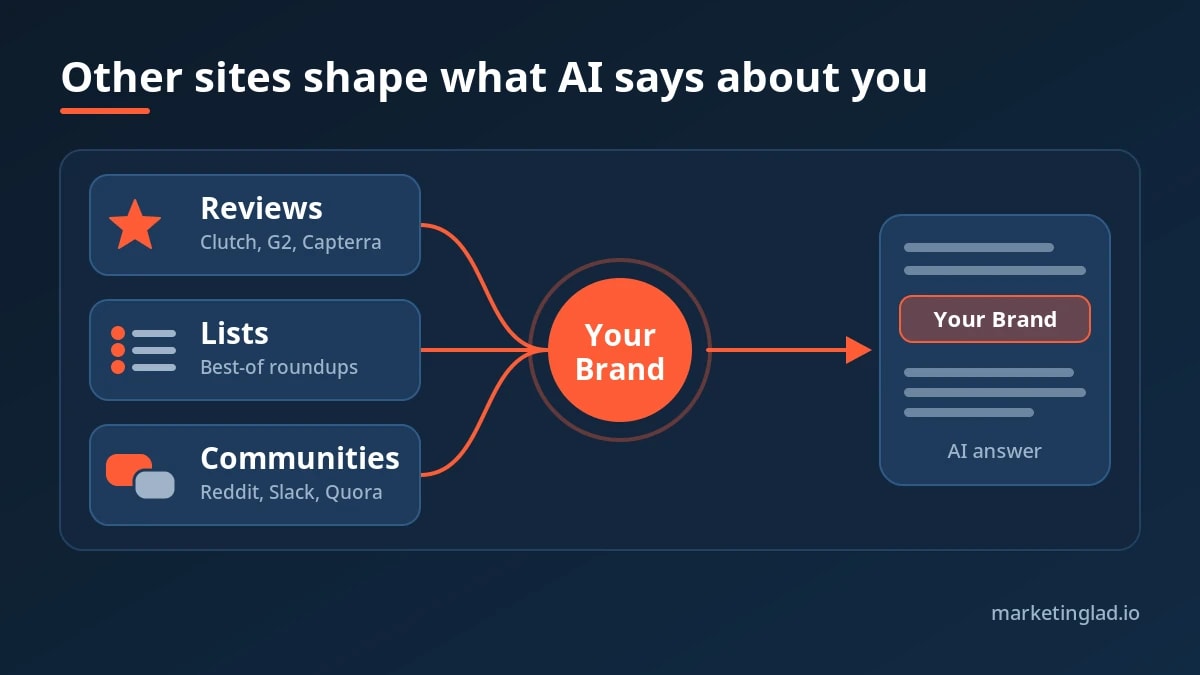
For many commercial questions, ChatGPT relies more on what other sites say about brands than on what brands say about themselves, which makes this the highest-impact step and the one where link building and AI visibility overlap.
Brand-name versus best questions. The Hoth, using Ahrefs Brand Radar on four brands in August 2026, found 69.6% of responses to brand-name questions cited the brand's own site, versus 1.3% for best questions. It's a small sample, but the pattern is clear.
Most mentions are external. AirOps found 85% of brand mentions came from other domains, and nearly 90% of those came from listicles, comparisons or reviews.
Mentions correlate with visibility. Ahrefs' 75,000-brand study found YouTube mentions and branded web mentions correlated most strongly with ChatGPT visibility. That's correlation, not proof of cause.
Reviews and communities help. SE Ranking's data, as summarized by Contently, found domains on several review platforms averaged 4.6 to 6.3 citations versus 1.8 for those absent, and heavy Reddit presence averaged 7 versus 1.8.
A four-step process:
Find what ChatGPT cites in your category. Run 15 to 20 buyer prompts and open the Sources panel on each answer. Note the pages that repeat.
Build a target list of those pages, noting where you and your competitors appear.
Earn the mention honestly with original data, a quote or a case study, and disclose sponsorships. Our ethical link building guide covers the approach. Never fake reviews.
Publish fair comparison pages on your own site, including where a competitor is the better fit.
The placements that raise search authority are often the pages ChatGPT reads, so one target list serves both goals. That's how our Brand Mentions and LLMO service and link building work fit together. Startups can begin with our link building for startups guide, and you can swap tactics with other SEOs in our Slack community.
Step 6: Track and Test Your Visibility
You test ChatGPT visibility with a fixed prompt set and read your analytics for the traffic you can identify. Treat results as a trend, because answers vary.
Build the prompt set. Write 10 to 15 buyer prompts and keep the wording fixed. Cover category prompts (best link building agency for B2B SaaS), comparisons, how-to questions, brand-name questions, and decision questions. Split results by type, since a brand can win one type and miss another.
Run each prompt at least three times. The same prompt can retrieve different sources and passages, and AirOps ran each of its 16,851 queries three times for this reason. Log the date, whether you were mentioned or cited, which URLs and competitors appeared, and whether the description of you was accurate. Test monthly and after major changes.
Track the traffic you can see. In GA4, create a custom channel group for AI sources such as chatgpt.com, and place its rule above the default Referral rule or the channel stays empty. Check that these domains aren't on your referral exclusion list.
Know what the numbers miss. Referral data is the floor, not the ceiling. Many users copy a recommendation and type your URL, and links opened in mobile apps often strip the referrer and land in Direct. Watch for lifts in branded search and direct traffic after visibility gains.
Want your team to run this in-house? Our SEO coaching is built for that.
Common Mistakes in SEO for ChatGPT
Blocking OAI-SearchBot by accident, or confusing it with GPTBot.
Hiding key content behind JavaScript.
Burying the answer under a long introduction.
Writing one huge page instead of focused ones.
Publishing generic advice with no original data.
Ignoring third-party sites.
Letting brand facts drift between pages and profiles.
Judging results from one test or from referral traffic alone.
Faking reviews or spamming communities.
Bottom Line
SEO for ChatGPT comes down to being reachable, quotable and mentioned. Let OAI-SearchBot read your pages, open each section with a direct answer, publish data only you have, keep your brand facts consistent, and earn mentions on the third-party pages ChatGPT already cites. Then test a fixed set of prompts every month to see what is working. Start with crawler access: it's the quickest fix, and everything else depends on it.
Frequently Asked Questions
What is SEO for ChatGPT?
It is the practice of making your site and brand easy for ChatGPT to find, understand and cite. Terms like GEO, LLMO and AEO are often used interchangeably with it.
Does blocking GPTBot remove me from ChatGPT search?
No. GPTBot relates to model training, while OAI-SearchBot controls whether you appear in ChatGPT search. You can block GPTBot and stay citable.
Do I need to rank on Google to be cited?
It helps, but it isn't required. AirOps found the top-ranked page was cited 58.4% of the time versus 14.2% at position 10, yet Grow and Convert found only 27% of cited sources ranked for ChatGPT's follow-up queries.
What content gets cited most?
Pages with a direct answer near the top, question-style headings and original data. For commercial queries, third-party listicles, comparisons and reviews dominate.
How long does it take to see results?
There's no guaranteed timeline. New content may need time to build retrieval signals, and third-party mentions depend on other sites publishing. Crawler access is the fastest fix, since it can take effect when the crawler next visits.