
Want to create reliable web scrapers fast?
Get started with Apify, a platform that lets developers build, deploy, and publish web scraping, data extraction, and web automation solutions.
Apify was founded in 2015 by Jan Čurn and Jakub Balada. The initial concept was to make it simple for developers to build versatile, scalable web crawlers. It used only front-end JavaScript, thanks to then-new headless-browser technology.
In 2016, the team secured seed funding and began building a business around the invention. They quickly realized clients’ use cases required more than a simple JavaScript crawler.
So they set out to create the most adaptable full-stack platform for web scraping and browser automation.
It provides easy access to compute instances (Actors), request and result storage, proxies, scheduling, webhooks, and more, all accessible through the Console web interface, Apify’s API, or JavaScript and Python API clients.
Apify Store offers over 1,500 ready-made web scrapers and automation tools meant exclusively for data extraction, or users can create their own using Python/JavaScript code templates, Scrapy, or Crawlee.
Apify can be used for:
a. Web Scraping: Crawl millions of websites to gather data for market research, competitor tracking, and product creation in formats such as Excel, CSV, or JSON.
b. Web Automation: Automate manual web workflows and processes, such as form filling or file uploading. Let robots do the grunt work and scale up.
c. Web Integrations: Connect online services and APIs, and allow data to flow between them. More complex workflows can include custom computing and data-processing elements.
Product
1. Apify Store
A marketplace where users can find 1500+ ready-to-use actors for web scraping or automation projects. Users can also create and publish their own.
It includes a variety of sources, such as social media, AI, Automation, E-commerce, Business, Marketing, SEO tools, lead generation, Jobs, and much more.
Features
It offers many pre-built actors for scraping tasks and automation projects.
General-purpose actors help users develop customized web scraping, crawling, or automation solutions for their projects.
Actors in the shop are version-controlled, so users can select specific versions or always use the latest.
2. Apify Actors
Apify’s main component is its actors. Actors are serverless cloud programs that perform computational tasks using the Apify platform. They are called Actors because, like human actors, they follow a script when performing their activities.
They can handle anything from simple tasks (like filling out a web form or sending an email) to complex processes (like exploring an entire website or removing duplicates from a huge dataset). Actor runs might be as brief or as long as required. They may last seconds, hours, or even infinity.
Features
Apify Actors can handle time-consuming tasks beyond the lifespan of a single HTTP transaction.
Join hundreds of developers who publish their Actors on the Apify Store and make money by developing.
Actors can also create a user interface for input configuration.
Users can use lower-level features and settings, or use the API to run Actors.
With a few simple instructions, users can deploy their Scrapy code to the cloud.
They can transform their Scrapy creations into Actors by running, scheduling, monitoring, and monetizing them.
3. Apify Integrations
Apify offers a complete API that enables users to interact with the platform programmatically.
Users can connect with Apify Actors and tasks to their favorite online apps and cloud services, get automated email notifications, and take their process automation to the next level.
Features
API: A RESTful API lets users connect to almost any cloud or local service. A user can control nearly every aspect of the Apify platform.
Webhooks: Webhooks let users configure the Apify platform to take action when a specific system event occurs. Users can use them to start another Actor when the current run is completed or fails.
GitHub: Users can connect Apify to their GitHub account, and it will automatically generate a new issue in their project if an Actor run fails.
4. Apify Enterprise
Apify Enterprise is Apify’s enterprise-grade service, designed to address the demands of large organizations with premium, customized web scraping solutions, and expert services for mission-critical tasks.
Features
The Service Level Agreement (SLA) is project insurance that includes agreed-upon deliverables, automatic monitoring, issue response times, and a customized maintenance package.
The Apify platform and solutions are readily scalable to hundreds of millions of web pages per month and gigabytes of data processing.
Apify eliminates the risk of users’ data pipelines running empty.
They provide clean, organized data and respond quickly to any concerns that affect dataset quality.
Its powerful automated monitoring tools detect mistakes and website updates as soon as they occur.
Users will receive an NDA, and we will never share their project or data information with third parties.
Users always retain full control over their data and solutions.
In-house legal staff also provide support for fully managed projects.
Extracted data is provided in JSON, CSV, Excel, and XML formats.
Apify may be simply integrated into your existing processes with Zapier, Make, and other ready-made connectors.
Users may also create custom integrations with the Apify API and webhooks.
Apify is an open platform, which means users can own the code.
This makes it easy to onboard technical staff, allowing businesses to maintain full control over ideas and develop them internally.
A specialized team of world-class professionals will collaborate closely with users to complete and manage their projects.
5. Apify Proxy
Apify Proxy is designed to optimize web scraper speed by intelligently switching between data center and residential IP addresses.
Proxies not only help avoid blocking but also let users access location-specific content. Users can combine this with smart proxy rotation to take their scraping to the next level.
Proxies are an important aspect of the Apify platform’s ecology, and they are simple to set up and use for any Actor. You can track proxy sessions to monitor usage and expenses.
Features
Without installing self-signed certificates, users can securely browse websites protected by SSL/TLS.
Apify Proxy periodically verifies that all IP addresses are operating on specified target websites to reduce errors.
Apify Proxy is accessible by a single hostname, making it easy to use from any HTTP proxy-enabled application.
Easily trace which domains and websites the proxy accessed, as well as the amount of data obtained.
Select any nation for home IP addresses to access country-specific versions of target websites.
Keep the same IP address for extended periods, such as during post-login tasks. For long logged-in sessions, ISP proxies are a common choice.
6. Apify Storage
Apify Storage is a scalable and dependable cloud storage optimized for web scraping and automation tasks. This storage option integrates into the platform, making it easy to manage and retrieve the information collected by actors. It offers the following benefits:
Whether you have a few records or a few hundred million, latency and reliability remain consistent. It uses Amazon Web Services for underlying data storage, ensuring high availability and peace of mind.
Apify offers low-cost storage designed for workloads heavily weighted toward web scraping and crawling operations.
You can access data online, allowing you to quickly evaluate and share it with others. The Apify API and SDK make it simple to incorporate your storage into your applications.
Features
Datasets
Apify allows users to save results from web scraping, crawling, and data processing operations as datasets. You can export these datasets in various formats, including JSON, CSV, XML, RSS, Excel, and HTML.
Request Queue
The request queue lets users track a list of web page URLs. It lets users recursively explore websites, starting with the original URLs and adding new links as they are identified, while avoiding duplication.
Key-Value Store
Apify lets users store arbitrary data records with their MIME content type. These documents have unique names and can be viewed and written quickly.
Use Cases
1. Data for Generative AI
Data is the fuel for AI, and the web is the most abundant source of data ever generated. Today’s most popular language models, such as ChatGPT and LLaMA, were all trained using data scraped from the internet. Apify provides tools that let users put large amounts of web data into their apps.
2. Lead Generation
Web scraping is essential for automating the collection of contact information from potential prospects. Apify’s features let users easily automate lead generation by gathering email addresses, phone numbers, and other contact information from websites.
3. Machine Learning
Web scraping has made it easier to collect large training datasets from the web; however, the more complex the AI, the larger the dataset it requires. To collect data from multiple sources, you need scalable web scrapers. Apify provides the tools and knowledge to help users quickly access the information they need.
4. Market Research
Users can monitor and analyze the competitors’ websites, social media profiles, and pricing tactics. They can use the collected data to better understand their shortcomings, uncover market gaps, and devise ways to differentiate themselves from competitors. Even if they are just getting started, benchmarking against industry leaders may provide insights on how to improve services and marketing.
5. Price Comparison
With Apify’s ready-made extraction and automation solutions, you can effortlessly monitor thousands of e-commerce sites across the internet. Across relevant item categories, adjust pricing based on competitive data, track how product prices and availability fluctuate over time, and receive notifications when major changes occur.
6. Product Development
Apify provides ready-made scrapers and automation tools to extract data and help businesses optimize their product strategy. The Actors (as we call them) can also be incorporated and scaled to become part of the growing solution. The options are limitless.
7. Robotic Process Automation
Robotic Process Automation (RPA) automates repetitive, digital data-driven operations ,that they would prefer to outsource rather than complete ourselves. While traditional RPA focuses on desktop apps, online RPA focuses on browsers. Apify provides the tools and experience to help businesses automate web browsers and outsource difficult, digital, data-driven activities to bots, optimizing business processes and boosting speed and efficiency. Sentiment Analysis
Sentiment analysis combines natural language processing, machine learning, and computational linguistics to identify a piece of text's sentiment, along with tone metrics, polarity, and main issues. Apify expertise can collect online data at scale and analyze sentiment across sectors and use cases.
9. Universal Web scrapers
A collection of generic, universal scrapers designed for various libraries, browsers, and frameworks. If a user is creating a browser automation tool or a dynamic page with JavaScript rendering, they can use Web Scraper, Puppeteer, or Playwright Scraper. If a user just needs to submit an HTTP request and receive HTML, less resource-intensive scraping can be done with tools such as Cheerio, Vanilla JS, or JSDOM.
10. Product Matching AI
To keep track of e-commerce websites, use all-in-one product-matching RPA. A must-have for market research, competitor analysis, and automated price intelligence.
Pricing
Apify is a flexible platform with flexible pricing options. Pricing starts with a free plan that includes $5 of free usage.
Users can create their scrapers from scratch or use one of the Apify Store’s pre-built online scrapers and web automation solutions. They can upgrade their membership or request a bespoke solution at any moment.
Reviews
1. G2
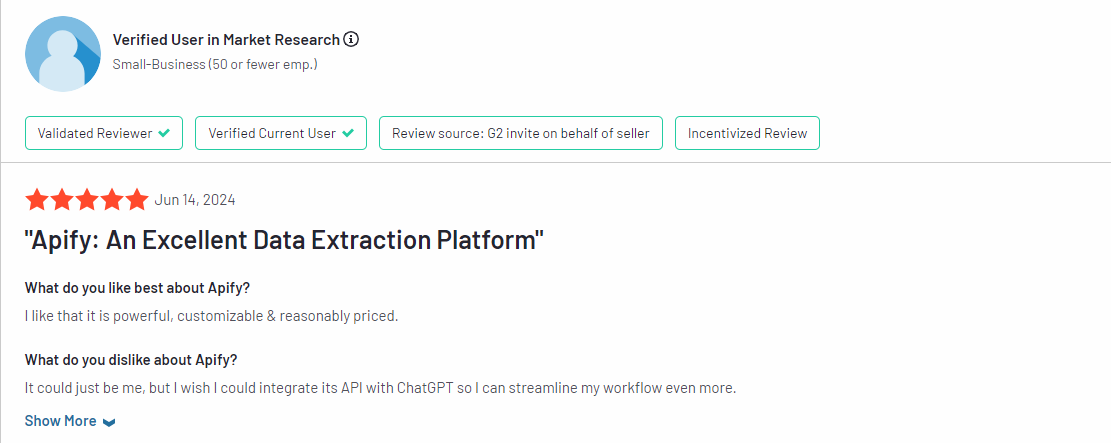
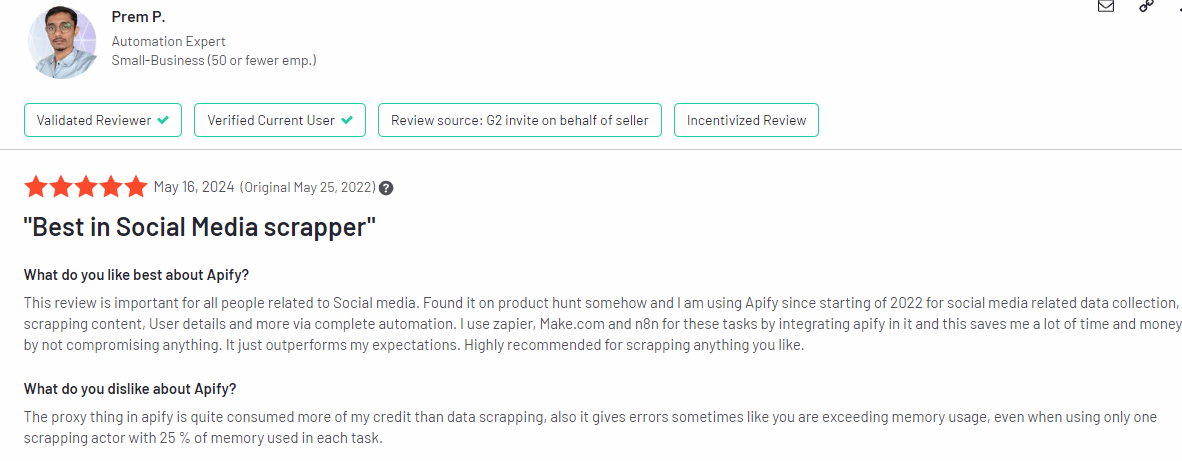
2. Capterra
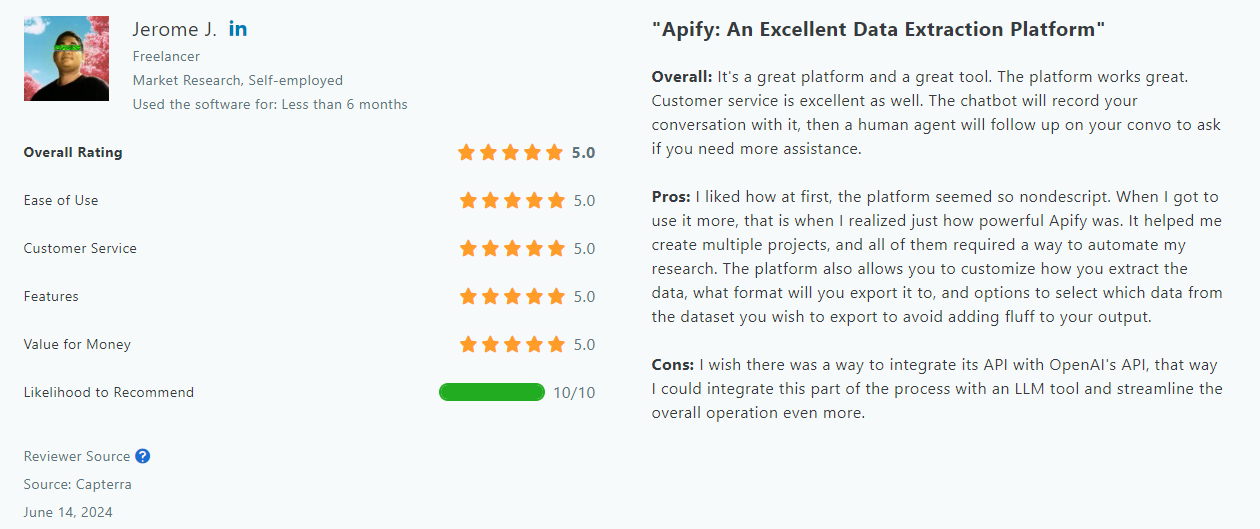
Final Thoughts
Apify is the world’s greatest cloud platform for designing and running web scraping applications.
Its user-friendly interface, extensive feature set, and solid infrastructure make it a fantastic solution for anyone who wants to scrape the web easily.
While customizing scrapers involves some understanding, the platform’s important documentation and support resources make the process easier.