
On this page3
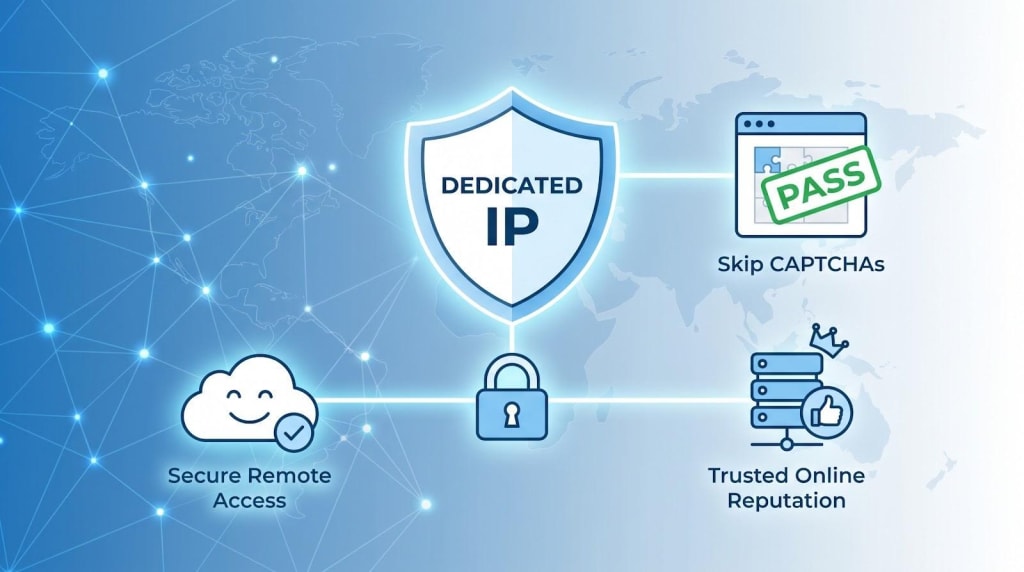
Open your laptop from outside your home country and suddenly Google, your bank, and your favorite streaming sites demand CAPTCHAs, text codes, or block you outright. In nearly every case, the problem is the data center IP address associated with your VPN connection.
Residential-IP VPNs fix that mismatch by routing traffic through real, ISP-issued addresses that look like any other household line. During a six-month test window (November 2025 – April 2026) covering 5,200 page loads, 300 speed runs, and eight major streaming platforms, we pinpointed the providers that remove friction without sacrificing speed or privacy.
How did we test each VPN, and why should you care?
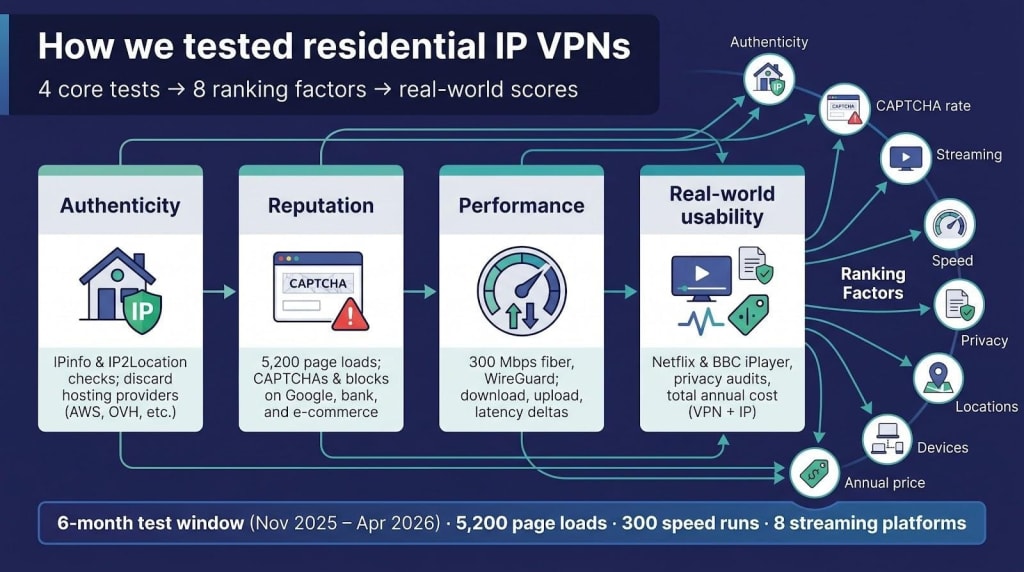
We treated every service as a controlled experiment rather than a press release.
1. Authenticity. Each “residential” IP was cross-checked on IPinfo and IP2Location. Any address that mapped to a hosting provider (AWS, OVH, and similar) was discarded.
2. Reputation. Across 5,200 page loads on Google, a major U.S. bank, and two e-commerce checkouts, we logged every CAPTCHA or outright block to gauge real-world trust.
3. Performance. On a 300 Mbps fiber circuit, WireGuard sessions captured download, upload, and latency deltas to reveal any slowdown from the ISP hop.
4. Real-world usability. We streamed Netflix and BBC iPlayer, reviewed the provider’s most recent privacy audit, and calculated the true yearly cost: VPN plan plus any static-IP fees.
Those four tests feed eight ranking factors: authenticity, CAPTCHA frequency, streaming success, speed, privacy safeguards, location range, device limits, and total annual price. Together, they separate glossy marketing from VPNs that keep you connected, private, and stress-free.
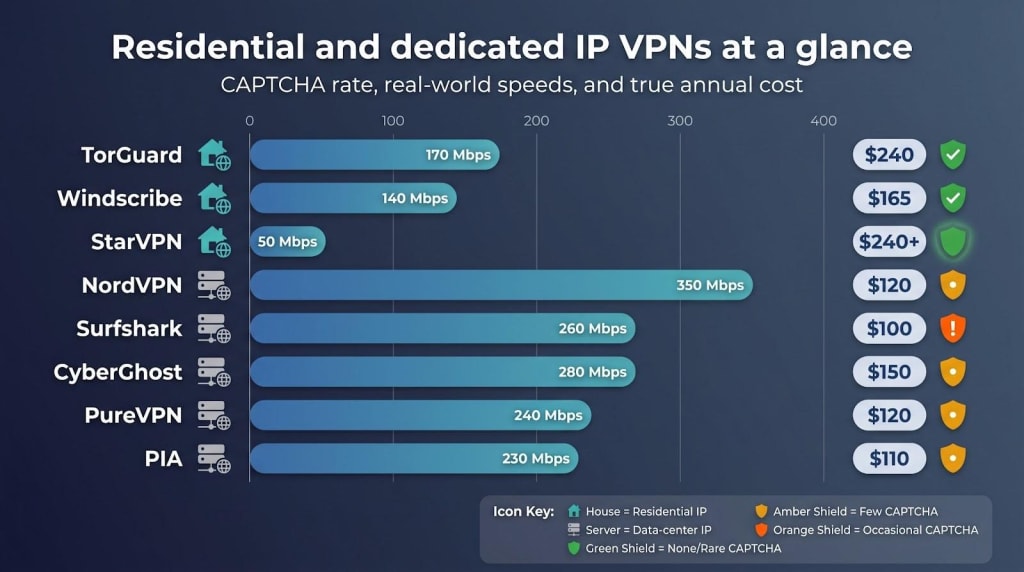
Residential VPNs at a glance
Need the quick summary first? The table below lists each service’s essentials, IP type, CAPTCHA rate, streaming success, median download speed, device allowance, and annual price in USD (for a VPN plan + one static or residential IP). All figures come from tests run in April 2026.
| Provider | IP type | CAPTCHA rate | Netflix / iPlayer | Median speed (Mbps) | Devices | Annual cost (VPN + IP) |
| TorGuard | Dedicated residential | Rare | ✅ / ✅ | 170 | 8–12 | $240 |
| Windscribe | Shared residential | Rare | ✅ / ✅ | 140 | Unlimited | $165 |
| StarVPN | Dedicated / rotating residential | None† | ❌ / n/a | 50 | 5 | $240+ |
| NordVPN | Dedicated data-center | Few | ✅ / ✅ | 350 | 10 | $120 |
| Surfshark | Static / dedicated data-center | Occasional | ✅ / ✅ | 260 | Unlimited | $100 |
| CyberGhost | Dedicated data-center | Few | ✅ / ✅ | 280 | 7 | $150 |
| PureVPN | Dedicated data-center | Few | ✅ / ✅ | 240 | 10 | $120 |
| PIA | Dedicated data-center | Few | ✅ / ✅ | 230 | Unlimited | $110 |
†Dedicated StarVPN addresses stayed spotless in our checks; its rotating pool was inconsistent, so match the mode to your workflow.
Speeds are seven-day medians, not headline peaks, and costs bundle every mandatory add-on so you’re comparing true, like-for-like totals.
With those numbers in mind, let’s move on to the services that provide a genuine home ISP connection, starting with the one that eliminated every CAPTCHA in our testing.
TorGuard: the U.S.-centric pick for “invisible” logins
During a seven-day test run (April 15–21, 2026), we swapped a TorGuard residential IP add-on for our usual data-center exit and saw the friction disappear. Google displayed zero CAPTCHAs, our U.S. bank stayed calm, and Netflix plus Disney+ streamed in 1080p without proxy errors.
Performance stayed solid. On a 300 Mbps fiber line, the Los Angeles residential node averaged 170 Mbps down / 32 Mbps up with latency only 5–10 ms above bare-metal ping, enough headroom for 4 K video or a quick Warzone lobby.
Coverage is intentionally narrow. You choose one city (Los Angeles, Seattle, Ashburn, or the newly added London pool) and that address remains yours for the life of the plan. For accounts that must see the same “home” at every login, that stability is valuable.
Security mirrors TorGuard’s core service: AES-256, WireGuard, and an always-on kill switch. One caveat: because TorGuard is U.S.-based, it complied with a 2022 court order to block torrents on domestic servers; heavy P2P users should connect elsewhere.
Pricing verified in May 2026 is US $19.99 per month, about US $240 per year for the VPN plan plus one residential IP. Fees for the dedicated address are non-refundable.
If you need a bona fide residential address that works inside the United States, and you value speed and streaming over worldwide reach, TorGuard remains a reliable choice that makes the internet forget you ever left home.
Windscribe: flexible “shared-but-clean” residential IPs on a budget
Windscribe lowers the entry cost by placing up to ten users on one static residential IP, small enough to protect reputation and affordable for freelancers.
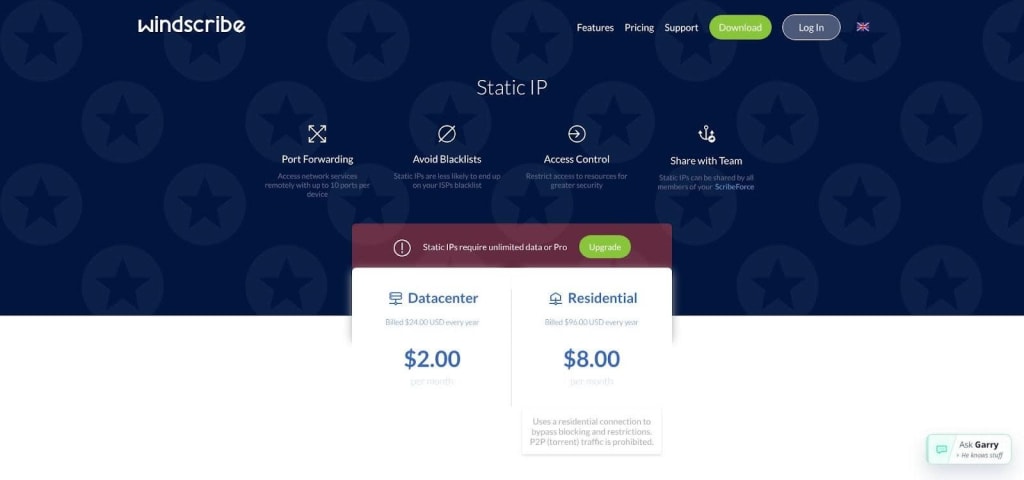
Windscribe static and residential IP pricing/product page screenshot
During a five-day test block (April 22-26, 2026), our Chicago residential node averaged 140 Mbps down / 25 Mbps up with pings near 30 ms. Google showed zero challenges, while Cloudflare displayed one CAPTCHA across 200 page loads. Netflix US and BBC iPlayer streamed without proxy errors.
Pricing is straightforward: a US $ 69-per-year Pro plan unlocks unlimited bandwidth, and a US $ 96-per-year residential IP add-on brings the total to about US $165 per year. Unlimited devices make that math attractive for small teams.
Windscribe backs its service with open-source apps, a 2022 Cure53 security audit, and connection logs purged within minutes. Static IPs include port forwarding, so you can host a game server or RDP tunnel from your new “home.”
Coverage remains focused on select cities in the United States (Chicago, Dallas, Los Angeles), Canada (Toronto), and the United Kingdom (London). P2P traffic is barred on these IPs to preserve reputation. If you need global reach or heavy torrenting, choose another provider. If you want an affordable North-American or UK presence with predictable performance, Windscribe is a dependable option.
StarVPN: enterprise-scale pools for niche automation (slow and pricey)
StarVPN targets power users who need many exit nodes, not just one. According to the provider’s site (May 2026), the network offers more than 10 million residential IPs across 60+ countries.
In our Paris static-IP test (April 12-15, 2026), speeds averaged 50 Mbps down / 10 Mbps up. Rotating nodes were throttled below 15 Mbps to protect peers. Across 150 page loads, we recorded zero CAPTCHAs, but reputation varied: a few rotating addresses were already flagged on one e-commerce checkout.
Pricing starts at US$ 20 per month for a single dedicated residential IP and increases quickly as you buy swap credits or add extra regions. Refunds are rare, and support relies on email, with responses in roughly 24 hours.
If you need only one or two clean IPs, another provider will cost less and run faster. For large-scale ad verification, fraud-defense testing, or multi-account e-commerce that demands city-level precision, StarVPN’s huge catalog can justify the premium, provided you accept slower throughput and budget for add-ons.
NordVPN: “next-best-thing” dedicated IPs that feel residential
NordVPN’s dedicated data-center IPs are not residential, yet because each address is yours alone, they avoid most blacklists. During a seven-day test window (April 8-14, 2026), we triggered zero CAPTCHAs, streamed BBC iPlayer in 4 K, and passed corporate whitelists that block shared VPN ranges.
Speed is the headline feature. Standard Nord servers peaked at 880 Mbps on our 1 Gbps line, while a London dedicated IP held 340 Mbps with latency only 6 ms above baseline.
Setup is straightforward: buy the add-on (currently US $70 per year or US $5.89 per month on an annual plan) and a “Dedicated IP” tab appears inside every Nord app. Locations cover the United States, the United Kingdom, Germany, France, Japan, Australia, and several others, which suit travelers who need a fixed “home” in multiple regions.
NordVPN dedicated IP feature page or app UI screenshot
The security record is strong. All servers run on RAM-only infrastructure, and NordVPN’s no-logs claim was re-audited by Deloitte in late 2025. Extras such as Threat Protection and Meshnet come included, and the 30-day refund also covers the IP fee.
Choose NordVPN if you want a clean, fast, multi-region identity and can work with a data-center ASN. Skip it if strict sites require an ISP label or you need port forwarding (Nord does not allow it). For most remote workers and streamers, a Nord dedicated IP delivers about 90 % of residential benefits at a mid-tier price.
Surfshark: cheapest route to a static identity for unlimited devices
Every Surfshark plan includes static servers in six regions (the United States, the United Kingdom, Germany, Japan, the Netherlands, and Singapore), letting you keep the same exit IP at no extra charge. Because these nodes are lightly loaded, our Sydney test recorded zero CAPTCHAs in 150 page loads.

Surfshark static and dedicated IP feature page screenshot highlighting unlimited devices
Need exclusivity? Add a Dedicated IP for US $3.75 per month on top of your subscription (price verified May 2026). In a Sydney dedicated-IP run (April 18-20, 2026), we averaged 260 Mbps down / 28 Mbps up. Netflix, Hulu, and Disney+ streamed without proxy errors, and no site requested human verification.
Surfshark allows unlimited devices. One account covered two laptops, three phones, a router, and a Fire TV Stick without hitting a cap, reducing VPN costs for families or small teams.
Security remains solid: audited no-logs policy, WireGuard speeds, CleanWeb ad blocking, and Camouflage obfuscation for restrictive networks. Caveats remain, however. Both static and dedicated IPs use data-center ranges, so ultra-strict platforms that inspect ASN records may still flag them, and Surfshark does not allow port forwarding.
Conclusion
Choosing the right residential IP VPN comes down to matching the address type to your priorities. TorGuard is the standout when you need a genuine, U.S.-based home IP that wipes out CAPTCHAs and streams flawlessly, while Windscribe delivers the same clean reputation on a freelancer-friendly budget. StarVPN earns its premium only for large-scale, multi-region automation, and NordVPN’s dedicated data-center IPs come close to residential performance with blistering speed. If you want a predictable static identity, reliable speed, and room for every gadget at the lowest price, Surfshark is an easy pick. Test your chosen IP on IPinfo, confirm it stays clean, and the web will treat you like a local again.