
On this page7
If you’ve been in SEO long enough, you know that the most interesting sites to study aren’t always the biggest ones. Sometimes it’s a small, quiet domain that does one thing exceptionally well and the numbers behind it tell a story worth paying attention to.
estoturf.fr is one of those sites.
It’s a French domain focused on PMU horse racing pronostics, tips and predictions for Pari Mutuel Urbain, France’s state-run horse racing betting system. Nothing exotic on the surface. But run it through Ahrefs and a few things immediately stand out: 50K organic visits a month from just 9 keywords, a DR of 37 built on only 16 referring domains, and here’s the part that’ll make you look twice 99% of that traffic coming from India.
For a .fr domain serving French horse racing content, that’s not what you’d expect.
From a link-building and SEO perspective, estoturf.fr is a clean case study in brand-dominant traffic, backlink efficiency, and what happens when a niche site earns authority without throwing hundreds of links at it. Whether you’re auditing a client site or benchmarking your own domain’s profile, the patterns here are worth understanding.
I pulled all the data from Ahrefs in March 2026. Here’s what I found.
Check out our latest blog on TechsSlaash: Is Techsslaash.com Really “Pushing Limits” in 2026?
What is estoturf.fr?
Estoturf.fr is a French website built around turf pronostics, horse racing predictions and tips, specifically for PMU (Pari Mutuel Urbain), the French state-owned horse racing and betting system. The site publishes daily picks and forecasts for bettors seeking an edge on race outcomes.
On paper, it’s a niche content site with a narrow focus and a country-specific domain extension. The kind of site you’d expect to rank locally, serve a French-speaking audience, and compete within the French betting and pronostics space.
Except that’s not what’s happening at all.
Despite the .fr TLD, the site’s audience is almost entirely international and not in the way you might expect. It isn’t pulling traffic from French-speaking West Africa or Europe. Its dominant traffic source is India, accounting for 99% of all organic visits. France, the home market, sends just 0.3%.
That disconnect between what the site appears to be and what the data actually shows is exactly what makes it a useful case study. It raises real questions about brand search behavior, geo-targeting, and what a domain extension actually signals to search engines versus real-world audiences.
For SEO professionals and link builders, estoturf.fr is worth studying not because of its scale, 50K monthly visits is modest, but because of how it achieves that traffic and what its backlink profile reveals about building domain authority efficiently.
Check out our latest blog on parivrai.org Traffic, Ranking & Backlinks: Full SEO Analysis
Domain Overview: DR, Backlinks & Key Metrics
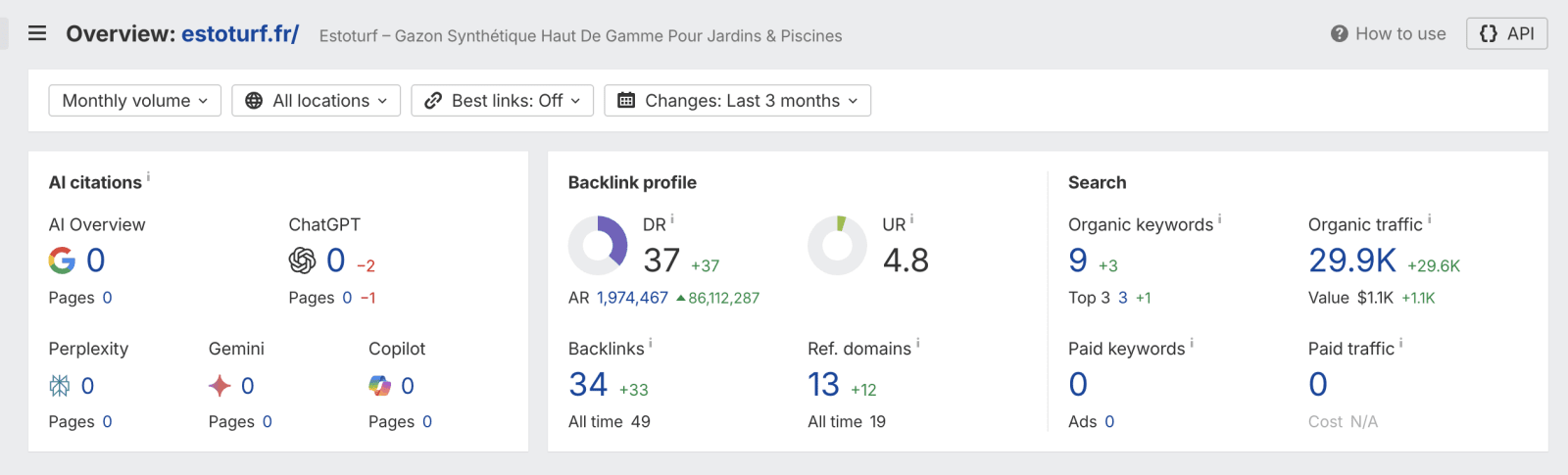
Let’s start with the numbers. Here’s where estoturf.fr stands as of March 2026, according to Ahrefs:
| Metric | Value |
|---|---|
| Domain Rating (DR) | 37 |
| URL Rating (UR) | 4.8 |
| Ahrefs Rank | 1,974,467 |
| Backlinks | 49 (all-time) |
| Referring Domains | 19 (all-time) |
| Organic Keywords | 9 |
| Organic Traffic | 30K/month |
| Traffic Value | $1.1 |
| Paid Traffic | 0 |
The number that immediately stands out, especially if you work in link building, is the relationship between DR and referring domains. A DR of 37 from just 19 referring domain is unusually efficient. Most sites at that DR level have accumulated significantly more links to reach it. The implication is that the domains pointing to estoturf.fr carry real authority. This isn’t a site that got to DR 37 by running guest post campaigns on DR 10 blogs. The links it has are doing serious work.
For a closer look at website performance, rankings, and traffic, check out TheModelEats.com Website Ranking, Traffic and Analysis.
The second thing worth flagging is the traffic value. Fifty thousand monthly organic visits but only $1.1K in estimated traffic value. That gap tells you something important about keyword intent: the people finding this site aren’t in a buying mindset that advertisers are willing to pay for. They’re searching for the brand by name, landing on the site, and that’s largely where the commercial signal ends. For link builders assessing a site’s monetization potential or pitching a client on SEO ROI, this kind of traffic-to-value mismatch is a useful pattern to recognize early.
Finally, zero paid traffic. The site runs no Google Ads, no paid search whatsoever. Every one of those 50K monthly visits is earned organically. For a site this reliant on a single keyword, that’s either a sign of strong confidence in its organic position or simply a niche where paid acquisition doesn’t make economic sense.
Organic Traffic Trend: What the Graph Shows
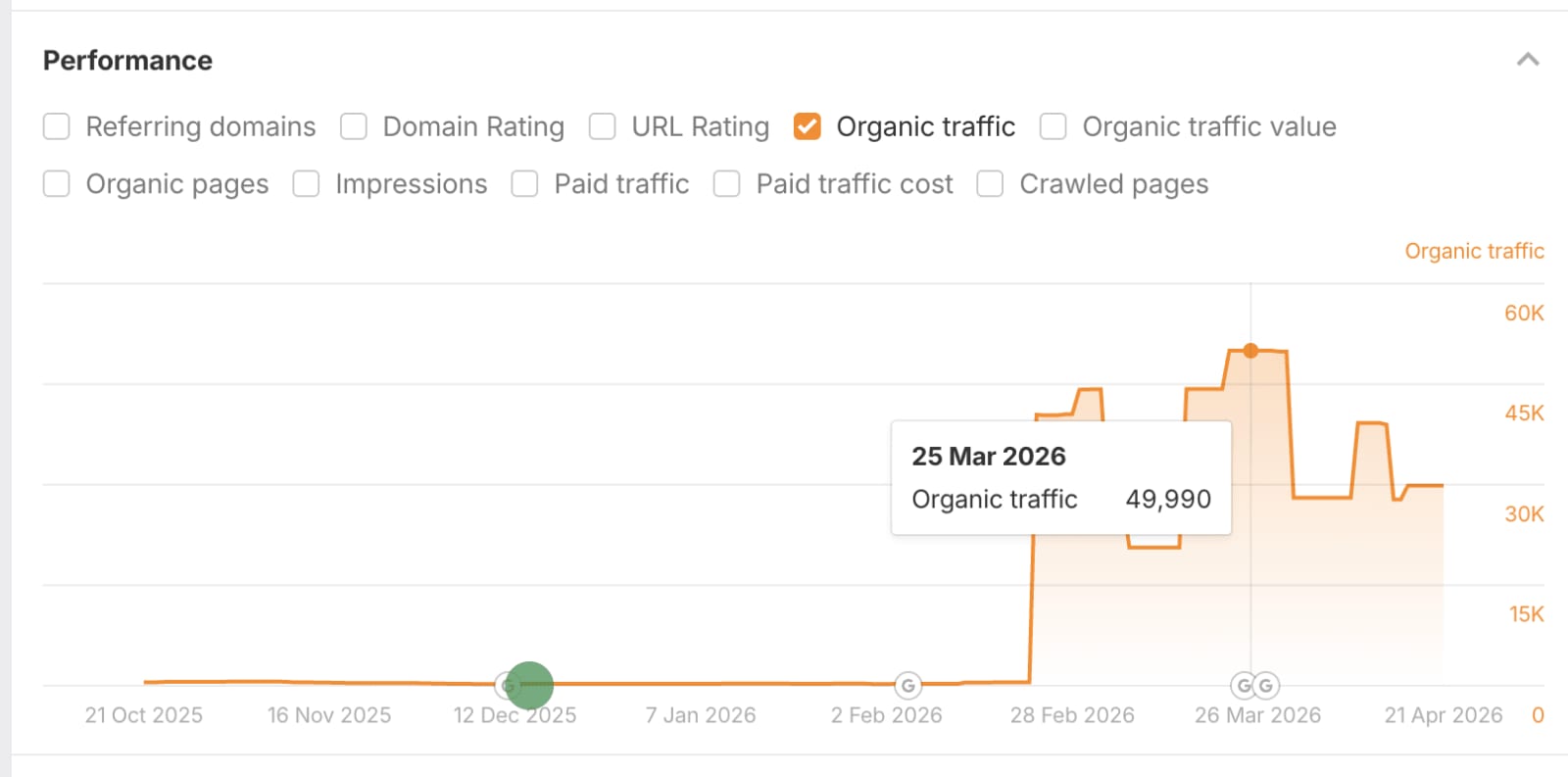
Looking at the Ahrefs traffic graph over the period February 27 to March 27, 2026, the pattern is straightforward but instructive.
Traffic was holding steady in the 45K–50K range through late February and into early March. Then, around March 7–11, there’s a noticeable drop, visits falling to the 25K–30K range, roughly half the site’s normal baseline. From March 15 onward, the recovery is sharp. By March 16, traffic was back up to 44,260 and continued climbing toward the 55K mark by late March.
That dip-and-recovery shape is something SEO professionals will recognize immediately. There are two likely explanations.
The first is a Google algorithm update. Mid-March fluctuations in organic traffic are common in the wake of core updates or spam updates, which Google has been rolling out with increasing frequency. A site this dependent on a single brand keyword is particularly exposed to ranking instability; even a brief position shift from #1 to #3 or #4 for “estoturf .fr” would cut traffic dramatically, given the search volume behind it.
The second possibility is a temporary ranking fluctuation specific to that keyword, which can happen independently of broader algorithm activity. Brand keywords are generally stable but not immune to volatility, especially when the domain is small and the backlink profile is thin.
What’s encouraging is the recovery. The site bounced back quickly and strongly, suggesting Google’s confidence in the domain’s relevance to its primary keyword remains intact. For a site with 16 referring domains and 9 ranked keywords, holding a #1 position at 50K monthly visits through a mid-March dip is a reasonable signal of organic resilience.
The broader lesson for SEO practitioners is one of concentration risk. When a single keyword accounts for nearly all of a site’s traffic, any movement in that ranking, however brief, hits the entire domain’s performance immediately. There’s no buffer from a diversified keyword portfolio. It’s something worth flagging when auditing client sites that show a similar pattern.
Here’s the Organic Keywords section:
Organic Keywords: 9 Keywords, One Dominant Player
Estoturf.fr ranks for just 9 keywords globally. For a site pulling 50K monthly visits, that’s an extraordinarily narrow footprint. Here’s the full breakdown:
| Keyword | Volume | Traffic | Position | Top Location |
|---|---|---|---|---|
| estoturf .fr | 76K | 49,468 | #1 | India |
| estoturf turf | 3.9K | 311 | 4.3 | Mali |
| estoturf | 23K | 146 | 6.5 | France |
| estoturf pmu | 1.2K | 58 | #7 | Mali |
| estoturf jour pronostic | 120 | 8 | #6 | Mali |
| pmu estoturf | 0 | 0 | #8 | Senegal |
| estotur | 40 | 0 | #5 | Burkina Faso |
| estotuf | 30 | 0 | #6 | Mali |
| estotruf | 60 | 0 | #7 | Burkina Faso |
The story here is almost entirely about one keyword: “estoturf .fr” It drives 49,468 visits per month, that’s 98.9% of the site’s total organic traffic, from a #1 position with a search volume of 76K. Remove that keyword and the site essentially disappears from an organic traffic perspective.
The remaining eight keywords account for around 523 visits per month, mostly from West African countries, Mali, Senegal, Burkina Faso, and Côte d’Ivoire, where PMU betting has a strong following. These are brand variations and long-tail predictive queries that chip in small but consistent numbers. None of them is moving the needle meaningfully on their own.
What’s particularly interesting from an SEO standpoint is the three misspelling variants at the bottom of the table: estotur, estotuf, and estotruf. The site ranks in positions 5–7 for all three, capturing users who are actively searching for the brand but misspelling it. Search volume for each is modest, and current traffic from them rounds to zero, but the fact that the domain ranks for its own misspellings without any apparent optimization effort is a quiet indicator of brand strength. Google has associated the domain closely enough with the brand intent that even garbled versions of the name surface estoturf.fr in results.
For link builders and SEO professionals, this keyword profile raises an important strategic question: is brand-dominant traffic a sign of success or a vulnerability? The honest answer is both.
On one hand, ranking #1 for a 76K-volume brand keyword with strong user intent is genuinely valuable. These are people who know the site, want the site, and are going directly to it through search. Brand loyalty expressed through search behavior is hard to manufacture and harder to compete against.
On the other hand, a nine-keyword profile with one keyword accounting for nearly all traffic is about as concentrated as an organic strategy gets. There is no content moat here, no long-tail diversity, no informational keyword cluster providing a buffer. If that #1 ranking slips due to an algorithm change, a competitor building brand recognition, or a manual action, the site has very little to fall back on.
It’s a profile worth keeping in mind when evaluating client sites or your own domain’s keyword distribution.
Traffic by Location: The India Anomaly
Here’s the geographic breakdown of estoturf.fr’s organic traffic:
| Country | Traffic | Share | Keywords |
|---|---|---|---|
| India | 49,500 | 99.0% | 1 |
| Mali | 302 | 0.6% | 4 |
| France | 146 | 0.3% | 2 |
| Côte d’Ivoire | 25 | <0.1% | 2 |
| Morocco | 22 | <0.1% | 2 |
For a .fr domain publishing French horse racing content, this table is genuinely surprising. France, the home market, the natural audience, the country the domain extension explicitly signals, accounts for just 0.3% of total organic traffic. India, on the other side of the world, accounts for 99%.
That’s not a rounding error. That’s the entire story of this site’s organic reach.
So what’s actually going on?
The most plausible explanation sits at the intersection of international betting culture and brand search behavior. PMU horse racing has a dedicated following among Indian bettors who track international racing markets, and estoturf.fr appears to have built enough brand recognition within that community that “estoturf .fr” has become a high-volume search query specifically originating from India. The 76K monthly search volume for that keyword is being driven almost entirely by Indian users searching for the site by name.
This is not the result of estoturf.fr targeting India through its content, its link building, or its technical SEO. There is no indication that the site has deliberately sought to build an Indian audience. The traffic found the site, not the other way around, which makes it both an interesting organic win and a fragile one. Brand awareness built through word of mouth or community channels, rather than through deliberate SEO, is harder to sustain and to grow intentionally.
The West African countries, Mali, Côte d’Ivoire, and Morocco, make more intuitive sense given the site’s PMU focus. French-speaking West Africa has a long and active PMU betting culture, and the brand-variation keywords ranking for those countries reflects users who are familiar with the site but searching in slightly different ways.
France itself at 0.3% is the data point that tells you the most about the site’s SEO positioning. It isn’t competitive in its home market. For the broader French-language turf and pronostics keyword “pronostic pmu”, “turf pronostic du jour”, “pronostic quinté” estoturf.fr simply doesn’t rank. That’s a significant gap between where the domain extension points and where the site’s actual organic authority lies.
For link builders and SEO professionals, the geographic distribution here surfaces a few practical considerations worth carrying into client work.
First, domain extensions don’t always dictate audience geography. A .fr domain can absolutely rank and build traffic in non-French markets if brand recognition takes root there organically. Country-code TLDs carry geo-signals for search engines, but real-world search behavior can and does override those signals when brand intent is strong enough.
Second, geo-concentrated traffic is a concentration risk in its own right, separate from keyword concentration. Estoturf.fr’s 99% India dependency means that any shift in how Indian users discover or search for the site, a competitor gaining brand recognition in that market, a change in betting regulations, or a shift in community recommendation patterns could cut traffic significantly with no geographic fallback.
Third, traffic source and commercial intent don’t always align geographically. The Indian audience, which drives 99% of visits, represents a market the site was never built for and likely doesn’t monetize well. The French and West African audiences, who would be natural customers for PMU pronostics content, represent a tiny fraction of actual traffic. That mismatch between who’s visiting and who the site could realistically convert is something SEO audits don’t always surface explicitly, but should.
Here’s the Backlink Profile section:
Backlink Profile: DR 37 with Only 16 Referring Domains
This is the section that will interest link builders the most.
Estoturf.fr has accumulated 33 backlinks from 16 referring domains across its entire history. That’s a remarkably small number for a site with a DR of 37. To put it in perspective, most domains at that DR level have hundreds of referring domains, often accumulated through years of active outreach, guest posting, digital PR, or link buying. Estoturf.fr has done it with sixteen.
That gap between link volume and domain authority is the most instructive data point in this entire analysis.
It tells you one thing clearly: the referring domains pointing to estoturf.fr are not average. When a site achieves DR 37 on 16 referring domains, the math only works if those domains carry significant authority of their own. A cluster of 10–20 DR blogs and directories won’t meaningfully improve a domain’s DR, regardless of how many there are. To reach DR 37 with this few links, you need referring domains that are themselves well-established, well-linked, and trusted by Google.
Unfortunately, Ahrefs doesn’t surface the full list of referring domains without a paid deep dive, so we can’t name every source. But the DR alone tells you enough about the quality threshold those links are clearing.
There are a few broader lessons here worth unpacking for SEO practitioners and link builders.
Quality compounds in ways quantity doesn’t. The link-building industry has spent years debating volume versus quality, and estoturf.fr’s backlink profile is about as clean an illustration of the quality argument as you’ll find. Thirty-three backlinks. Sixteen domains. DR 37. If those same link slots had been filled with low-DR guest posts and directory submissions, the domain would likely be sitting at DR 15–20 at best. The difference is entirely in the authority of the referring sites.
A small backlink profile is easier to protect but harder to grow. Sixteen referring domains mean estoturf.fr has very little redundancy in its link profile. If two or three of those domains go offline, get penalized, or remove their links, the DR impact could be significant. There’s no cushion of dozens of mid-tier links absorbing the loss. For clients with similarly lean profiles, this is an important risk to flag and an argument for measured, consistent link acquisition over time rather than a one-time burst.
The site isn’t actively building links. With only 33 backlinks accumulated over the domain’s lifetime and zero paid traffic, estoturf.fr doesn’t appear to be running any deliberate SEO or link-building campaign. The authority it has was likely earned passively, through citations, organic mentions, or a small number of high-value placements that happened without a formal outreach strategy. That’s an unusual position to be in, and it raises the question of what this domain could achieve with even a modest, targeted link-building effort.
For anyone auditing a niche content site with a similar profile, high DR relative to referring domain count, no active link acquisition, and strong brand keyword dominance, the opportunity framing is straightforward. The foundation is solid. The ceiling is much higher than the current keyword footprint suggests.
Here’s the Key SEO Takeaways section:
Key SEO Takeaways for Link Builders & SEO Pros
Estoturf.fr isn’t a site you’d hold up as a model SEO operation. It ranks for nine keywords, depends almost entirely on one of them, serves an audience it was never built for, and shows no signs of active optimization or link acquisition. By most conventional measures, it has significant gaps.
And yet it drives 50K organic visits a month with a DR of 37, zero paid spend, and sixteen referring domains.
That combination of limitations and performance is exactly what makes it useful to study. Here are the takeaways worth carrying into your own work.
1. Brand equity in search is underrated as an SEO asset
The entire estoturf.fr story is built on one thing: people searching for it by name at high volume. That’s brand equity expressed through search behavior, and it’s one of the most durable organic assets a site can have. Unlike informational keyword rankings, which can be displaced by a competitor publishing better content, brand keyword dominance is much harder to attack directly.
For SEO professionals, this is a reminder that building brand recognition, through community presence, word of mouth, social signals, or consistent content, has direct implications for organic search. It doesn’t always show up in traditional keyword research, but it shows up in traffic.
2. DR efficiency matters more than DR alone
A DR of 37 means very different things depending on how it was built. Estoturf.fr’s DR 37 from 16 referring domains represents a fundamentally different backlink profile than a DR 37 built from 400 low-quality guest posts. The former is lean, efficient, and built on genuine authority signals. The latter is bloated, vulnerable to link loss, and likely propped up by links that don’t pass meaningful equity.
When evaluating a site’s backlink profile, whether for a client audit, a link prospecting exercise, or a site acquisition, consider the ratio of DR to referring domains alongside the DR value itself. A site punching above its link count is a signal worth investigating further.
3. Single-keyword dependency is a business risk, not just an SEO risk
It’s tempting to frame keyword concentration purely as an SEO vulnerability, and it is, but the business implications go further. A site that generates all its traffic from a single keyword has no fallback if that keyword moves. No secondary traffic stream, no content buffer, no geographic diversification to absorb the impact. The mid-March traffic dip estoturf.fr experienced, dropping from 50K to 25K–30K in under a week, is a direct consequence of that concentration.
For clients with a similar profile, the conversation around keyword diversification isn’t just about SEO best practices. It’s about revenue stability and long-term business resilience.
4. Traffic volume and traffic value are not the same metric
Fifty thousand monthly visits sounds impressive in isolation. Seventy-five dollars in traffic value tells a very different story. The gap between those two numbers is one of the most important things to communicate when reporting SEO performance to clients or stakeholders who are accustomed to equating traffic with commercial outcomes.
High-volume, low-intent traffic, brand searches, navigational queries, and misspelling variants can inflate organic visit counts significantly without generating proportional leads, conversions, or revenue. Building traffic value alongside traffic volume, by targeting keywords with genuine commercial intent, is what separates vanity metrics from business results.
5. Passive link acquisition has a ceiling
Estoturf.fr’s backlink profile suggests the site has never run a deliberate link-building campaign. The links it has were likely earned organically over time, citations, mentions, and a handful of high-value placements that happened without outreach. That’s genuinely impressive, but it also explains why the site’s keyword footprint has remained so narrow. Without active link acquisition targeting topically relevant, high-authority domains, there’s no mechanism pushing the site into broader keyword rankings.
The foundation estoturf.fr has built is a clean, efficient backlink profile and strong brand keyword dominance, which is a solid base. But passive link earning alone won’t expand it. A targeted link-building campaign focused on turf, PMU, and betting-adjacent content sites could realistically push this domain into a much wider set of rankings. The DR headroom is there. The content focus is clear. What’s missing is intentional execution.