
On this page11
- What Is Link Prospecting?
- How Link Prospecting Tools Help With Backlink Acquisition
- 10 Best Link Prospecting Tools
- Link Prospecting Tools Compared
- How to Choose the Right Link Prospecting Tool
- How to Use Link Prospecting Tools Effectively
- Common Link Prospecting Mistakes to Avoid
- Link Prospecting Tools vs. Manual Prospecting
- How Marketing Lad Approaches Link Prospecting
- Final Thoughts
- People Also Ask: Link Prospecting Tools
Finding websites that are genuinely worth pursuing for backlinks is one of the most time-consuming parts of link building. The challenge is not simply discovering thousands of websites. It is identifying the relatively small number of sites that are relevant, credible, and realistic opportunities for outreach.
Link prospecting tools help SEO teams discover potential backlink opportunities, analyze competitor link profiles, research publishers, identify outreach contacts, and organize qualified prospects. The best results come from combining these tools with manual research and human judgment.
A strong prospecting process looks beyond metrics such as Domain Rating or Domain Authority. Topical relevance, audience fit, content quality, organic visibility, editorial standards, and the reason a website might naturally reference your content all matter.
Here are the best tools and methods to consider, followed by a practical framework for choosing and using them effectively.
What Is Link Prospecting?
Link prospecting is the process of finding websites, publishers, blogs, resource pages, organizations, and other online properties that could potentially link to your website.
It is an important stage of link building because the quality of your prospect list directly influences the quality of your outreach campaign.
There is an important distinction between finding prospects and qualifying prospects.
A tool may identify a website that links to one of your competitors. That makes it a potential prospect, but it does not automatically make it a good opportunity. You still need to determine whether the site is relevant, trustworthy, active, and appropriate for your campaign.
Useful qualification factors include:
Topical relevance
Audience relevance
Content quality
Organic search visibility
Website authority
Editorial standards
Link potential
Outreach accessibility
The goal is not to build the biggest prospect database possible. The goal is to build a list of websites where earning a backlink would make genuine sense.
How Link Prospecting Tools Help With Backlink Acquisition
Without dedicated tools, prospecting can involve manually reviewing hundreds of websites, checking competitor backlinks, finding relevant pages, locating contact information, and recording everything in spreadsheets.
Link prospecting tools reduce much of this repetitive work.
They can help with four major stages of the process.
Discovery: Find websites, referring domains, publishers, resource pages, and potential opportunities.
Competitive research: Analyze where competitors are earning backlinks and identify patterns worth investigating.
Qualification: Filter prospects using metrics such as authority, traffic, relevance, and backlink data.
Outreach preparation: Organize prospects, identify contacts, and prepare targeted outreach campaigns.
A practical workflow is:
Discover - Qualify - Segment - Research Contacts - Outreach - Measure - Improve
The key is to avoid treating automated discovery as the final decision. Tools provide the data. Human review determines whether that data represents a worthwhile opportunity.
10 Best Link Prospecting Tools
1. Ahrefs
Ahrefs is one of the strongest options for backlink research and competitor analysis.
Its backlink database makes it useful for discovering referring domains, examining competitor link profiles, and identifying websites that have already linked to similar content.
For link prospecting, one of its biggest advantages is the ability to start with competitors and work backward. If several relevant competitors have earned links from the same publisher, that publisher may deserve further investigation.
However, competitor backlinks should be treated as signals, not guaranteed opportunities. A competitor may have earned a link because of a particular relationship, research project, partnership, or piece of content that you cannot replicate.
Best for: Competitor backlink research, referring-domain analysis, content opportunities, and large-scale SEO research.
2. Semrush
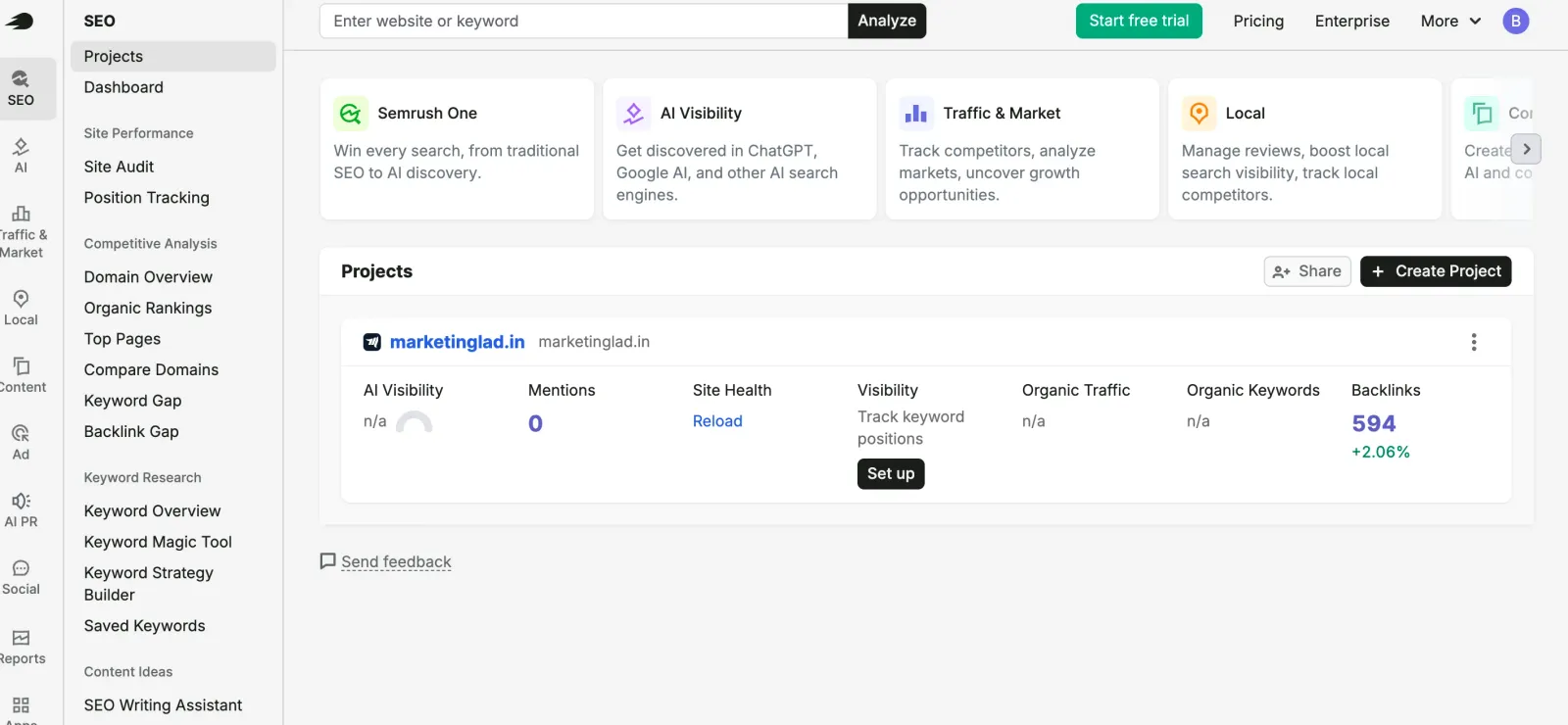
Semrush combines backlink research with a much broader SEO toolkit.
Its link analysis capabilities can help identify competitor backlink patterns and potential referring domains while giving SEO teams additional context around organic search performance.
This makes it particularly useful for agencies and teams that want their backlink research connected to wider SEO analysis rather than working with a standalone link database.
The strongest use case is identifying patterns across several competitors and then evaluating which websites may be relevant to your own campaign.
Best for: Competitor research, backlink analysis, broader SEO workflows, and agency campaigns.
3. Moz Link Explorer
Moz offers a straightforward way to research backlinks and referring domains.
Moz Link Explorer can be useful for smaller SEO teams that need reliable backlink discovery without building an unnecessarily complicated workflow.
It can help compare domains, investigate competitor links, and identify potential websites for further qualification.
Its main value for prospecting is simplicity. Instead of treating every metric as a final decision, marketers can use the available backlink data to create an initial prospect pool and then manually review the strongest candidates.
Best for: Backlink research, competitor discovery, domain comparison, and smaller SEO teams.
4. Majestic
Majestic is heavily focused on backlink intelligence and understanding link relationships between websites.
Metrics such as Trust Flow and Citation Flow can help researchers evaluate backlink profiles and compare domains. These metrics are most useful when viewed as part of a broader assessment rather than as standalone measures of website quality.
Majestic can be particularly useful for marketers who spend a significant amount of time analyzing link ecosystems and competitor backlink profiles.
The key is to combine its quantitative data with qualitative evaluation of the actual website and its content.
Best for: Detailed backlink research, link profile analysis, competitor research, and link-focused SEO teams.
5. BuzzStream
BuzzStream approaches prospecting from an outreach and relationship-management perspective.
Instead of treating a prospect as simply a domain in a spreadsheet, BuzzStream helps teams manage websites, contacts, campaign activity, and follow-ups.
This is useful when link building involves ongoing communication with publishers and website owners. Keeping track of who was contacted, what was discussed, and when follow-up is required can become difficult when managed manually.
BuzzStream is therefore particularly valuable after the initial discovery stage.
Best for: Prospect management, relationship building, outreach organization, and link-building teams managing multiple campaigns.
6. Pitchbox
Pitchbox combines prospecting, outreach, and campaign management.
It is designed for teams handling larger-scale link-building campaigns where manually managing every prospect and follow-up can become inefficient.
Pitchbox can help streamline the movement from prospect discovery to outreach, but automation should not eliminate qualification. A large list of poorly selected prospects will still produce poor results, even when the outreach workflow is highly automated.
Best for: Agencies, scaled link building, large prospect lists, and structured outreach campaigns.
7. Respona
Respona connects prospecting with outreach and content-driven campaigns.
It can be useful when the link-building strategy depends heavily on finding publishers and websites that are likely to be interested in specific content, research, or resources.
This makes it a strong option for campaigns where relevance and content fit are particularly important.
As with other platforms, the software can accelerate discovery and outreach, but researchers still need to determine whether each opportunity is genuinely appropriate.
Best for: Content-driven link building, publisher research, digital PR, and relevance-focused campaigns.
8. Hunter
Hunter serves a different purpose from backlink databases.
It is primarily useful for finding professional contact information once you have already identified a website worth approaching.
A practical workflow might look like this:
Find website - Qualify website - Identify relevant person - Find contact - Personalize outreach - Track response
This distinction matters because discovering a good website and finding the right person to contact are two separate problems.
Best for: Contact discovery, email research, and supporting link-building outreach.
9. Google Search
Google Search remains one of the most flexible prospecting methods available.
It can uncover opportunities that do not necessarily appear in conventional backlink databases, particularly when you are searching for highly specific pages or niche publications.
Useful search patterns include:
intitle:resourcesinurl:resources"write for us""submit an article""industry resources""recommended websites"
The strength of Google Search is its flexibility. You can search for publishers, associations, resource pages, local organizations, specialist blogs, and other opportunities based on the exact campaign you are running.
Best for: Manual prospecting, niche opportunities, resource pages, and targeted campaigns.
10. Google Sheets and Manual Prospecting
Manual prospecting does not require expensive software.
For smaller or highly targeted campaigns, Google Sheets combined with manual research can be remarkably effective.
A useful prospecting sheet can include:
Field | Purpose |
|---|---|
Website | Identify the prospect |
Target page | Relevant page or opportunity |
Prospect type | Blog, publisher, resource page, etc. |
Topic relevance | Explain topical fit |
Organic visibility | Assess search presence |
Authority metrics | Support prioritization |
Contact | Relevant person |
Outreach reason | Explain why the site matters |
Status | Track campaign progress |
Follow-up date | Manage follow-ups |
Notes | Store research details |
The Outreach Reason field is particularly valuable. It forces the researcher to explain why a website deserves attention instead of adding domains simply because they meet an arbitrary metric.
Best for: Small campaigns, niche industries, local link building, and quality-focused research.
Link Prospecting Tools Compared
Tool | Backlink Research | Prospect Discovery | Outreach | Best For |
|---|---|---|---|---|
Ahrefs | Excellent | Excellent | Limited | SEO teams and agencies |
Semrush | Excellent | Excellent | Limited | Broad SEO campaigns |
Moz | Excellent | Good | Limited | Smaller SEO teams |
Majestic | Excellent | Good | No | Link specialists |
BuzzStream | Limited | Good | Excellent | Outreach teams |
Pitchbox | Good | Excellent | Excellent | Scaled campaigns |
Respona | Good | Excellent | Excellent | Content and PR campaigns |
Hunter | No | Limited | Excellent | Contact discovery |
Google Search | No | Excellent | No | Manual research |
Google Sheets | No | Manual | Manual | Small campaigns |
In many cases, the best solution is not one tool but a combination.
For example, an SEO team might use Ahrefs or Semrush for backlink discovery, Google Search for additional niche opportunities, manual review for qualification, Hunter for contact research, and BuzzStream or Pitchbox for outreach management.
How to Choose the Right Link Prospecting Tool
Start with the problem you are trying to solve.
If competitor backlink research is your biggest challenge, Ahrefs, Semrush, Moz, or Majestic may be the best starting point.
If your primary challenge is managing large outreach campaigns, BuzzStream, Pitchbox, or Respona may provide more value.
If you work in a narrow niche and need highly specific prospects, Google Search and manual research can be more effective than relying entirely on automated databases.
Ask yourself:
Do I need backlink discovery or contact discovery?
How many prospects do I research each month?
Do I need competitor backlink analysis?
Do I need integrated outreach management?
How much manual qualification can my team handle?
What part of prospecting currently takes the most time?
The right toolkit should solve a real workflow bottleneck rather than simply provide the longest feature list.
How to Use Link Prospecting Tools Effectively
The strongest campaigns begin with the asset being promoted.
Before searching for prospects, understand why another website would want to reference your content. That could be an original study, useful guide, industry data, expert resource, calculator, research report, or another genuinely valuable asset.
Next, build a broad prospect pool using competitor research, search engines, backlink tools, industry publications, and other relevant sources.
Then qualify the prospects.
A simple framework is:
Relevance + Authority + Traffic + Editorial Fit + Outreach Potential
After qualification, segment prospects according to the type of opportunity. Useful categories include:
Industry publications
Resource pages
Niche blogs
Competitor link opportunities
Data and research publishers
Contributor opportunities
Local organizations
Partnerships
Segmentation makes outreach more specific because each group can be approached for a different reason.
Finally, track campaign performance. Monitor response rates, positive replies, opportunities generated, and links earned by prospect category.
This reveals which types of websites are actually producing results.
Common Link Prospecting Mistakes to Avoid
The biggest mistake is treating prospecting as a numbers game.
A list of 2,000 irrelevant domains is less useful than a carefully researched list of 50 relevant prospects.
Another common mistake is relying entirely on authority metrics. A high-authority website with no meaningful connection to your audience may be a weaker opportunity than a smaller specialist publication with strong topical relevance.
Avoid copying competitor backlinks blindly as well. A competitor's link may exist because of a unique relationship, research project, partnership, or content asset.
You should also avoid contacting websites without understanding why they are relevant. Reviewing the specific article, resource page, or editorial section that makes a prospect interesting leads to better outreach and stronger personalization.
Other warning signs include:
Thin or repetitive content
Excessive unrelated outbound links
Suspiciously broad topical coverage
Obvious link-selling behavior
Inactive websites
Poor audience relevance
Unnatural backlink patterns
The objective is not simply to acquire links. It is to earn links that make sense for the website, its audience, and your own content.
Link Prospecting Tools vs. Manual Prospecting
Tools and manual research are not competing approaches. They solve different parts of the problem.
Tools are better at scale. They can process large backlink datasets, identify competitor patterns, and filter prospects quickly.
Manual research is better at context. It can determine whether a website genuinely fits the campaign, whether its content is high quality, and whether there is a realistic editorial reason for a link.
Prospecting Task | Tools | Manual Research |
|---|---|---|
Large-scale discovery | Excellent | Poor |
Competitor backlink analysis | Excellent | Time-consuming |
Filtering | Excellent | Moderate |
Topical qualification | Good | Excellent |
Editorial evaluation | Limited | Excellent |
Niche opportunity discovery | Good | Excellent |
Contact research | Excellent with dedicated tools | Good |
Personalization | Limited | Excellent |
The strongest approach combines both.
Use software to find opportunities faster, then use human judgment to decide which opportunities deserve attention.
How Marketing Lad Approaches Link Prospecting
A quality-focused link-building process starts with relevance rather than raw domain metrics.
At Marketing Lad, the objective should be to identify websites where a backlink would make sense for the publisher, its audience, and the brand being promoted.
That means considering the website's industry, audience, content focus, location, editorial standards, and potential relationship to the asset being promoted.
Prospect discovery can come from multiple sources:
Competitor backlink analysis
Referring-domain research
Google Search
Industry publications
Resource pages
Associations
Niche blogs
Relevant directories
Editorial opportunities
Existing relationships
After discovery, each prospect should be qualified before outreach.
A practical qualification process asks:
Is the website relevant?
Does its audience overlap with the target audience?
Is the content genuinely useful?
Does the site have organic visibility?
Is there a legitimate editorial reason for a link?
Is the website credible and maintained?
Is there a realistic person to contact?
This approach naturally produces smaller prospect lists, but those lists are more useful.
The overall workflow is simple:
Discover - Qualify - Segment - Research - Personalize - Outreach - Measure - Refine
The tools provide the research infrastructure. Human judgment determines which opportunities are worth pursuing.
Final Thoughts
Link prospecting tools can make backlink research faster, more organized, and considerably more scalable. Platforms such as Ahrefs, Semrush, Moz, Majestic, BuzzStream, Pitchbox, Respona, and Hunter each solve different parts of the prospecting and outreach process.
But the tool itself is not the strategy.
The strongest campaigns focus on relevance, audience fit, editorial quality, organic visibility, and a genuine reason for another website to reference the content. Authority metrics can help prioritize prospects, but they should never replace contextual evaluation.
For many SEO teams, the most effective approach is a combination of tools and manual research. Use backlink platforms to discover patterns and opportunities. Use Google Search to uncover niche prospects. Use contact tools to identify the right people. Then qualify every prospect before investing time in outreach.
Ultimately, good link prospecting is about finding the right websites, not the most websites.
When discovery, qualification, outreach, and measurement work together, link prospecting becomes a repeatable process for building relevant backlinks and strengthening long-term SEO performance.
People Also Ask: Link Prospecting Tools
What are link prospecting tools?
Link prospecting tools are SEO platforms and research methods used to find websites that may be potential backlink opportunities. They can identify competitor backlinks, referring domains, publishers, resource pages, and outreach contacts.
Which tool is best for link prospecting?
There is no single best tool for every campaign. Ahrefs and Semrush are strong for backlink and competitor research, while BuzzStream, Pitchbox, and Respona are better suited to prospecting combined with outreach. Google Search remains useful for highly targeted manual research.
How do I find backlink opportunities?
Start by researching competitors, relevant publishers, resource pages, industry websites, and niche blogs. Use backlink tools and Google Search to build a prospect list, then manually qualify each website for relevance, quality, audience fit, and legitimate linking potential.
Are link prospecting tools worth paying for?
They can be worthwhile when backlink research is a regular part of your SEO process or when you manage large campaigns. Smaller campaigns may be able to achieve strong results with Google Search, spreadsheets, and selective use of one backlink research platform.
What should I look for when qualifying a link prospect?
Look for topical relevance, audience alignment, quality content, organic visibility, credible editorial standards, and a realistic reason the website might reference your content. Authority metrics should support your decision rather than determine it on their own.