
On this page8
The Pyramid of Maslow is an excellent example of classic marketing, but do you know how?
NO?
Don’t worry, and get ready to get your facts clear with us.
The idea is to help you understand digital marketing from a different perspective, so that you can segment effectively and identify outstanding content.
Abraham Maslow presented this idea based on his work, “A Theory of Human Motivation,” in 1943. Hence, it is named after him and is popularly known as Maslow’s hierarchy of needs.
The theory explains the rationale of how an individual prioritizes their needs to feel satisfied.
Now the main question that comes to play is what roles do companies, vloggers, bloggers, etc., play in it?
Every brand’s focus is to satisfy its customers, make them loyal, and retain them in the long run.
It only makes sense that brands understand their customers’ thought processes. Hence, the pyramid comes into play. The pyramid is very insightful when creating logical strategies to fulfil customer satisfaction.
Along with fulfilling the company’s goal.
In this article, we will help you develop some solid strategies to understand your customers better using Maslow’s Pyramid.
Debate and Maslow’s Pyramid
The first question that comes to mind when discussing needs is how they are created. Are they already present, or are the needs created?
Every individual or company indeed has needs, which already exist.
In a world full of materialistic things! We strive to surpass others and are never content with what we have. We are still unclear about the differences between the things we need and the things we shop for.
- Should we buy a new outfit for every new occasion?
- Do you need to buy an iPhone when you already have a mobile?
- Do you need to have multiple pairs of the same shoes but of different colours?
I don’t think so.
This is my own experience! I bought several things that I don’t need and also that don’t satisfy Maslow’s Pyramid, but that does calm my desire for consumerism. I think this is very common and we all must have experienced this.
Can brands create needs?
With evolving technology, brands are working hard to fulfil the target audience’s demands. They are conducting surveys, collaborating with influencers and launching offers that give mutual benefits to the customer as well as the brand.
Numerous brands have successfully gained the trust of consumers, such as NYKAA, Amazon, and Coca-Cola.
Many beloved celebrities have endorsed these brands, presenting themselves in a way that sparks a desire among customers to make a purchase. Many brands sell belts at a moderate price, but it would be beneficial to discuss GUCCI and LOUIS VUITTON in more detail.
Why?
- Do we need to spend so much on a belt, too?
- What needs would such expensive belts satisfy?
NONE, wearing expensive brands just to look cool and show off doesn’t lie under Maslow’s Pyramid.
Actual Needs v/s Impulse Purchase.
A brand must know what the customer is looking for and what trends are currently in vogue, and then set strategies that engage the customer with the specific brand.
The latest collaboration of the two famous brands, Sabyasachi and H&M, indeed created a buzz. It created a strong sense of excitement among brand lovers to see the collaborative collection. This desire to consume a brand that has a status and is renowned is called ‘DESIRE FOR POSSESSION’.
The brand’s primary focus would be, of course, to maintain its reputation and maximise its sales. As consumers, we should now be able to distinguish why we want to purchase from a specific brand.
The strategy used by a product designed to satisfy a need will not be the same as another designed to awaken that “intense” purchase impulse.
The Traditional Maslow’s Pyramid
In Maslow’s Pyramid, the meaning of motivation is integral. Awareness of the target audience’s needs is a key to influencing them directly.
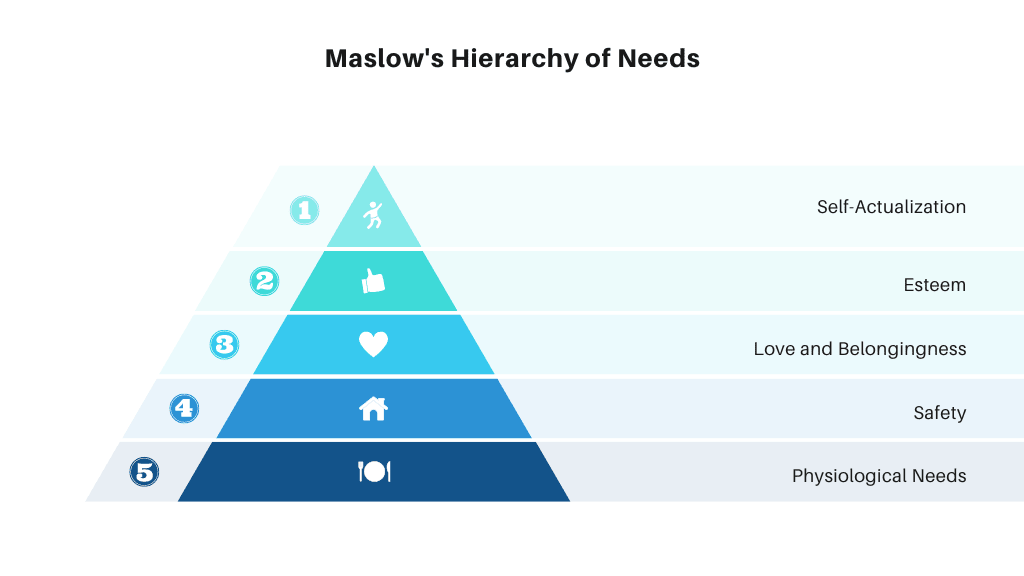
Maslow’s Pyramid has 5 steps that represent different types of needs a person must fulfill to live, from basic to the needs that make a person feel self-realized, having reached their goals and objectives.
The primary agenda of Maslow’s hierarchy is that the ‘strongest’ needs gain our attention when the basic needs are satisfied.
The 5 steps of Maslow’s Pyramid
The first four levels can be grouped into “deficit needs,” and the last level is also referred to as “growth motivation”.
The difference between the two cases lies in the fact that while the deficit needs can be satisfied, the need for the 5th step is a continuous driving force, creating the urge to achieve the goals.
a. Physiological – 100%
Physiological refers to things that are related to our body. There are numerous physiological needs essential for survival. Example- sleep, eat, breathe, drink water, etc. Maslow states that these basic physiological needs must be addressed before humans progress to the next level of fulfillment.
b. Security – 80%
We need to feel safe and secure in our environment. Keeping a proper check on yourself from threats and staying away from useless arguments. It is a need to be with someone who makes us feel safe and protected.
Safety needs include protection from violence and theft, emotional stability and well-being, health security, and financial security. In the digital age, tools like a password manager also contribute to personal safety by protecting online accounts from unauthorized access.
c. Membership – 60%
As humans, we are social and curious beings. Becoming a member of a particular group is a responsibility in itself; we learn teamwork, respect others’ viewpoints, and gain a great deal from one another.
d. Recognition – 40%
These are the needs related to feeling useful and productive, which can boost your self-esteem and increase your confidence in yourself. To obtain recognition from others, you will invest maximum effort with an outstanding level of motivation.
e. Self-realization – 30%
It is the final stage, when you “cross the goal” that you set, and you feel like a self-realized person because you have achieved everything you set out to do. When discussing needs, it is also important to address conflicts.
Conflict occurs when there is dissatisfaction, which creates frustration; it makes the person feel disturbed because their needs have not been met.
Conflict leads to frustration, which in turn leads to a negative attitude and makes a person angry. If it goes out of control, it may lead to ‘wrongful behavior,’ which can cause harm to oneself or others.
Factors that contribute to the conflict are :
- Insult in public or disrespect
- Lack of communication
- Unmet needs
- Confrontation of different values and principles
- Lack of resources and development opportunities
- Differing expectations about how things should be done
- Work conditions and wages
- The different responsibilities of management and employees
- Differences in values, beliefs, needs, or priorities
Maslow’s Pyramid Applied to Social Networks
It is no surprise that consumers exhibit different and new behaviors, evolving along with the latest technologies and trends. The needs are evolving, too.
It doesn’t mean that the philosophy of Maslow’s pyramid no longer exists, but rather that it has been modified. Nowadays, consumers are well-informed and up-to-date at all times.
The influence of Social Networking takes all the credit for this; every piece of information is available with just one click.
Social networking channels have given customers exposure that they previously lacked. Now, before buying any product, we can see its unboxing, features, and reviews, and can also differentiate between other products; it has become more accessible to know the user’s experience.
Additionally, customer care services and return and exchange policies play a significant role in maintaining user trust.
That is why they play such an important role for brands, because you can use them as a “tool” to learn more about your target audience and thus give them what they need at the most appropriate time.
The 5 steps of Maslow’s Pyramid 2.0 – Social Media Pyramid
Using the hierarchy-based pyramid model as a structural basis, one may create a comprehensive social media strategy for the brand.
To start with, one needs to understand the basic structure of the model, i.e., the different tiers of the pyramid model. Every human being requires specific needs to be fulfilled to achieve their full potential.
For them to achieve their maximum potential, they need to progress through the five tiers of the hierarchy model.
From fulfilling the most basic needs of setting up a social media team to maximizing your potential with the help of analytics data, the hierarchy model helps you achieve your social media goals easily.
1. Physiological: the mobile as an extension of our body
A very relatable example is our Smartphone. It can be considered an extension of our body. We need it almost every time; life would be so hard without it, especially nowadays.
It helps us at work, in our leisure time, etc. You need to build your own social media team, start working on the social media handle, and upload content with remarkable consistency.
A social media team should be composed of a head, social media content creator (s), community manager, graphic designer, video editor/producer, copywriter, Ads manager, and social media analyst.
Furthermore, depending on the nature of your business, budget, target audience, and other key requirements, you can establish a social media team.
2. Security: data protection and safe purchases online
Security needs to be adapted to the internet and social network world, incorporating elements such as antivirus software, strong passwords, a password manager, data protection, and firewalls.
Everything that keeps your mobile devices and your social network profiles safe. When it comes to your social media strategy, you need to have a proper plan along with a backup.
Every brand and business is vulnerable to poor audience opinion. To keep your business growing, you need to protect your brand from crises.
One poor feedback can render all your efforts down the drain. Keep a close eye on everything and stay up-to-date with the latest trends.
3. Affiliation: We measure ourselves by the number of followers, friends, or fans
The person continues to seek acceptance from others and to feel loved, doing so in a manner similar to what occurs in the traditional Pyramid. People need attention and want to be liked by their group members.
They want to appear superior and will do anything to reach that level. Engagement is a crucial step in establishing trust and loyalty and in the process, building a community. Similarly, to realize the best potential for your brand on social media platforms.
You ought to build strong relationships with your target audience. The key to creating an effective relationship with your target audience lies in achieving maximum engagement with them.
Introducing schemes that are of mutual interest would be beneficial. Responding to all your comments, messages, and feedback regularly helps maintain a strong relationship with your audience. Keeping the floor open for input from the audience also builds a strong bond.
4. Recognition: the more likes, the better
We all like to feel valued, accepte,d and part of the social group with which we interact. Now, most of our relationships grow and evolve in the large online communities of Facebook, Twitter, YouTube, or Instagram.
We share all kinds of content: videos, infographics, links, ideas, opinions, photos, and personal moments with which we seek “the approval of the other.”
In this context, recognition takes the form of likes, followers, subscribers, the number of visits, and audience engagement. In today’s time, competition is so tough that some people are practising wrongdoings to gain the limelight. People buy fake followers.
5. Self-actualization: I am already an “influencer.”
We could say that in this case, the goal would be to become an “influencer,” that is, someone who is socially influential. Everything you say and do through your social networks will have a significant impact on the rest, to the point that you can influence their actions or way of thinking.
“I do believe that collaboration of brands with influencers is an excellent practice for marketing. What we see more is what we buy. Brands are now making customers happy by launching giveaways.
Which would increase their audience engagement rate and would create a buzz about the brand everywhere.” Nicole, marketing strategist – 10BestReviews.co & littlelittlesteps.co.
Maslow’s Pyramid, Google, and Content Marketing
We recognize that users have varying needs based on their level of expertise. We also know that Google is the most widely used “needs search engine” for information in the world.
Apart from having a quality product or service. To increase your visibility in search engines and attract more visitors to your website, you must develop a strong content strategy. Additionally, connect with your target audience through relevant networks and offer them something of value. You can use these tools and tricks:
- Use Google’s keyword planner to find the highest average search volume in your industry
- Write articles on your website blog that add value and help your community, and attach videos along with it to give a virtual idea.
- Spy on the keywords that your competition uses with Semrush.
- Utilize social networks to engage with users and gather information about their interests, needs, and concerns.
- Utilize more relevant hashtags and design eye-catching posters.
Conclusion
Nowadays, if a brand wants to understand its consumers perfectly, it must take into account both pyramids and work based on that to meet the needs of its customers.
It has become essential to maintain good relations with customers and strive to meet their needs.
I hope that after reading our article, you will be able to trace your target audience.