
On this page14
- Key facts
- Where Answer Engines Show Up
- AEO vs SEO (and Where GEO Fits)
- How Answer Engines Choose Which Answer to Use
- How to Do AEO: A Step-by-Step Framework
- AEO in Practice: A Before-and-After Rewrite
- How to Measure AEO Performance
- The Buyer Who Skips Your Search Results
- Why Your Rankings Will Not Guarantee Visibility
- Is AEO a Replacement for Traditional SEO?
- Starter AEO Framework for Marketing Teams
- How Long Before You See AEO Results?
- A Build In-House or Bring in a Specialist for AEO?
- Your AEO Action Plan for This Week

A buyer needs a new tool for her team. A year ago, she’d have Googled it, opened a handful of tabs and spent an afternoon comparing vendors. Today she types the question into ChatGPT, reads a short answer naming three companies, and books two demos before lunch.
She never saw your search result, even if you rank on page one.
This is happening more often. Demandbase data shows ChatGPT referrals to B2B websites nearly quadrupled in a year, reaching about 2.6 million visits a month by June 2026. And that only counts the people who clicked. Many more read the answer and move on without visiting anyone’s site.
Answer engine optimization (AEO) is how you make sure your content is the answer they read. It means structuring your pages so that AI tools, Google’s AI Overviews and voice assistants can find a clear answer, trust it and use it.
The good news is that AEO isn’t a separate discipline you have to learn from scratch. Most of it builds on SEO work you’re already doing. The difference is in how you write and structure the page.
This guide covers what AEO is, how it differs from SEO, how answer engines pick their answers, and a step-by-step framework you can apply to your own pages.
Check out our analysis on Voozon.com: Review: What the Traffic Numbers Don’t Tell You
Key facts:
AEO is about being the answer, not just a result. The aim is for Google’s AI Overviews, ChatGPT, Perplexity and voice assistants to pull their answer from your page.
It builds on SEO. Pages that can’t be crawled or don’t rank rarely get picked, so solid SEO comes first.
Structure decides whether you’re quoted. Direct answers near the top, question-style headings, tables and short definitions are far easier for answer engines to use.
AEO works on your own pages. Getting other sites to mention your brand is GEO's job, its close relative. You need both.
Success looks different. Track how often you’re cited and mentioned, not just rankings and clicks.
What Is Answer Engine Optimization (AEO)?
Answer engine optimization (AEO) is the practice of structuring your content so that answer engines can find it, understand it and use it as the direct answer to someone’s question.
An answer engine is any tool that responds with an answer instead of a list of links. That includes Google’s AI Overviews and AI Mode, ChatGPT, Perplexity, Gemini, Microsoft Copilot and voice assistants like Siri and Alexa.
How the Meaning of AEO Has Changed
AEO started out closely tied to Google’s featured snippets, the answer boxes at the top of search results, and to voice search, where a device reads out a single answer. Optimizing for AEO meant writing short, clear answers that Google could lift and display.
The term has since widened. With AI tools now writing full answers from several sources, AEO today is mostly about getting your content cited and your brand mentioned in those AI responses. HubSpot, for example, now defines AEO as improving how often and how accurately a business appears in AI-generated answers.
Both versions share the same core idea: write so that a machine can pull a clear answer from your page.
What Does AEO Stand For?
In marketing, AEO stands for answer engine optimization. You may also see it used for unrelated things, most commonly “Authorized Economic Operator,” a certification used in international customs and trade. Context usually makes it obvious which one is meant.
A quick example of AEO
Say someone asks, “How long does B2B link building take to show results?”
Two pages cover the topic. The first opens with three paragraphs about why link building matters and mentions timelines halfway down. The second opens with: “Most B2B link building campaigns take three to six months to show a clear movement in rankings, depending on your starting authority and competition.”
An answer engine is far more likely to use the second page. The answer is right at the top, stated plainly and easy to quote. That's AEO in a nutshell.
Where Answer Engines Show Up
AEO matters because answers now appear in a lot more places than a list of ten blue links. Here are the main ones, and what each means for your content.
Google AI Overviews and AI Mode
AI Overviews are the AI-written summaries that appear at the top of many Google searches, with links to the pages they drew from. Google said at its I/O conference in 2026 that AI Overviews now reach more than 2.5 billion people a month.
AI Mode is Google’s fuller, conversational search experience, where you can ask follow-up questions and get longer answers. Both pull from Google’s own index. So a page that already ranks well, and answers the question clearly, stands the best chance of being cited.
Featured snippets
Featured snippets are the answer boxes Google shows above regular results. They were the original target of AEO, and they still exist. But they appear far less often than they used to. An Ahrefs study of one million US searches found featured snippets showed up on 15.41% of results in January 2025, falling to 5.53% by June. Over the same period, AI Overviews jumped from 3.93% to 27.43%.
In practice, much of the space featured snippets once held now belongs to AI Overviews. The good news is that the same habits help with both: a clear, direct answer near the top of the page.
ChatGPT
ChatGPT is now one of the biggest places people go for answers. OpenAI reported 900 million weekly active users in February 2026. When ChatGPT searches the web, it reads pages, writes an answer and links to the sources it used. When it doesn’t search, it answers from what it learned during training.
For AEO, the first case is the one you can influence quickly. Pages that rank for the searches ChatGPT runs and state their answers clearly are the ones it tends to cite.
Perplexity, Gemini and Copilot
Perplexity searches the web for almost every question and always shows its sources, which makes it easy to see whether your pages are being used. Gemini draws on Google Search, and Microsoft Copilot draws on Bing. If you’ve ignored Bing until now, Copilot is a good reason to check how your pages appear there.
Voice assistants
Siri, Alexa and Google Assistant usually read out one short answer rather than a list. There’s no second place in voice search. A concise, well-structured answer is what gets read aloud.
What they all have in common
Every one of these engines is trying to do the same thing: find a trustworthy page with a clear answer and pass that answer on. The engines differ in where they search and how they display results, but the content they reward looks much the same. That’s why one solid AEO approach works across all of them.
AEO vs SEO (and Where GEO Fits)
AEO and SEO aren’t rivals. They share most of the same foundations, but they aim for different outcomes and measure success differently.
SEO gets your pages ranking in search results so people click through to your site.
AEO gets your content chosen as the answer, whether that’s in an AI Overview, a ChatGPT response or a voice assistant’s reply. Often the person never clicks at all.
Side-by-side comparison
SEO | AEO | |
|---|---|---|
Goal | Rank and earn clicks | Be used as the answer |
Where it shows up | Google and Bing results | AI Overviews, AI Mode, ChatGPT, Perplexity, voice assistants |
Unit of competition | The whole page | A passage, definition or data point |
What wins | Relevance, backlinks, technical health | Clear answers, structure, trust and coverage of related questions |
How success is measured | Rankings, clicks, organic traffic | Citations, mentions, AI referral traffic |
Does it need a click? | Yes | Often no |
What stays the same
Google is clear on this point. Its guidance for AI Overviews and AI Mode says SEO best practices still apply, and there are no extra requirements to appear. Pages simply need to be indexed and eligible to show a snippet. Google also says you don’t need special AI files or new markup.
So if your pages can’t be crawled, aren’t indexed or carry no authority, AEO won’t rescue them. Strong SEO is the starting point.
What changes
Ranking for your main keyword used to be most of the job. That’s no longer enough on its own.
In July 2025, an Ahrefs study found that 76% of pages cited in AI Overviews ranked in Google’s top 10 for the same search. When Ahrefs repeated the analysis in March 2026 with a much larger sample, that figure had dropped to 38%. Ahrefs’ likely explanation is that Google now splits a search into several related sub-questions and pulls answers from those results too.
The practical takeaway is that you need to answer the main question and the questions around it. A page on “B2B link building” that also clearly covers cost, timelines and risks gives answer engines many more chances to use it than a page that only targets the headline keyword.
Where GEO fits
You’ll often see AEO mentioned alongside GEO, short for generative engine optimization. The two overlap heavily, but there’s a useful split:
AEO focuses on your own pages: structuring content so answer engines can find and use it.
GEO focuses on your brand across the web: earning the mentions, reviews and coverage that make AI tools confident enough to recommend you.
You need both. AEO makes your pages easy to quote. GEO makes your brand worth quoting.
How Answer Engines Choose Which Answer to Use
No AI company publishes the rules for which sources get cited. But several large studies now show clear patterns. It helps to think of the process in two stages: first the engine finds candidate pages, then it picks which passages to use.
Stage 1: Getting into the running
An answer engine can only quote pages it has found. For most engines, that means pages that are crawlable, indexed and ranking in search, as Google’s own guidance for AI Overviews makes clear.
But “ranking” now means more than your main keyword. As covered above, Ahrefs found that only 38% of pages cited in AI Overviews ranked in the top 10 for the original search, down from 76% a year earlier. Answer engines increasingly break a question into smaller related searches and pull from those results too. Pages that cover a topic broadly, including the follow-up questions, get more chances to be picked.
Stage 2: Which passage gets used
Once an engine has a set of pages, it chooses specific sentences to build its answer. A February 2026 analysis by growth advisor Kevin Indig examined more than 18,000 verified ChatGPT citations, matching each to the exact sentence it came from. Together with earlier research, it points to five signals that make a passage more likely to be used.
1. The answer appears early. 44.2% of ChatGPT citations came from the first 30% of a page. Only 24.7% came from the final third. If your best answer is buried near the end, it’s less likely to be found.
2. It defines things clearly. Cited passages were nearly twice as likely to use plain definitions, such as “X is” or “X refers to.” A clean one-sentence definition is one of the easiest things for an engine to lift.
3. Headings ask the question. Cited content was twice as likely to include a question mark. Of the citations tied to questions, 78.4% came from headings. A heading like “How long does AEO take?” mirrors exactly what people ask.
4. It’s specific. Heavily cited text was dense with names, such as companies, products, places and people. Proper nouns made up 20.6% of it, compared with 5% to 8% in typical English writing. The original GEO research from Princeton found something similar. Citing sources was one of the most effective changes it tested, while keyword stuffing actually performed worse than doing nothing.
5. It’s easy to read. The most-cited content in Indig’s analysis had a Flesch-Kincaid grade of 16, compared with 19.1 for content that performed worse. In plain terms: shorter sentences and simpler structure win. In the Princeton study, improving fluency was also among the highest-scoring changes.
Freshness helps, but less than you’d think
An Ahrefs study of nearly 17 million citations found that pages cited by AI assistants were, on average, about 25.7% newer than pages ranking in Google’s regular results. ChatGPT showed the strongest preference for newer content. Google’s AI Overviews showed almost no preference for freshness.
Still, the cited pages averaged nearly three years old. Ahrefs also warned against simply changing a page’s date without real updates, which Google discourages. Freshness is a tiebreaker. It won’t make a weak page the answer.
What this means for your pages
Put together, the pattern is consistent. Answer engines reward pages that:
put the answer near the top
define terms plainly
use question-style headings
name specific things
read easily
None of these are tricks. They’re the same habits that make a page easier to skim. The next section turns them into a step-by-step framework.
How to Do AEO: A Step-by-Step Framework
Here’s how to put those signals to work. Start with your most valuable pages: service pages, comparison pages and the guides that already bring in leads. Then work outward.
Step 1: Find the questions your buyers actually ask
AEO starts with questions, not keywords. Build a list of the real questions people ask before buying what you sell.
Good places to look:
Keyword tools. In Ahrefs Keywords Explorer, switch the results to “Questions” to see what people search for in question form.
Google’s “People also ask” box for your main topics.
Your sales and support teams. The questions prospects raise on calls are often word-for-word what they type into ChatGPT.
Reddit and industry forums, where people describe problems in their own words.
For each main question, note the follow-ups too. Someone asking “What is AEO?” usually wants to know how it differs from SEO, how long it takes and what it costs next. Since answer engines now pull from searches related to the original question, covering these follow-ups gives your page more ways in.
Step 2: Give each page one clear job
Pick one main question per page, then answer the closely related ones on that same page. Avoid spreading near-identical answers across several thin posts. They compete with each other, and none of them becomes the obvious best source.
If two of your pages answer the same question, merge them into one stronger page and redirect the other.
Step 3: Put the answer first
Answer engines pull most of their citations from the top of a page. So:
Open with the answer. The first sentence or two under your main heading should answer the question directly, before any background.
Do the same under every subheading. Lead with a one- or two-sentence answer, then explain.
Define key terms in one sentence. Use the simple “X is…” format.
Quick test: If someone read only the first two sentences under each heading, would they get the answer? If not, rewrite the opening.
Step 4: Structure the page so answers can be lifted
Write headings as questions where it fits naturally. “How much does link building cost?” works better than “Pricing.”
Use tables for comparisons and short lists for steps or options.
Keep sections self-contained. A paragraph should still make sense if you pull it out on its own.
Be specific. Name the tools, companies, numbers and places. “Most teams use Ahrefs or Semrush” is more useful than “many tools exist.”
Write plainly. Short sentences, everyday words and one idea per paragraph.
Step 5: Make your content worth trusting
Answer engines favor sources that look reliable. On every important page:
Show who wrote it with a real author byline and a short bio.
Back up claims with named sources or your own data.
Add original information where you can: client benchmarks, survey results or first-hand examples. A fact that exists only on your site can only be cited from your site.
Step 6: Check the technical basics
None of this matters if answer engines can’t reach your page.
Make sure the page is indexed and can show a snippet. Google says that’s all a page needs to be eligible for AI Overviews and AI Mode. Check that you haven’t added a
nosnippettag by mistake.Don’t block AI search crawlers. Check your robots.txt and CDN settings. Cloudflare has blocked AI crawlers by default for new domains since July 2025. It helps to know the difference between bots:
OAI-SearchBot decides whether your pages appear in ChatGPT search.
GPTBot collects content for training OpenAI’s models.
OpenAI treats the two separately, so you can allow search while blocking training.
Perplexity’s search crawler is PerplexityBot.
Avoid hiding key content behind JavaScript. Most AI crawlers don’t run JavaScript, so text that only appears after scripts load may be invisible to them. Server-side rendering fixes this.
Treat schema as housekeeping. Organization, Article and Product schema help search engines understand your pages. But Google says no special schema is needed for its AI features, and it stopped showing FAQ rich results in May 2026. Don’t add FAQ schema expecting a visual boost in search.
Step 7: Keep pages fresh, for real
AI assistants lean slightly toward newer content, so review your key pages every few months:
Update facts, prices and examples.
Add answers to new questions you’ve heard from buyers.
Change the “last updated” date only when the content has actually changed. Google discourages date changes without real updates.
AEO in Practice: A Before-and-After Rewrite
It’s easier to see AEO than to describe it. Below is a typical blog section rewritten using the framework above. The topic is link insertions, but the same changes work for any subject.
Before
Understanding Link Insertions
Businesses are always looking for new ways to stay ahead of the competition. Link building has long been one of the most important parts of any SEO strategy, and over the years many different approaches have emerged. One of these approaches, which has become increasingly popular among marketers, involves working with existing content rather than creating something new from scratch. This is what is often referred to as a link insertion, and it can be a valuable tactic when used correctly as part of a wider strategy.
It’s not wrong, but an answer engine has almost nothing to work with:
The heading doesn’t match any question someone would ask.
The actual definition doesn’t arrive until the fourth sentence, and even then it’s vague.
There are no specifics: no names, no examples, no clear statement of what a link insertion is.
After
What is a link insertion?
A link insertion is when a website adds a link to your page inside an article it has already published. It’s also called a niche edit. Instead of writing a new guest post, you ask the site owner to place your link in an existing, relevant article, usually one that already ranks and gets traffic.
When does a link insertion make sense?
Link insertions work best when an existing article already covers your topic and your page adds something the article is missing, such as a deeper guide, a tool or fresh data. For example, a B2B marketing blog with a post on SEO reporting might link to your free SEO reporting template.
What changed, and why it matters
Change | Signal it targets |
|---|---|
Heading rewritten as a question | Question-style headings |
Definition moved to the very first sentence | Answer appears early |
“A link insertion is…” format | Clear definitions |
Alternative name (“niche edit”) and a concrete example added | Specificity |
Filler removed; shorter sentences | Easy to read |
A follow-up question answered in its own section | Covers related questions |
The rewrite is actually shorter than the original, yet it gives an answer engine far more to use. Someone asking ChatGPT “What is a link insertion?” could get your first sentence almost word for word. Someone asking “When should I use a link insertion?” has a second section ready to quote.
Try it on your own pages
Pick one important page and run this quick check on each section:
Does the heading match a question a buyer would ask? If not, rewrite it.
Is the answer in the first one or two sentences? If not, move it up.
Would the opening make sense on its own, pulled out of the page? If not, add the missing context.
Is there at least one specific name, number or example? If not, add one.
Can you cut any warm-up sentences? Usually, yes.
Most pages improve noticeably after a single pass.
How to Measure AEO Performance
AEO is harder to measure than SEO because answer engines don’t hand you a full report. You can still build a clear picture from a few sources. Here’s the short version. For a full walkthrough, see the tracking section of our GEO guide. [Internal link: /generative-engine-optimization/]
1. Check whether you’re being used as the answer
Take the questions from Step 1 of the framework and run them through ChatGPT, Perplexity, Gemini and Google each month. For each answer, note whether it cites your page, mentions your brand, and matches what your page says.
Run your most important questions several times, not just once. A January 2026 SparkToro study found AI tools almost never return the same list of brands twice. A single check can be misleading. What matters is how often you appear across many runs.
Once your list grows beyond a few dozen questions, an AI visibility tool can run these checks for you. We compare the options in our guide to the best AI visibility tools.
2. Track AI referral traffic in GA4
Set up a custom channel group in GA4 that pulls visits from ChatGPT, Perplexity, Gemini, Copilot and Claude into their own “AI Search” channel. The GEO guide has the step-by-step setup.
Expect the numbers to undercount a little. Some ChatGPT visits arrive without referrer information, or lose their tracking tag along the way, and GA4 files those under Direct. If your Direct traffic rises around the same time as your AI traffic, that’s part of the reason.
3. Use the official reports you do have
Google Search Console. Google says clicks and impressions from AI Overviews and AI Mode are included in your normal Search Console data, under the “Web” search type. You can’t separate them from regular results, but rising impressions on question-style queries are a good sign.
Bing Webmaster Tools. Its AI Performance report, added in early 2026 and still in preview, shows how often Copilot cites your pages and which searches triggered those citations. It’s free, and it’s the most direct citation data any major platform offers today.
A simple monthly scorecard
Keep it to one page:
Share of tracked questions where you’re cited or mentioned
New questions won and any lost
Accuracy issues spotted in AI answers
AI referral sessions and the leads they produced
Impressions for question-style queries in Search Console
Copilot citations from Bing Webmaster Tools
Judge AEO trends over several months, not any single answer.
The Buyer Who Skips Your Search Results
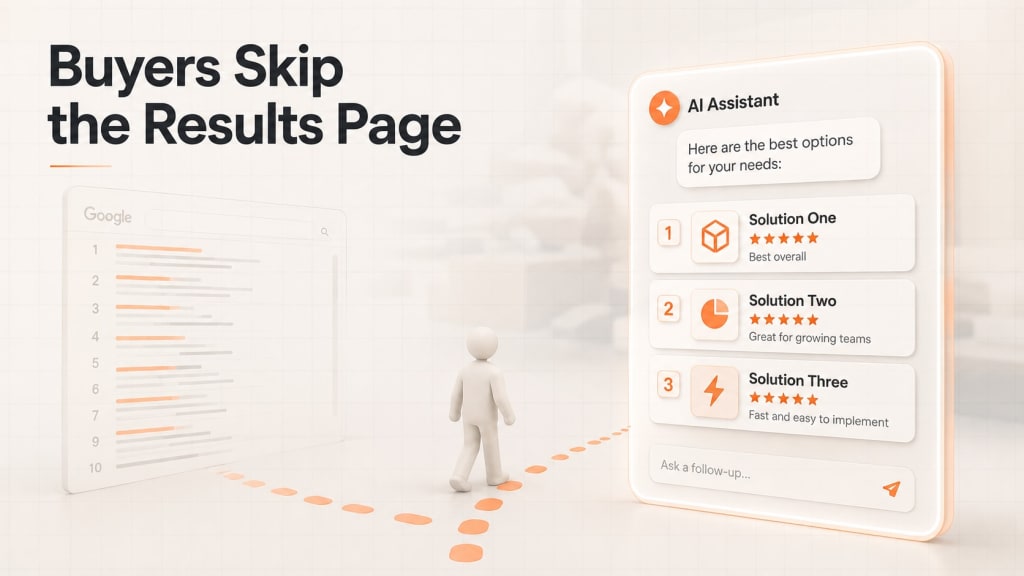
Part of your target buyers are bypassing the traditional results page entirely. Perplexity alone now handles over 1.5 billion queries every month, queries that previously ended with a click to a search results page. Gartner projected that traditional search engine volume would drop by 25% by 2026, as AI chatbots and virtual assistants absorb intent that used to land on Google.
This pattern is what’s happening in the B2B buying journey. When a revenue leader is researching CRM platforms, a marketing manager is comparing SEO tools, a founder is evaluating GTM agencies: these buyers ask an AI tool for a shortlist rather than running a search and comparing results pages. From there, the AI provides an answer, and the buyer acts in that moment.
The brands in that shortlist are not always the ones that rank on page 1 and that gap is what AEO addresses. AEO also overlaps heavily with generative engine optimization (GEO), which focuses on getting your brand cited across AI-written answers.
Why Your Rankings Will Not Guarantee Visibility
Your page can sit on page 1 of Google results for a target keyword and still be invisible when an AI answers the same question. Search rankings from traditional SEO and AI citations work differently, and optimizing for one does not automatically benefit the other.
This breaks common reporting: when the answer happens off your site, your organic traffic and click-through rate metrics stop measuring what matters. The real performance question shifts: does the AI name us when a buyer asks about our category?
A distinct specialist field has emerged to answer that question. Agencies such as Intelligent Resourcing now build their practice entirely around getting brands cited by AI engines, treating AI share of voice as a primary measure of search visibility alongside keyword rankings and domain authority.
For most marketing teams, this requires a new measurement layer alongside existing SEO reporting, not a replacement.
Is AEO a Replacement for Traditional SEO?
AEO does not replace SEO, but they run in parallel and share several inputs.
SEO continues to drive traffic for research-stage queries, comparison searches and long-tail content where the buyer wants to read multiple sources from different blue links before deciding. AI answers dominate at the moment of decision, especially when a buyer wants a shortlist, not 10 blue links to evaluate and compare.
This is where they diverge:
SEO | AEO | |
Primary signal | Keyword match and backlink authority | Entity consistency and structured data |
Key metric | Traffic, position, CTR | AI share of voice, citation frequency |
Content goal | Best match for query intent | Consistently described brand across the web |
Timeline | 3-6 months for new content | 2-4 months for citation shifts after structural fixes |
Running both in parallel is the right position for most marketing teams in 2026. Abandoning SEO to chase AI citations is premature. Ignoring AI citations because your rankings look strong is a slow way to lose ground as buyer behavior shifts.
Answer engines prioritize pages that are structured, specific, authoritative, and fresh. The signals they rely on fall into these 5 categories:
Signal | What it means in practice |
Structured data and schema | Structured data provides a machine-readable layer that helps AI systems and search crawlers identify entities, relationships, and key facts, according to Google’s documentation. |
Answer-first content | Pages that lead with a direct answer before elaborating are cited more often. AI systems extract the clearest, most complete answer and not the most beautifully written paragraph. |
Entity consistency | Your brand name, product name, and category descriptors must be consistent across your site, directories, press coverage, and partner pages because inconsistencies erode trust signals. |
Authority and third-party signals | Citations and backlinks from credible sources, along with brand mentions across independent publications, are signals to AI systems that your content is worth referencing. |
Freshness | Content with recent publish or recent update dates has more weight, especially on fast-changing topics. |
AEO requires all 5 working together, and content that performs on 2 of 3 of these signals often still falls short.
Starter AEO Framework for Marketing Teams
The starting point is to do an audit, run your category and brand queries across ChatGPT, Perplexity, and Gemini and record what the AI returns. This tells you where you stand before you change anything.
Starter framework: 5-step
Run the AI brand audit:
Ask each AI tool:
What are the best [your category] tools/agencies/solutions?
Tell me about [your brand name].
Note who gets cited, what is said, and which sources are referenced.
Restructure priority pages
Identify the pages that should appear in AI answers, and rewrite them to lead with a direct answer. The first paragraph of each page should answer the buyer’s most likely question within the first 60 words.
Add and validate schema
Implement FAQ, HowTo, and Organization schema on priority pages.
Build your topical authority through third-party citations
Because AI engines cite brands that appear consistently across credible, independent sources. A content program that earns backlinks and brand mentions from relevant publications or third-party compounds over time.
Monitor AI share of voice monthly
Track how often your brand is cited across AI tools for your core category queries.
How Long Before You See AEO Results?
Most teams see their first measurable citation within the period of 60 to 90 days of structural changes, but the timeline depends on these 3 factors:
1. How established your brand already is
AI models carry prior knowledge of established brands. A brand that already appears in credible third-party sources sees faster citation improvements after structural fixes than a newer brand building its entity presence from scratch.
2. How quickly crawlers pick up your changes
Schema additions and content restructuring take time for AI systems to process. Pages with frequent crawl schedules and recent update dates move faster.
3. How consistent your entity signals are
If your brand name, service description, or category is inconsistent across your site, directories, and/or partner pages, that delays citation. Cleaning up entity signals is often the fastest way available to a team starting from a low baseline.
A realistic expectation:
Month 1: Run the baseline audit. Fix entity inconsistencies. Begin schema implementation.
Months 1-2: Restructure priority pages to answer-first format. Start citation-building through content and PR.
Month 3: Recheck AI citation rates across all 3 major tools.
Months 4-6: This is where you see changes in competitive category queries.
A Build In-House or Bring in a Specialist for AEO?
Whether to run AEO internally depends on 2 factors: technical capacity and consistency. Schema implementation, citation auditing, and entity consistency are well within an experienced in-house team's capabilities. But they require sustained attention, not a one-time sprint.
When in-house makes sense:
You have an SEO manager or content lead who can own the program
You already have a link-building or digital PR function that produced third-party citations
When you can commit to monthly citation monitoring
When to bring in a specialist:
Your team lacks technical depth for the schema implementation and validation
You need the audit and monitoring cycle running quickly
You want a benchmark before committing to in-house capacity
If your team lacks the capacity to run citation audits and schema work consistently, an answer engine optimization agency in Australia can handle the full audit-to-monitoring cycle: benchmarking your current AI visibility, fixing the structural gaps, and running the program on an ongoing basis.
Your AEO Action Plan for This Week
Run an AI Audit: Use ChatGPT, Perplexity, and Gemini to ask them these questions about a shortlist of the best in your category, a solution in your market, or your brand.
Establish Your Baseline: Document exactly what comes back.
Were you mentioned?
What was the context?
Which competitors showed up
What sources did the AI cite?
Optimize and Measure: Use the highest-traffic page on your site that should appear in those AI answers. Rewrite the first paragraph to directly answer the buyer’s question in 60 words or less, then test the AI prompts again after 30 days.
AEO requires consistency and clear, specific answers, and the marketing teams that build this habit in 2026 will be ahead as AI discovery becomes the standard way buyers find products.
FAQs
Engines that search the web live, like Perplexity, ChatGPT search and Google’s AI Overviews, can pick up improved pages within weeks once they’ve been recrawled. In one published example, fintech company Ramp raised its AI visibility for accounts payable from 3.2% to 22.2% between December 2024 and mid-February 2025 by publishing four targeted pages. Expect a clear trend over three to six months rather than instant results.
AEO, or answer engine optimization, is the practice of structuring your content so that answer engines can use it as the direct answer to a question. Answer engines include Google’s AI Overviews and AI Mode, ChatGPT, Perplexity, Gemini, Copilot and voice assistants. The goal is to be the answer people read, not just one of the links they might click.
No, but they overlap heavily. SEO aims to rank pages and earn clicks, while AEO aims to have your content chosen as the answer, often without a click. Google says SEO best practices still apply to its AI features, so AEO builds on SEO rather than replacing it.
AEO focuses on your own pages: making them easy for answer engines to find, understand and quote. GEO, or generative engine optimization, focuses on your brand across the web: earning the mentions, reviews and coverage that make AI tools confident enough to recommend you. Most businesses need both.
No. Google says no special schema or markup is needed to appear in AI Overviews or AI Mode. Organization, Article and Product schema are still good housekeeping. But Google stopped showing FAQ rich results in May 2026, so adding FAQ schema won’t change how your page looks in search.
For tracking, popular options include Ahrefs Brand Radar, Semrush’s AI Visibility Toolkit, Otterly.AI, Peec AI and Profound. Bing Webmaster Tools also offers a free AI Performance report showing how often Copilot cites your pages. For finding questions to target, keyword tools with a question filter, plus Google’s “People also ask” box, are a good start.
Partly. Google includes clicks and impressions from AI Overviews and AI Mode in your normal Search Console data, under the “Web” search type, but you can’t separate them from regular results. For a fuller picture, combine Search Console with AI referral traffic in GA4 and regular checks of your target questions in AI tools.
AEO services usually include a content audit, rewriting key pages so answer engines can use them, question research, technical fixes and ongoing tracking of citations. Published agency pricing guides for 2026 put one-time audits at around $2,500 to $5,000 and monthly retainers at roughly $3,500 to $8,000, with enterprise programs going higher. Compare quotes like for like, since scope varies widely.