
On this page11
- What Is Podcast Link Building?
- Why Podcast Link Building Matters for SEO
- Podcast Link Building vs Traditional Link Building
- How to Find Podcasts That Can Generate Valuable Backlinks
- How to Get Backlinks From Podcasts
- How to Increase Your Chances of Getting a Podcast Backlink
- Podcast Link Building Strategies for SaaS Companies
- Common Podcast Link Building Mistakes
- How to Measure Podcast Link Building Results
- Final Thoughts
- Frequently Asked Questions
Traditional link building often means sending outreach emails, pitching guest posts, promoting digital assets, or searching for websites willing to reference your content. These tactics can work, but competition for quality backlinks is high.
Podcast link building offers another route.
Podcast link building is the process of earning backlinks through podcast appearances, usually when a relevant podcast publishes an episode page, guest profile, show notes, or resource section containing a link to the guest's website.
The SEO benefit is only part of the opportunity. A relevant podcast appearance can also generate referral traffic, increase brand visibility, strengthen expert positioning, and create relationships with publishers and industry professionals.
For B2B and SaaS companies, the strategy can be particularly useful because founders, executives, marketers, and subject-matter experts already have knowledge that can be turned into valuable podcast conversations.
What Is Podcast Link Building?
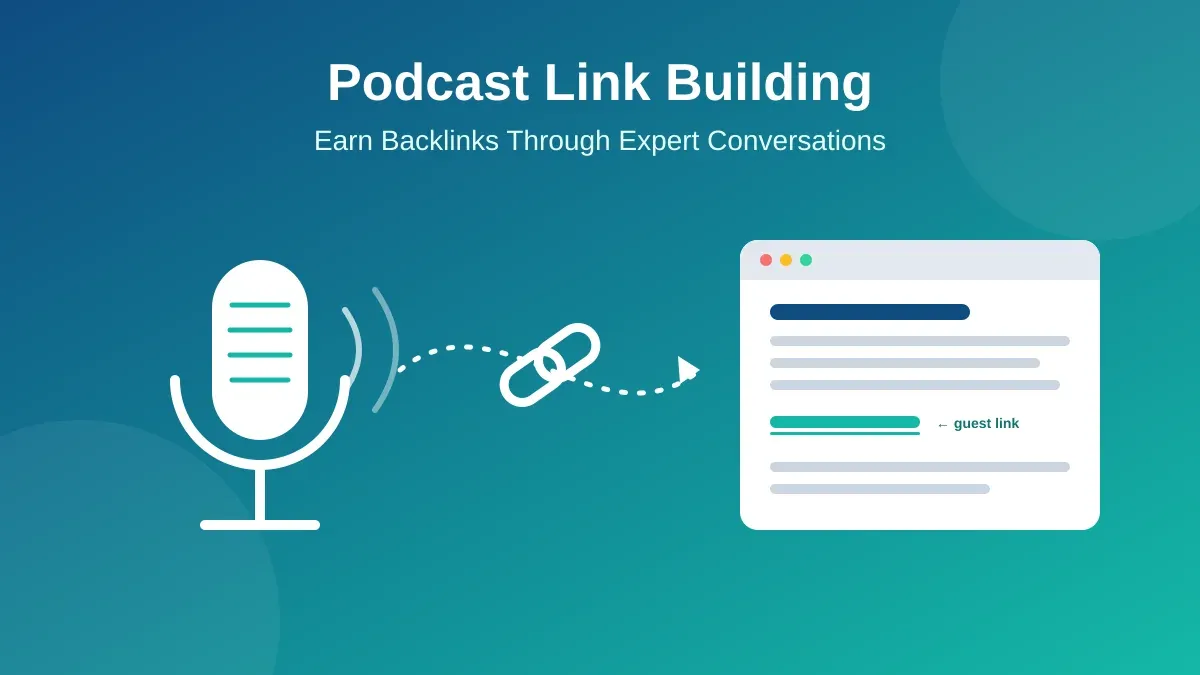
Podcast link building is a link acquisition strategy built around appearing as a guest on relevant podcasts and earning links from the web pages created around those appearances.
The process generally looks like this:
Identify relevant podcasts.
Research their websites and previous episodes.
Check whether guests receive website links.
Develop a useful topic that fits the podcast's audience.
Pitch the host or producer.
Appear on the podcast.
Provide relevant information and resources.
Monitor the published episode for backlinks and referral traffic.
The important distinction is that the backlink should not be treated as the entire purpose of the appearance. Podcast hosts are looking for knowledgeable guests who can provide useful conversations for their audience.
A SaaS SEO specialist, for example, could appear on a B2B marketing podcast to discuss how AI search is changing organic acquisition. Once the episode is published, the podcast website might include the guest's company website, profile, research, or another relevant resource.
Where Can Podcast Backlinks Come From?
Potential link locations include:
Podcast episode pages
Show notes
Guest profile pages
Speaker biographies
Resource sections
Articles supporting the episode
Company or expert pages
Not every podcast offers these opportunities. Some shows have little web presence beyond third-party audio platforms, while others maintain detailed, searchable episode archives.
For SEO purposes, the strongest prospects are generally podcasts with relevant audiences, active websites, dedicated episode pages, and a history of linking to guests or useful resources.
Why Podcast Link Building Matters for SEO
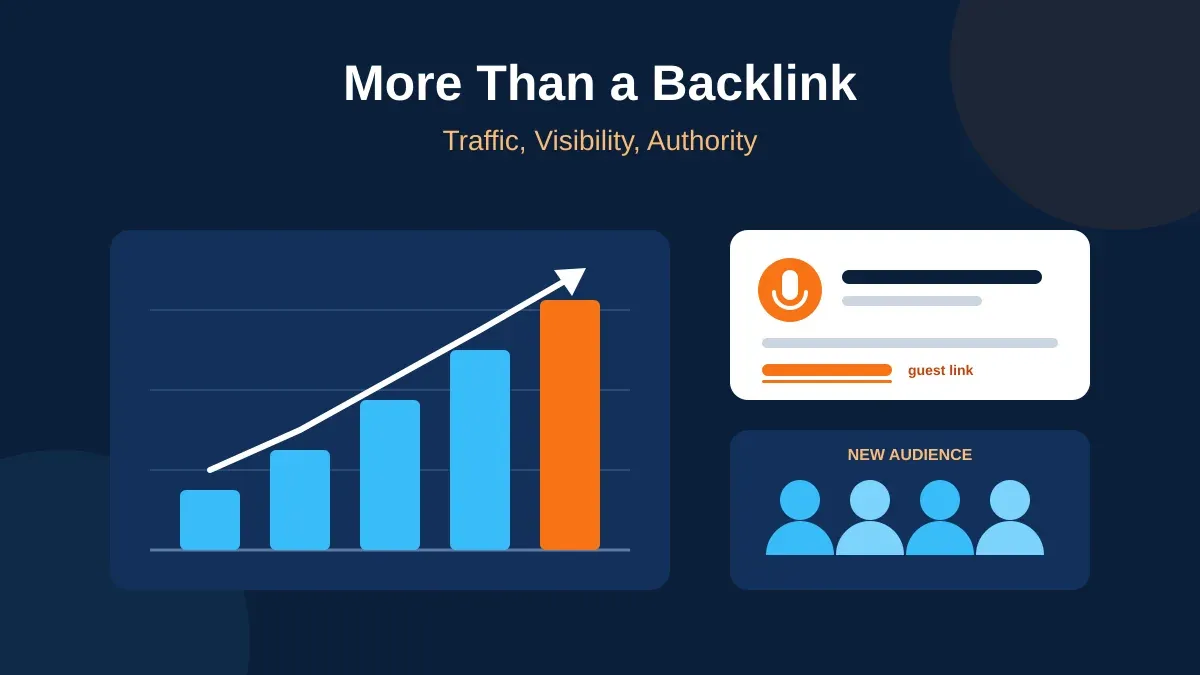
The value of podcast link building extends beyond acquiring another referring domain.
A relevant podcast can introduce a company to an audience that may never discover it through conventional search. Listeners can visit the website, search for the brand later, share the episode, or reference the company in their own content.
The episode itself can also remain available for years. That creates a lasting web asset that may continue generating referral traffic and brand exposure long after the original recording.
Podcast appearances can contribute to:
Relevant backlink acquisition
Referral traffic
Brand visibility
Expert positioning
Branded searches
Industry relationships
Content opportunities
This broader value makes podcast link building especially relevant for B2B brands.
Why Podcasts Work Well for B2B and SaaS Companies
B2B companies often have specialists with valuable knowledge that translates naturally into podcast discussions.
A founder might discuss SaaS growth. A marketing leader could explain demand generation. An SEO specialist could discuss AI search. A product leader could share lessons from building software in a competitive market.
The strongest approach is to think about the question:
What can this expert teach the podcast audience?
That is more effective than asking how to get a backlink.
When the conversation provides genuine value, the website attribution becomes a natural part of the editorial relationship.
Podcast Link Building vs Traditional Link Building
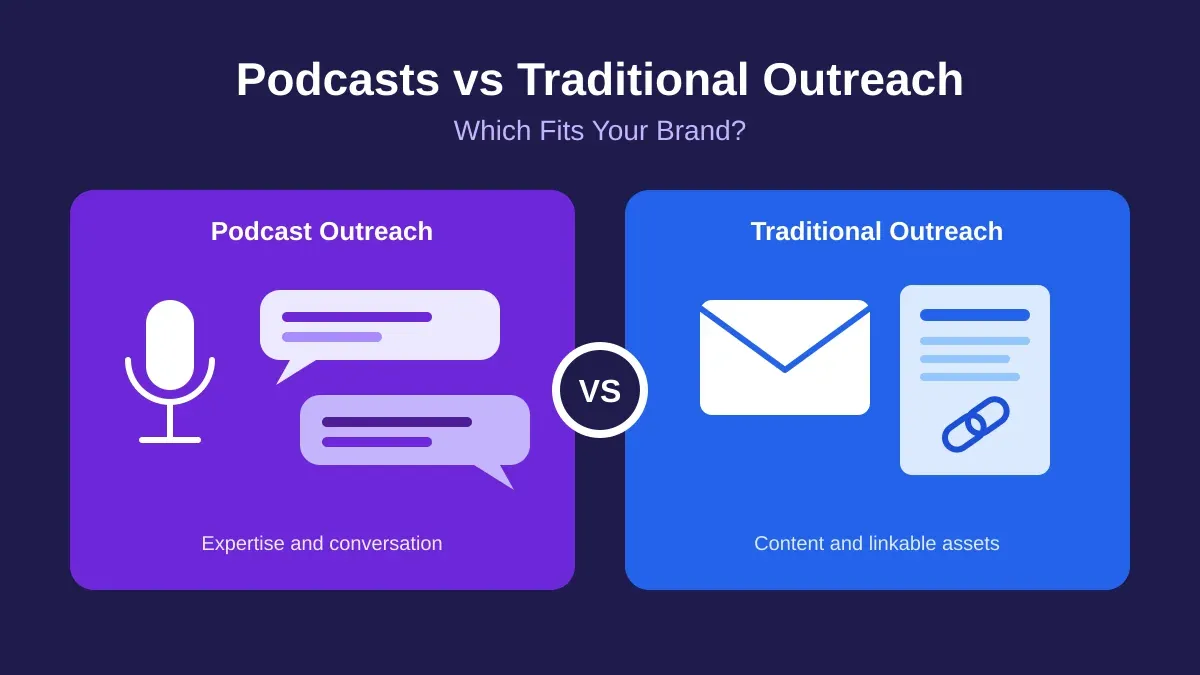
Podcast link building works alongside established SEO tactics rather than replacing them.
Factor | Podcast Link Building | Traditional Outreach |
|---|---|---|
Primary asset | Expertise and conversation | Content or linkable asset |
Outreach target | Podcast hosts | Editors and site owners |
Typical link location | Episode page or show notes | Article or resource page |
Content requirement | Guest appearance | Written content or resource |
Relationship potential | High | Moderate to high |
Brand exposure | Usually strong | Depends on placement |
Best suited for | Experts and B2B brands | Content-led campaigns |
Podcast Link Building vs Guest Posting
Guest posting requires creating an article that meets a publisher's editorial standards. Podcast link building allows the expert to contribute through conversation instead.
This makes podcasts useful for founders and executives who have valuable experience but limited time to produce multiple written articles.
Guest posting can be easier to scale when a company has a strong content team, while podcasts tend to require more relationship-building and coordination.
Podcast Link Building vs Digital PR
Digital PR generally depends on something newsworthy, such as proprietary research, original data, company announcements, or expert commentary.
Podcast outreach can have a lower barrier to entry. A company does not need a major announcement to become a guest. Expertise and a compelling discussion topic may be enough.
The two strategies can also support each other. Original research can be promoted through PR while simultaneously becoming a topic for podcast appearances.
How to Find Podcasts That Can Generate Valuable Backlinks
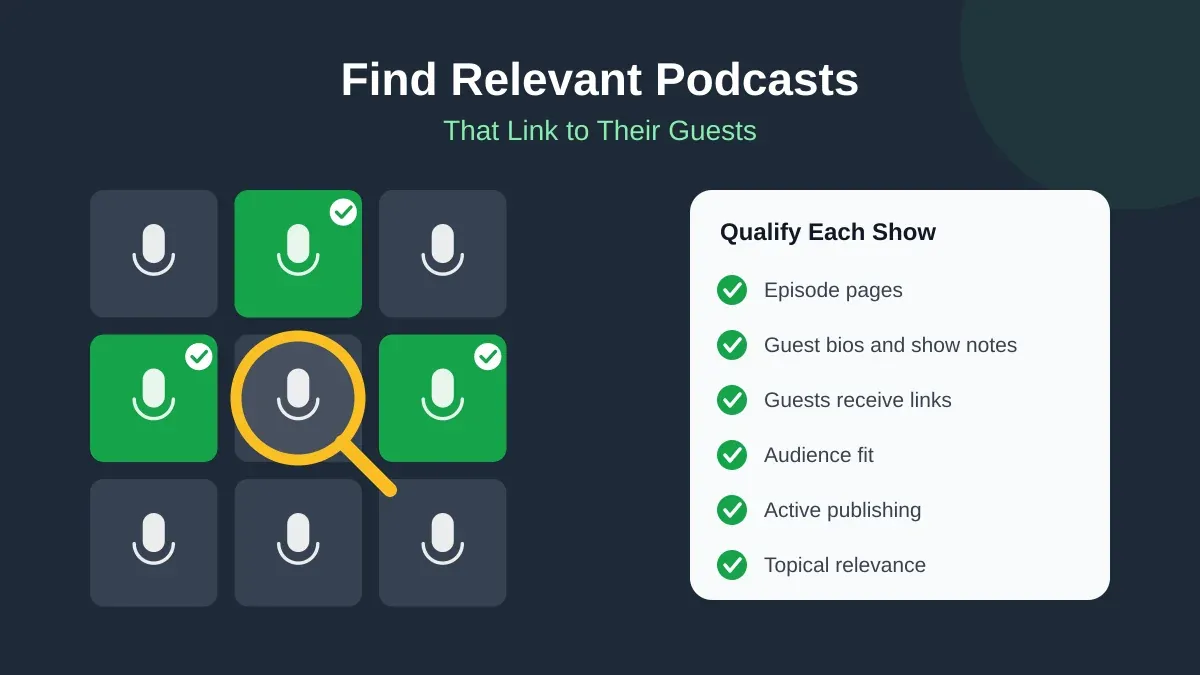
Finding podcasts is easy. Finding podcasts that are genuinely useful for SEO and business development requires more research.
Start with the topics your company already has expertise in.
Useful searches include:
"SaaS" "podcast""SEO" "podcast" "guest""B2B marketing" "podcast""SaaS founders" "podcast""AI search" "podcast""marketing leaders" "podcast"
You can also combine your niche with terms such as “podcast guest,” “guest interview,” “be a guest,” and “submit a guest.”
Once you find a potential podcast, visit its actual website rather than relying entirely on podcast directories.
Check whether it has:
Dedicated episode pages
Guest biographies
Show notes
Searchable content
Resource sections
Active publishing
Links to previous guests
Then examine several recent episodes. If guests consistently receive website links, that is a useful signal for your campaign.
Prioritize Relevance Over Raw Metrics
Do not evaluate podcast opportunities solely through domain authority or traffic estimates.
A smaller podcast that reaches SaaS decision-makers may be more useful to a B2B software company than a much larger general-interest show with an unrelated audience.
Consider:
Qualification | What to Look For |
|---|---|
Topical relevance | Strong connection to your expertise |
Audience fit | Listeners resemble your target customers |
Website quality | Active and credible website |
Link potential | Guests receive relevant links |
Publishing activity | Recent and consistent episodes |
Guest quality | Credible industry professionals |
Organic visibility | Searchable web content |
How to Get Backlinks From Podcasts
Once you've identified qualified podcasts, the next step is outreach.
The biggest mistake is treating podcast outreach like a backlink placement request.
Hosts want interesting guests and useful conversations. They are unlikely to invite someone simply because that person wants a backlink.
Build a Qualified Prospect List
Track each opportunity in a central database.
Include:
Podcast name
Website
Host
Topic
Recent episode
Contact information
Guest requirements
Previous guest links
Proposed topic
Outreach status
Published episode
Backlink status
This allows your team to identify which podcast categories and topics consistently produce results.
Pitch a Specific Conversation
A generic pitch such as “I'd love to come on your podcast and discuss SEO” gives the host little reason to respond.
Instead, propose a specific conversation.
For example:
“How B2B SaaS Companies Can Build Organic Visibility as AI Search Changes the Buyer Journey”
The pitch should answer three questions:
Why you? Why this topic? Why would the audience care?
Listen to a recent episode before pitching and reference something specific about the show. That demonstrates that the outreach was created for the podcast rather than sent to hundreds of hosts.
Keep the Backlink Secondary
Avoid leading with requests such as:
“Can you give me a dofollow backlink?”
“Will you add my website to the episode?”
“I want to build links through your podcast.”
Instead, focus on your expertise and the value of the conversation.
If the podcast routinely links to guests, the website attribution can happen naturally as part of the publishing process.
How to Increase Your Chances of Getting a Podcast Backlink
Getting accepted onto a podcast is only half the strategy. You also want to make the resulting episode useful enough that the host has legitimate reasons to reference your company or resources.
Provide Useful Resources
If you discuss original research, a case study, framework, or guide during the interview, make it easy for the host to find that resource.
Useful materials might include:
Original research
Industry reports
Case studies
Frameworks
Guides
Tools
Relevant company pages
Do not send promotional material simply for the sake of getting a link. Give the host resources that improve the episode for listeners.
Make the Host's Job Easier
After recording, provide accurate information such as:
Name and job title
Company website
Short biography
Relevant resources
Social profiles
Headshot
This reduces the amount of work required to publish the episode and makes accurate attribution easier.
Follow Up After Publication
Once the episode goes live, check the page.
Confirm that:
Your company is identified correctly.
Your website is linked.
Relevant resources are included.
The episode page is accessible.
The link points to the correct destination.
If a useful resource discussed during the interview was omitted, a polite follow-up can be appropriate.
Podcast Link Building Strategies for SaaS Companies
SaaS companies can build podcast campaigns around different internal experts.
SaaS Expert | Potential Topics |
|---|---|
Founder | SaaS growth and entrepreneurship |
SEO Lead | SEO, AI search, organic acquisition |
Product Marketer | Positioning and demand generation |
Sales Leader | B2B sales and pipeline growth |
Product Leader | Product development and retention |
Technical Expert | AI, automation, and technology |
This creates multiple podcast opportunities without forcing one spokesperson to appear everywhere.
A particularly effective approach is to build campaigns around one expertise area.
For example, a SaaS company focused on AI search could identify podcasts covering SEO, SaaS, AI, B2B marketing, and digital strategy. Each show can then receive a different discussion angle based on its existing content.
The campaign becomes:
Research → Qualify → Match expert → Develop topic → Pitch → Record → Publish → Verify link → Measure
That process can eventually become a repeatable acquisition channel.
Common Podcast Link Building Mistakes
Several mistakes can reduce the effectiveness of podcast outreach.
Chasing Metrics Instead of Relevance
A large domain is not automatically a valuable prospect. Audience and topical relevance should come first.
Sending Generic Pitches
Hosts are more likely to respond when the pitch references their actual content and proposes a specific conversation.
Making the Backlink the Main Objective
A host wants a valuable guest, not a link placement request. Build the relationship around expertise.
Pitching Irrelevant Topics
Your expertise needs to match the podcast's audience. Review recent episodes before proposing a topic.
Ignoring the Website
Always check how the podcast publishes episodes and whether previous guests receive links.
Failing to Track Results
Record published episodes, backlinks, referral traffic, and commercial outcomes so you know which podcasts deserve more attention.
How to Measure Podcast Link Building Results
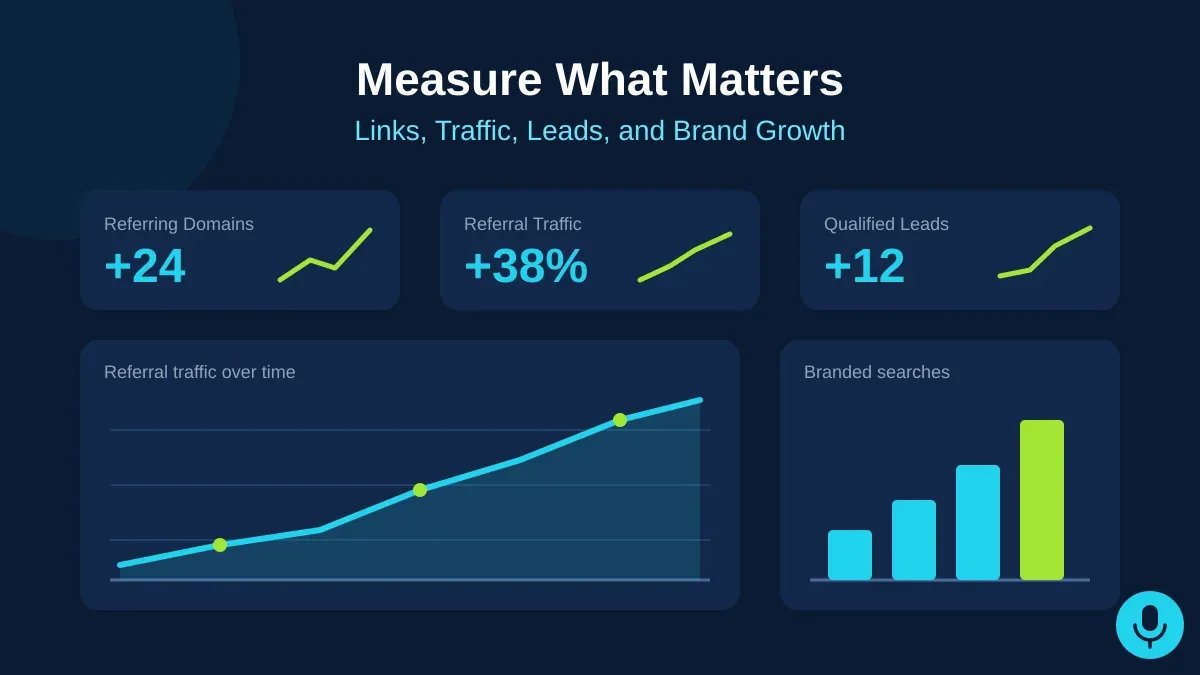
Backlinks are important, but they should not be the only measurement.
Metric | What It Tells You |
|---|---|
Podcast appearances | Outreach effectiveness |
Published episodes | Successful placements |
Referring domains | Link acquisition |
Backlinks | Direct SEO outcome |
Referral traffic | Audience response |
Branded searches | Brand visibility |
Leads | Commercial impact |
Guest relationships | Long-term opportunities |
Evaluate the quality of each link based on relevance, context, website credibility, and potential referral value.
A podcast that produces fewer visitors but several qualified leads may be more valuable than one that generates large amounts of low-quality traffic.
Final Thoughts
Podcast link building is not simply another way to collect backlinks. Its real advantage is that it combines SEO with expert positioning, brand exposure, referral traffic, and relationship building.
The strongest campaigns start with relevance. Find podcasts that already reach your target audience, identify topics where your expertise can add something useful, and pitch a conversation rather than a backlink.
For B2B and SaaS companies, the strategy can become particularly powerful because founders, marketers, product leaders, and SEO professionals already have knowledge that podcast audiences want to hear.
The backlink should be viewed as one outcome of a valuable editorial relationship, not the entire objective.
When the right expert appears on the right podcast and contributes genuinely useful insights, the result can be much broader than a single referring domain. It can create a lasting content asset, introduce the brand to new audiences, generate referral traffic, strengthen authority, and open the door to future industry relationships.
That makes podcast link building a useful addition to a broader SEO strategy, particularly for brands that want to build authority while earning relevant backlinks.
Frequently Asked Questions
What is podcast link building?
Podcast link building is the process of earning backlinks through podcast appearances. Links may appear on episode pages, guest profiles, show notes, or resource sections.
Are podcast backlinks good for SEO?
They can be valuable when they come from relevant, credible websites and appear naturally within useful editorial content. Relevance and context matter more than backlink volume.
How do I get backlinks from podcasts?
Find relevant podcasts, research their previous episodes, pitch a useful topic, appear as a guest, and provide accurate information and resources for the published episode.
How do I find podcasts that accept guests?
Search for podcasts using your industry or expertise combined with phrases such as “podcast guest,” “guest interview,” “be a guest,” and “submit a guest.” Review the podcast website to confirm that it actively features external guests.
Is podcast link building better than guest posting?
Neither is universally better. Guest posting can be effective for content-led backlink acquisition, while podcast appearances add expert positioning, relationships, referral traffic, and brand exposure. Using both can create a stronger overall link-building strategy.