
On this page9
AI search is changing how brands are found. A study by Rand Fishkin at SparkToro reported that over 60% of Google searches now result in zero-click interactions, while AI-generated answers pull in traffic that previously would have led to your website.
Once you know where you stand, our B2B playbook for getting cited by AI covers how to improve those numbers.
A 2025-2026 survey of marketing professionals found that monitoring brand mentions across AI models is a top 5 agency challenge in building digital presence.
This shift means agencies can no longer rely solely on traditional rankings, organic traffic, and search visibility to measure how effectively a brand is being discovered. They also need to understand how often their clients appear in AI-generated responses and which engines are driving those mentions.
As AI search becomes part of the customer research journey, tracking these mentions can provide agencies with a clearer picture of brand visibility beyond conventional search results. The right AI monitoring platform can also help teams identify visibility gaps, compare performance across engines, and turn these insights into actionable SEO and content strategies.
With options ranging from $50-$1,500 per month, there are many growing opportunities, but not all are equal. Differences in pricing, supported AI engines, reporting features, and agency capabilities make it important to evaluate each platform based on your clients' needs and your existing workflow.
Quick Tool Comparison
Platform | AI Models Tracked | Key Feature | Pricing | Best For |
|---|---|---|---|---|
AI Peekaboo | 7 (ChatGPT, Perplexity, Gemini, Google AI Overviews, Google AI Mode, Claude and Microsoft Copilot) | Multi-client dashboard + white-label | From $50/mo | Agencies needing affordable multi-client scale |
Promptwatch | Multiple | Sentiment + competitor monitoring | From $99/mo | Data-driven marketers wanting deep analytics |
Mentions.so | 3–8 (tier-dependent) | Clean UI + industry ranking | From $49/mo | Small teams wanting intuitive tracking |
Trakkr | 8 AI models | Revenue attribution via Google Analytics | From $79/mo | Brands connecting AI traffic to revenue |
LLMrefs | 10+ AI engines | Keyword-centric + geo-targeting | From $79/mo | SEO professionals tracking at keyword level |
1. AI Peekaboo
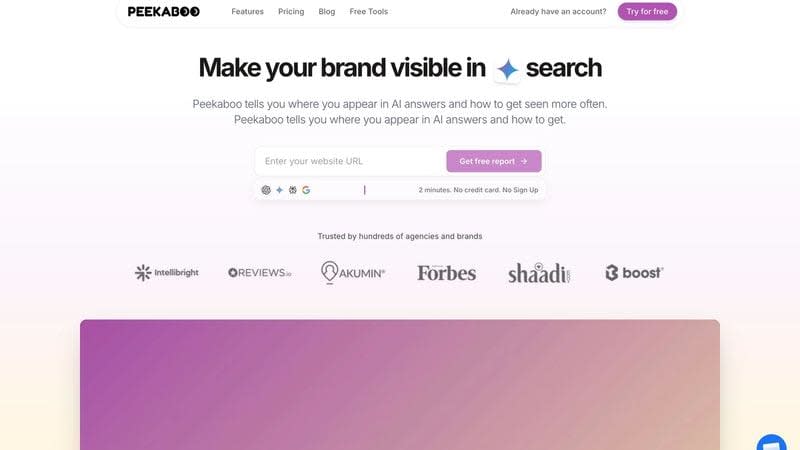
Best for: Agencies looking for white-labeled AI visibility tracking across many clients on an agency-first plan.
Built for agencies and brands looking to track AI visibility for a portfolio of clients, AI Peekaboo tracks brand mentions and citations across five key AI engines – ChatGPT, Perplexity, Gemini, Google AI Overviews, and Google AI Mode, Claude and Microsoft Copilot – all from a singular, multi-client dashboard. As opposed to some competitors built for enterprise businesses, AI Peekaboo was born from an agency-first perspective, offering unlimited team seats, white-labeled reporting and per-client campaigns from its cheapest, introductory tier. AI Peekaboo also plans to add automatic content generation and posting features to close the gap between what the platform can discover and how it should be addressed.
Read our guide on How to Track AI Referral Traffic in GA4 (2026 Guide)
Key strengths:
Tracks 7 major AI engines (ChatGPT, Perplexity, Gemini, Google AI Overviews, and Google AI Mode, Claude and Microsoft Copilot) on all plans.
You can pick how many prompts, which AI models, and how often you can track prompts (Daily, Every 2 Days, Every 3 Days or on a Weekly basis)
Citation source inspection showing where AI answers pull information from
Google Search Console integration for search-demand context
Multi-client workspace built for agencies managing several brands
White-label reporting
Looker Studio connector
Read + Write API
MCP that connects to Claude, ChatGPT and other AI Agents
Pricing: Starter $50/month; Peek $100/month; Grow $200/month. Custom Pricing available for agencies managing 10+ brands
Limitation: AI Peekaboo does not include traditional SEO features or enterprise security controls. Teams needing integrated keyword rank tracking alongside AI visibility will require a separate SEO platform.
Learn how answer engine optimisation helps improve your brand’s visibility in AI-generated answers and search results. Discover practical strategies to optimize content for AI-powered search experiences.
2. Promptwatch

Best for: Data-driven marketers who want advanced analytics and actionable visibility into AI responses.
Promptwatch is designed for marketers and uses brand mentions, sentiment, and competitor analysis to generate structured reports with ready-to-use recommendations (not raw data. While it doesn’t include full competitive intelligence in the mold of tools like BuzzSumo, the analytics layer gives it an edge over less advanced AI trackers. Brands can use their share of voice over time, compete with others across different AI models and see what areas they need to improve their citations in.
Key strengths:
Detailed analytics report
Tracks brand mentions (with sentiment)
Performance monitoring against others across the main AIs
Workflow-oriented recommendations to get things done
Tracks performance of the major AIs.
Pricing: Essential $99/month; Professional $249/month; Business $579/month. Trial available for $1.
Trade-off: However, because of the depth of analytics, the initial learning curve is steeper than with simpler tracking tools. All new users will likely need onboarding time and support to get the most out of the reporting module.
3. Aimentiontracker
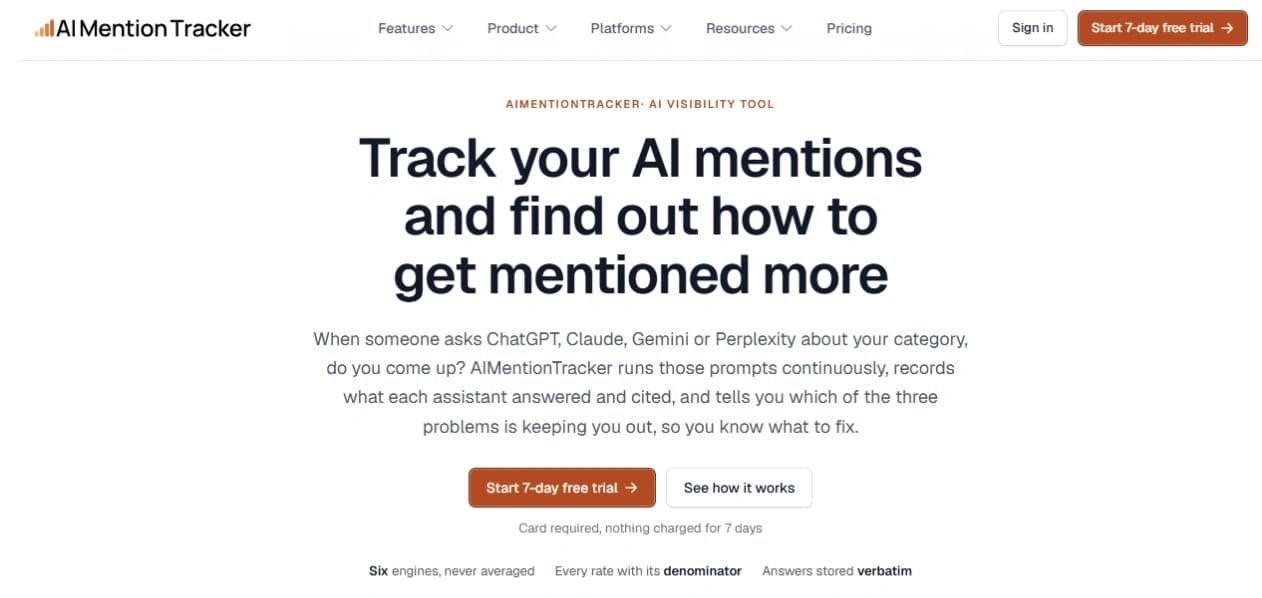
Best for: Brands and agencies that want per-engine AI visibility data and a clear reason behind every gap.
AI visibility tracking tool Aimentiontracker tracks how often your brand is named across six AI engines: ChatGPT, Claude, Gemini, Perplexity, Google AI Overviews and Google AI Mode.
Each engine is reported separately instead of blended into one score, so you can see exactly which assistants name you and which do not. What sets it apart is how it explains an absence. Rather than a flat "not mentioned," it splits the gap into three states: never retrieved, retrieved but not cited, and cited but not named. Each state points to a different fix.
Each rate also includes its sample size, and full answers are stored with their citations, so you can read the actual response instead of guessing from a number.
Key strengths:
Tracks 6 AI engines, with results never averaged across platforms
Three-state gap diagnosis: never retrieved, retrieved but not cited, cited but not named
Sentiment analysis with the evidence behind each mention
Citation tracking, including cases where you are cited but not named
Share of voice against competitors named in the same answers
Custom prompt tracking
Searchable archive of full AI answers with sources
Pricing: Solo $9/month (2 prompts); Starter $19/month (5 prompts); Growth $29/month (9 prompts); Scale $49/month (15 prompts). Yearly billing gives two months free. All plans include all six engines and 5 brands; only the number of prompts and monthly answers differ. 7-day free trial (card required, nothing charged during the trial).
Trade-off: Plans are limited by prompt count and a monthly answer allowance, so brands tracking a large prompt set across many markets will need the higher tiers. Like any AI tracker, results are observations rather than guarantees, since AI answers vary from day to day.
4. Mentions.so
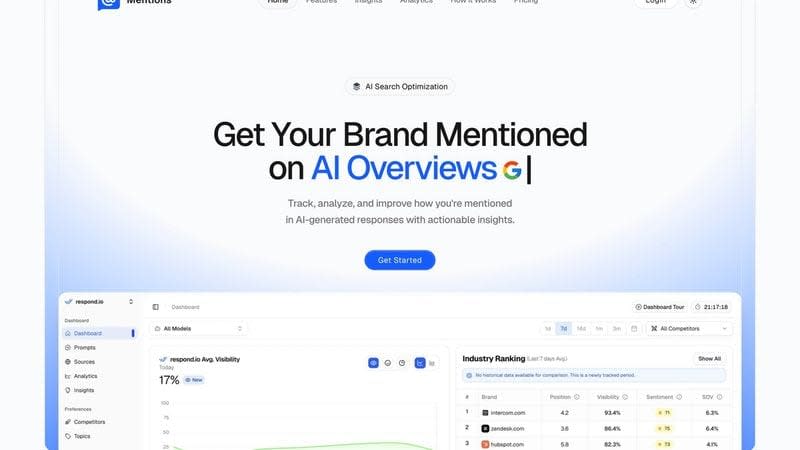
Best for: Small teams & individuals on a budget looking for easy AI visibility detection
Mentions.so is the simplest place to start AI visibility monitoring, designed with a UI for teams without analysts. Users can track the top 3 LLMs on the free plan, with mentions beyond them included in higher plans.
With in-depth rankings showing competitive share of voice within specified industries, brands starting visibility tracking get relevant metrics to gauge performance, regardless of prior industry experience.
Businesses on team tiers access this at the agency tier for $399/mo with all multiple clients.
Key strengths:
Simple, clean user interface; easy to learn with very little training.
Covers the basics for ChatGPT, Gemini, and Claude at a starting level.
Includes Industry rankings and competitor tracking.
Sentiment analysis comes standard.
Offers an agency plan, ideal for working with multiple clients.
Pricing: Starter $49/month; Pro $99/month; Business $199/month; Agency $399/month.
Trade-off: While a clean beginner plan is offered for as low as three LLMs, this would still cause you to miss tracking a brand's reach among users who work with the wider spectrum of AI models out there. The tool is still fairly undeveloped compared to older tools.
5. Trakkr

Best for: Brands and agencies in search of an “AI visibility to actual dollars” answer
Trakkr is distinctive in that it provides revenue attribution. It connects your Google Analytics with your AI “citation traffic,” making it possible to add revenue conversions into the blend, a factor most AI presence tools don’t track. Trakkr consists of in-depth measurements of 8 alternative ways AI presents search, “perception studying”, site efficiency perception, and automatic site optimization recommendations.
These capabilities make it a useful option alongside other AI automation tools for improving search visibility and marketing performance. The software includes many features relevant to company shoppers, including white-label studies and a free tier, giving customers a chance to get started with Trakkr at no cost.
The income attribution choices particularly suit e-commerce manufacturers, as well as corporations focused on performance-based marketing endeavors.
Key strengths:
AI-to-revenue attribution via Google Analytics integration
Tracks 8 AI models, including major platforms
Citation tracking and perception analysis
Automatic site optimization suggestions
White-label agency reporting
Free plan available (1 brand, 5 queries)
Pricing: Free plan; Growth $79/month; Scale $399/month.
Trade-off: The UI can feel cluttered compared to cleaner, less busy alternatives. The free tier is limited to 1 brand and 5 queries; therefore, it's difficult to assess thoroughly without switching to a higher plan.
6. LLMrefs

Best for: SEOs who want to measure AI visibility at a keyword level while getting the widest engine reach
LMrefs approaches the problem at the keyword level rather than the prompt level, making it the most organic for SEO teams already used to a keyword workflow. They currently track your brand and keyword rankings across more than 10 AI engines, the most in our comparison, with geo-targeting available. The familiar interface means there won’t be a steep learning curve if your team is used to tracking rank tracker tools, and the price stays competitive given how many engines you get.
Key strengths:
Tracks 10+ AI engines, broadest coverage in this comparison
Keyword-centric approach familiar to SEO professionals
Geo-targeting capabilities included
Affordable pricing relative to feature set
Straightforward interface with low onboarding friction
Pricing: Starter $79/month; Pro $159/month; Business $399/month.
Trade-off: The keyword-level methodology may not capture brand visibility patterns that emerge at the prompt or conversation level. Teams focused on how AI models discuss their brand in open-ended queries may find prompt-level trackers more informative.
Selection Criteria
Price is not an indicator of fit on its own. $50-a-month, 5-engine tool with white-labeled reporting might well exceed $500-a-month, 10-client agency dashboard, if the latter isn’t built with multi-client infrastructure.
Engine-coverage needs differ by audience. Brand consumers who are “overrepresented” users of Google products need coverage for both Google AI Overviews and Google AI Mode, and some platforms track one but not both. Multi-language global teams need geo-targeted reporting.
Agency infrastructure distinguishes between tools built for clients and those built for single brands. White-label reporting, client dashboards beyond a single panel, and seat-licensing policies distinguish platforms built to scale with agencies from those destined for replacement once a brand outgrows its single-brand purpose.
Attribution depth varies. 90% of tools measure only visibility, mentions, and citations, without linking them to actual traffic or revenue. Teams working on both brand visibility and performance marketing need strong analytics integrations.
Reporting frequency matters for operationality. Visibility events may need to be addressed daily, not weekly.
Conclusion
For agencies managing clients on constrained, competitive budgets, AI Peekaboo offers the best mix of multi-client capabilities, engine breadth, and price.
Its white-label dashboard, team seats, and five engines are essential for an agency without the enterprise-tier costs. Promptwatch and Trakkr, for their part, exist for more niche use cases: revenue reporting and advanced analytics.
Ultimately, the best platform depends on what an agency needs to monitor and how deeply it wants to integrate AI visibility data into its reporting process. Agencies managing multiple brands will generally benefit most from tools that combine broad engine coverage with straightforward reporting and collaboration features.
As AI search continues to influence how users discover and evaluate brands, monitoring visibility across these platforms is likely to become a more regular part of digital marketing workflows.
Choosing a tool that balances coverage, usability, and cost can therefore help agencies build a more practical approach to measuring and improving AI-driven brand visibility.