
On this page10
- Why SEO for Forex Is Different From Other Niches?
- Forex Keyword Strategy Before You Build Links
- Link Building Tactics That Work for Forex Sites
- On-Page SEO Factors That Amplify Your Forex Backlinks
- Measuring the ROI of Forex Link Building
- Common Forex Link Building Mistakes to Avoid
- Content Types That Attract Forex Backlinks Naturally
- Building Authority in Regulated Forex Markets
- Conclusion
- Frequently Asked Questions
Table of Contents
Forex is one of the most fiercely competitive niches on the internet, where top brokers, signal providers, and trading educators are all fighting for the same high-intent organic traffic. Getting your forex website to rank takes more than solid on-page optimization; it requires a deliberate, well-structured link-building approach that meets both search engine standards and strict financial industry guidelines.
This guide walks you through the core pillars of SEO and link building for forex, so you can build sustainable authority that actually converts.
Why SEO for Forex Is Different From Other Niches?
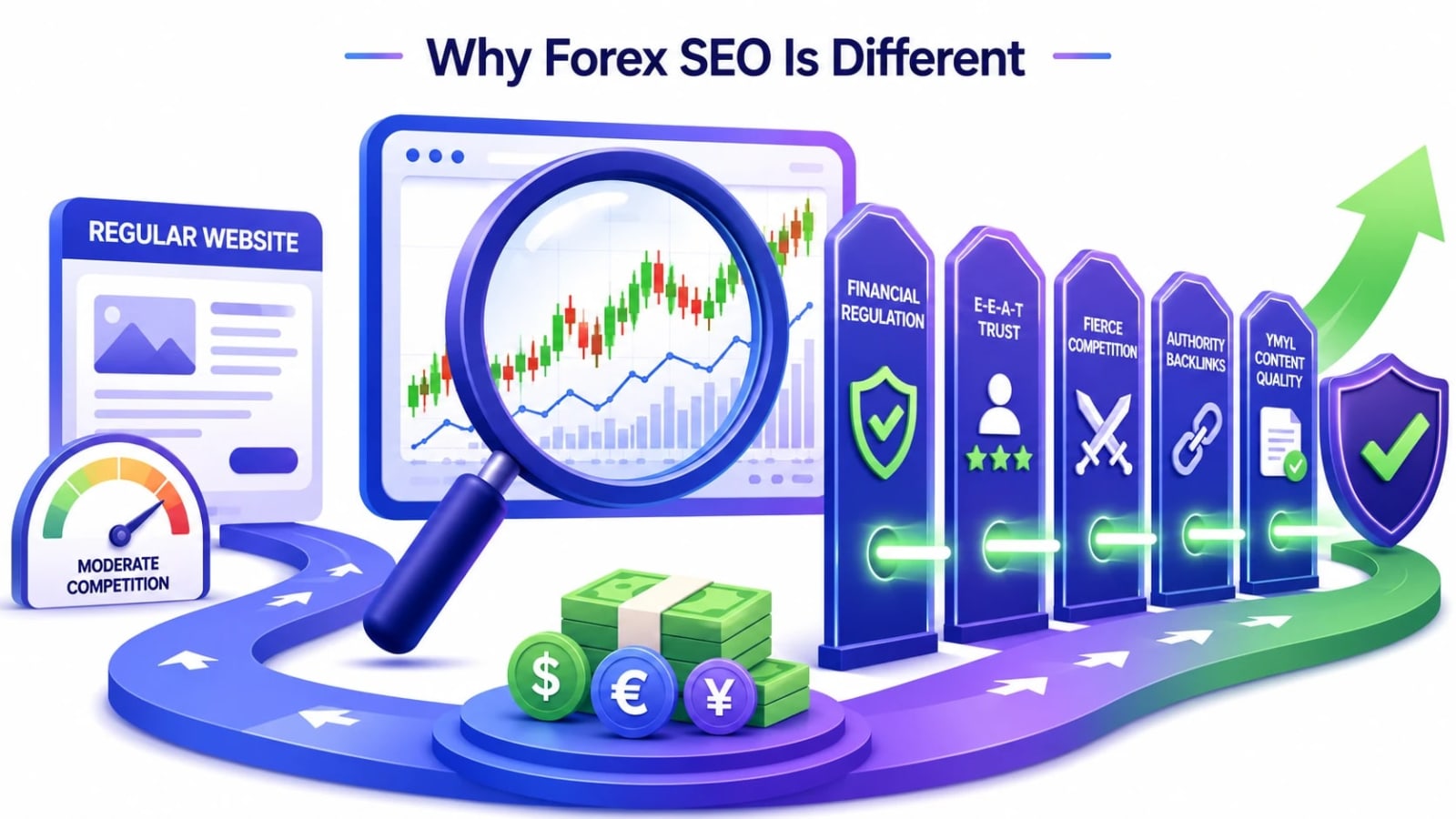
If you have worked in SEO across multiple industries, you already know that tactics that perform well in one niche can fall flat in another. Forex, however, presents a unique set of challenges that go far beyond typical competitive verticals.
a. Google’s YMYL Classification Changes Everything
Forex content falls squarely under Google’s “Your Money or Your Life” (YMYL) category. This classification means Google applies significantly higher quality thresholds when assessing content in the financial trading space. Pages that offer trading advice, broker reviews, or investment-related guidance are held to a stricter standard of Experience, Expertise, Authoritativeness, and Trustworthiness (E-E-A-T).
For forex websites, this means generic content farms or thin affiliate pages will rarely rank, regardless of how many backlinks point to them. Google wants to see demonstrated expertise, credible authorship, and links coming from sources that are themselves authoritative within the financial publishing space.
b. Regulatory and Compliance Pressures
Forex brokers and trading platforms operate under strict regulatory frameworks that vary by country, including oversight from bodies such as the FCA, ASIC, CySEC, and others. These compliance requirements affect not just the content you can publish, but also who is willing to link to you. Many high-authority financial publishers and news outlets are cautious about linking to forex brands that lack visible regulatory credentials or transparent ownership.
That is why building trust signals on your website, such as regulatory badges, clear terms of service, and verifiable team bios, isn't optional. Without them, your backlink outreach will face higher rejection rates from quality publishers.
c. The Competition Is Capitalized and Aggressive
Major forex brokers invest millions annually in SEO and content. They have dedicated link-building teams, sponsored content budgets, and long-established domain authority. Competing with them requires a focused niche strategy rather than a broad assault on the most generic forex keywords. Smaller forex brands often succeed by targeting underserved sub-niches, specific trading instruments, or regional markets where the giants have thinner coverage.
Forex Keyword Strategy Before You Build Links
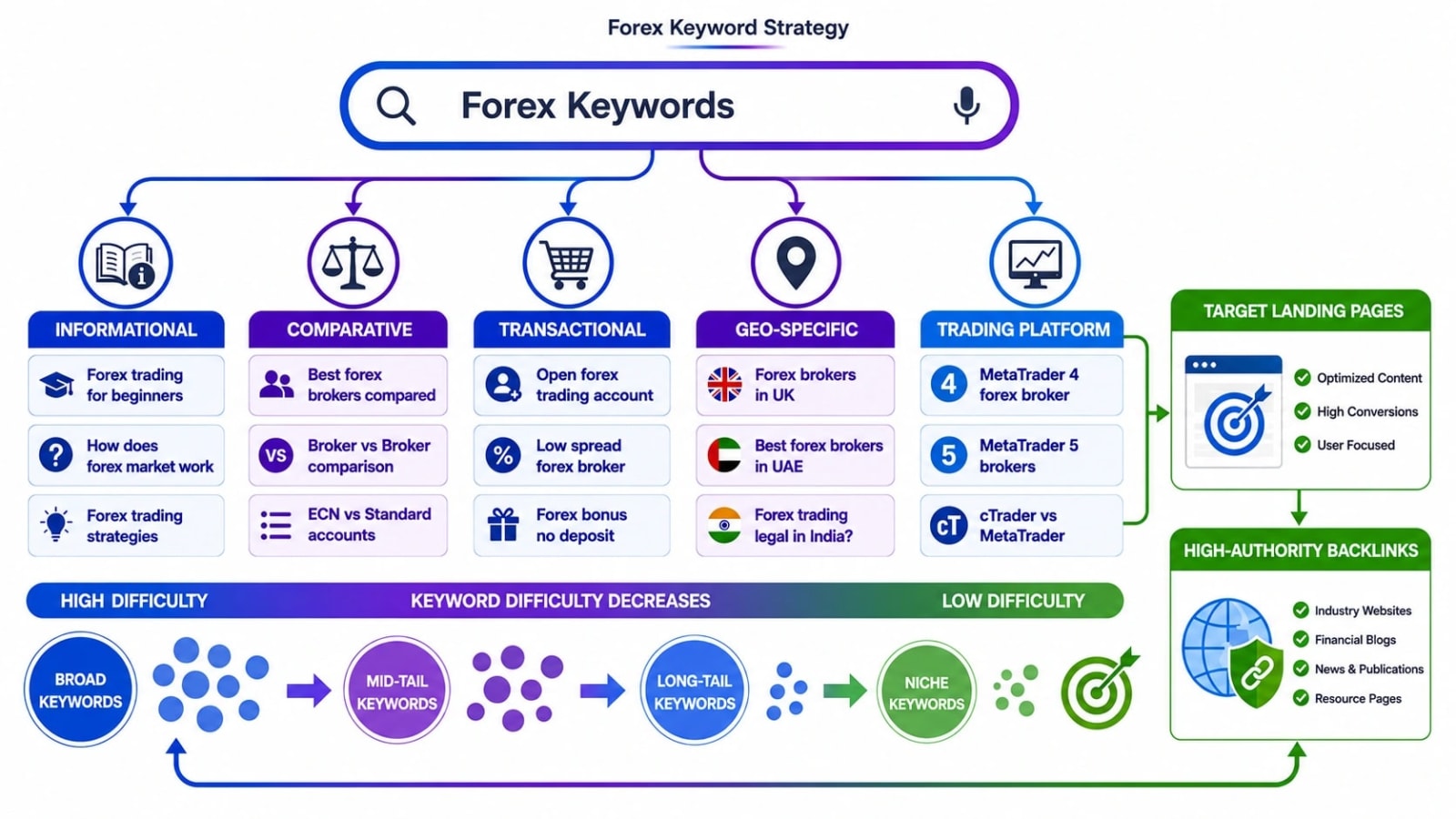
Many forex websites make the mistake of jumping into link acquisition before they have a clear keyword strategy. Link building amplifies what already exists on your site, so if your pages are targeting the wrong keywords or are poorly optimized, backlinks alone will not move the needle significantly.
a. Mapping Keywords to Search Intent
Forex keywords fall into several distinct intent categories, and each requires a different content approach. Informational queries such as “what is a pip in forex” attract beginners looking for education. Comparative queries such as “best forex brokers for US traders” signal a user who is close to making a decision. Transactional queries such as “open forex trading account” indicate readiness to convert.
Your link-building efforts should prioritize pages that target comparative and transactional intent, since these carry the highest commercial value. However, informational content plays a critical supporting role because it attracts natural editorial links from other publishers who reference your explanations or data.
b. Finding Low-Competition Opportunities in a High-Competition Niche
Rather than targeting “forex trading” head-on, successful forex SEO strategies look for keyword clusters with lower difficulty scores and strong conversion potential. Examples include geo-specific terms like “forex brokers in South Africa,” instrument-specific queries like “gold trading forex strategy,” or platform-specific searches like “MetaTrader 5 forex brokers.” These clusters allow you to build topical authority incrementally while earning backlinks in a more targeted, cost-efficient way.
c. Aligning Keyword Targets With Your Link-Building Plan
Once you have identified your priority keyword clusters, map each cluster to specific pages, then build a link acquisition plan around those pages. Links to your broker review pages should come from finance and investment publications. Links to your educational content can come from trading blogs, YouTube channel descriptions, or online trading communities. This alignment between keyword targets and link sources is what separates a strategic campaign from random outreach.
Link Building Tactics That Work for Forex Sites
Forex is one of the most competitive verticals in online publishing, so generic link-building approaches rarely move the needle. The sites that climb in search rankings earn backlinks from finance publishers, regulatory-adjacent resources, and trading education portals.
Guest posting on established finance blogs remains one of the most reliable methods, provided the host site carries real editorial standards and an engaged audience. A link from a respected trading publication carries far more weight than dozens of links from low-quality directories.
Digital PR is another tactic that consistently delivers for forex brands. Publishing original research, such as currency volatility reports, retail trader sentiment data, or pip movement analyses, gives journalists and bloggers a genuine reason to cite your domain. This type of content attracts editorial links naturally, often without direct outreach.
When you combine strong data-driven assets with targeted outreach to finance desks and economic news sites, the link acquisition rate improves significantly. Broken link building also works well in this niche, particularly targeting outdated forex guides on university finance departments or legacy trading portals.
Here is a quick breakdown of the most effective link building tactics for forex sites and how they compare on effort versus impact:
Tactic | Effort Level | Link Quality | Best For |
|---|---|---|---|
Guest posting on finance blogs | Medium | High | Authority building |
Digital PR with original data | High | Very High | Editorial links at scale |
Broken link building | Medium | Medium to High | Quick wins on aged domains |
HARO and journalist queries | Low to Medium | High | Passive authority growth |
Niche directory submissions | Low | Low to Medium | Citation consistency |
Prioritize sites with a Domain Rating above 50 and genuine organic traffic
Avoid forex-specific link farms, which Google has penalized heavily in past algorithm updates
Anchor text diversity matters; mix branded, partial match, and naked URL anchors
Focus outreach on Tier 1 financial markets publications when targeting international forex audiences
On-Page SEO Factors That Amplify Your Forex Backlinks
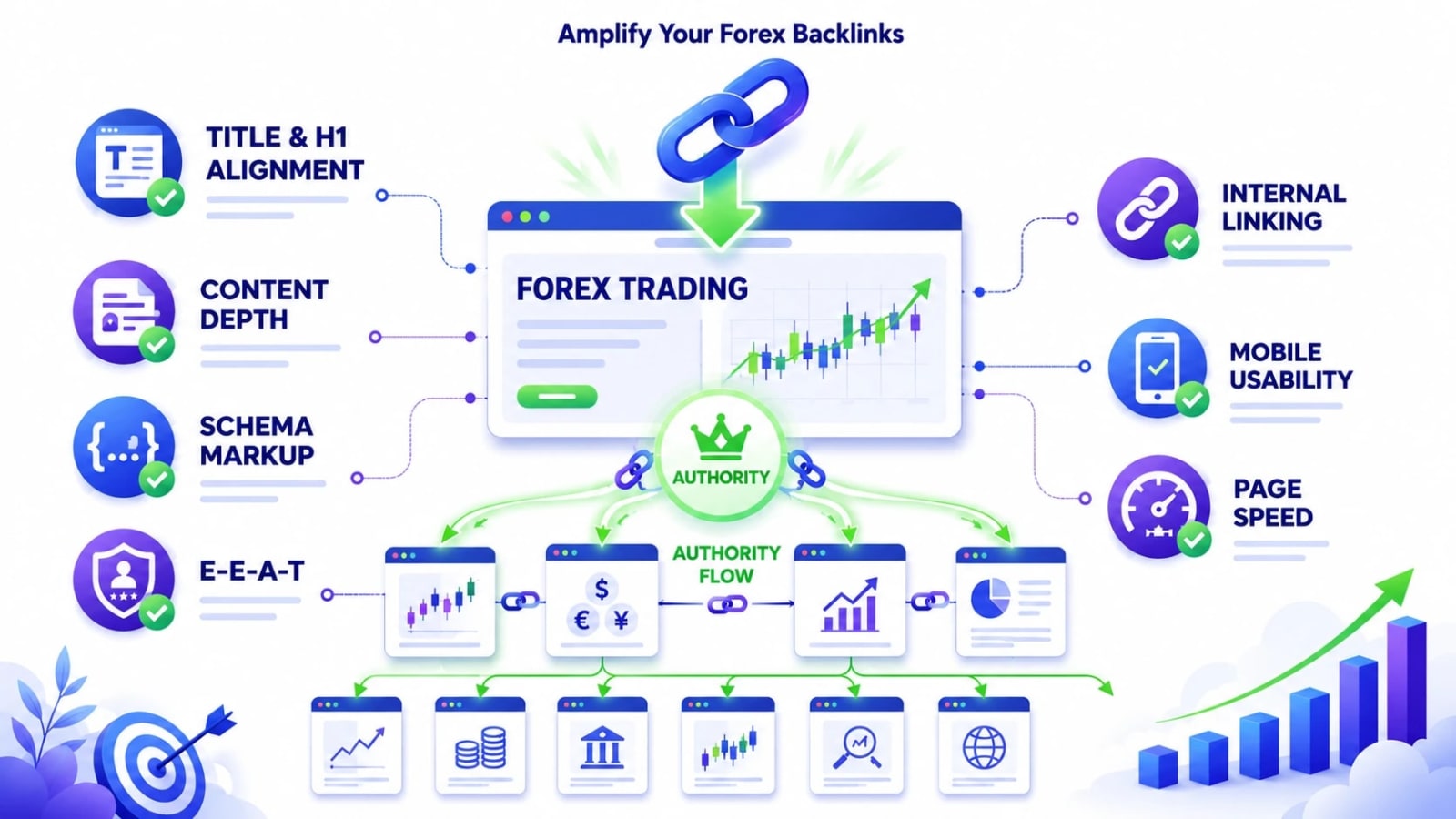
Backlinks do not work in isolation. The on-page signals of the page receiving those links determine how much ranking value actually passes through. For forex sites, this means the target page needs to demonstrate topical depth, proper keyword placement, and a clear content structure that satisfies both users and crawlers.
If a high-authority finance site links to a thin or poorly structured forex page, Google’s algorithms discount that link's value considerably. Building strong on-page foundations before investing heavily in outreach is simply the smarter sequencing.
Internal linking is a particularly underused amplifier in the forex space. When a new backlink lands on one page, connecting that page internally to other key trading content spreads the authority across your site’s architecture.
For example, a backlink pointing to a forex broker comparison page should have internal links flowing toward currency pair guides, risk management articles, and platform tutorial pages. This creates a web of topical relevance that reinforces your authority on trading-related queries.
Page speed and mobile usability are also critical, since many retail forex traders access content via mobile devices.
The following on-page elements have the greatest impact on how effectively your backlinks convert into rankings:
Title tag and H1 alignment: The primary keyword should appear naturally in both without keyword stuffing
Content depth: Pages targeting competitive forex terms typically need 1,500 words or more to outrank established financial publishers
Schema markup: Financial article schema and FAQ schema help search engines understand your content format
E-E-A-T signals: Author bios with trading credentials, cited sources, and last-updated timestamps all strengthen trust in YMYL verticals
Core Web Vitals: LCP under 2.5 seconds and low CLS scores are increasingly important ranking factors for finance pages
Measuring the ROI of Forex Link Building
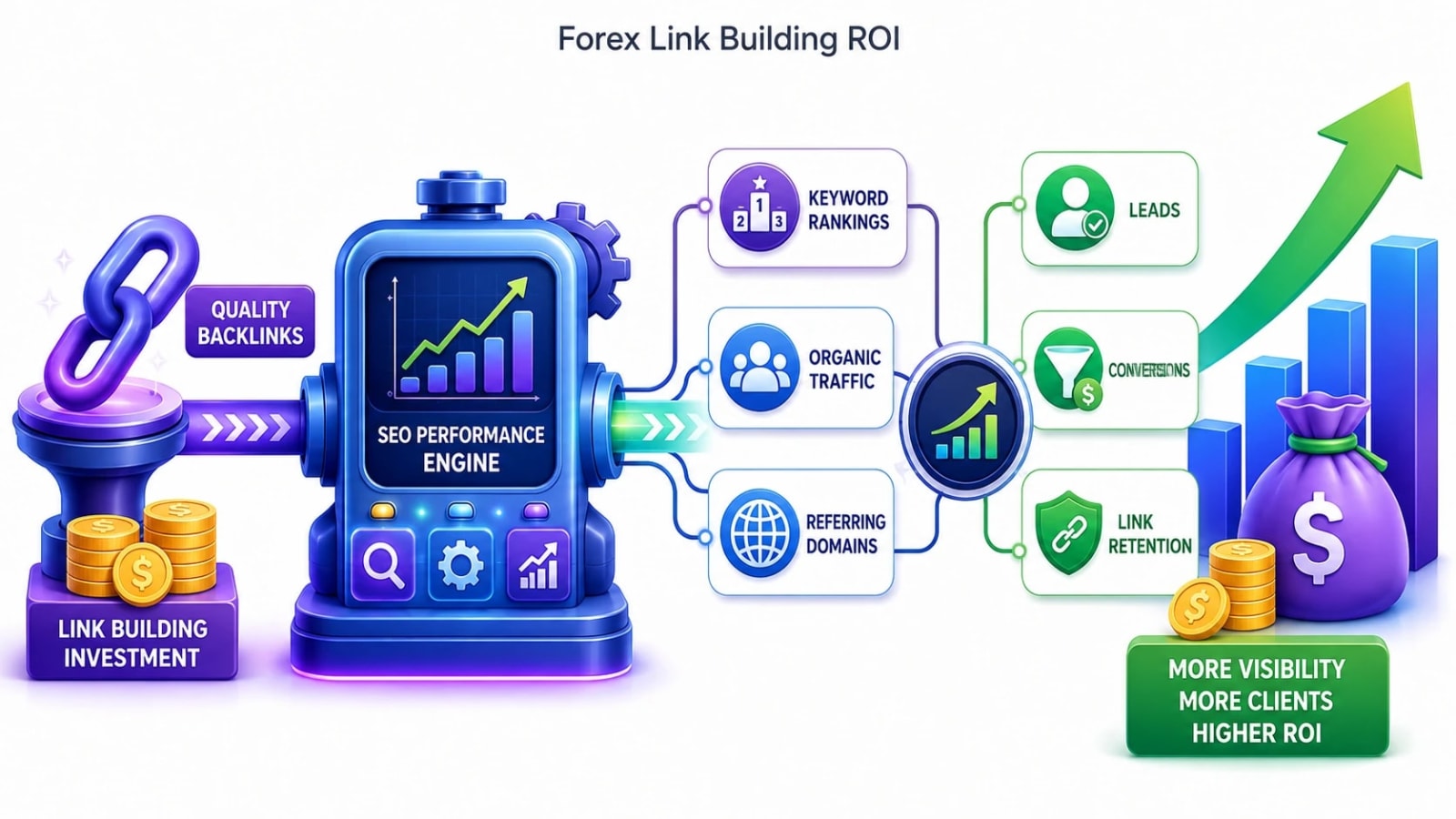
One of the biggest mistakes forex marketers make is treating link building as a set-and-forget activity without tracking what each link actually contributes to business outcomes. ROI measurement in forex SEO needs to go beyond vanity metrics as Domain Rating increases.
The real indicators are organic traffic growth to target pages, movement in keyword rankings for high-intent terms, and ultimately, lead generation or account sign-up conversions that originate from organic search. Setting up proper conversion tracking in Google Analytics before starting a link campaign is non-negotiable.
Attribution is more nuanced in forex than in most other industries. A trader might discover a broker through an organic search result, leave, return via a retargeting ad, and convert weeks later. This means organic channels are often undervalued in last-click attribution models.
Using assisted conversion reports alongside position tracking tools gives a more accurate picture of how link building contributes across the full acquisition funnel. Tracking keyword rank changes at 30-, 60-, and 90-day intervals after new links are acquired provides a clearer signal of what is working.
SEO monitoring lets marketers track key performance changes, identify ranking trends, and evaluate whether their SEO campaigns are producing measurable results.
Use the table below as a reference framework for evaluating link building performance across key metrics:
Metric | What to Track | Target Benchmark | Tracking Tool |
|---|---|---|---|
Keyword ranking movement | Position changes for target terms | Top 10 within 90 days for mid-competition terms | Ahrefs, SEMrush |
Organic traffic growth | Sessions to linked pages | 15 to 30% increase within 60 days | Google Analytics 4 |
Referring domain growth | New unique linking domains per month | Consistent monthly additions from DR 50 plus sites | Ahrefs |
Conversion rate from organic | Sign-ups or leads from organic sessions | Varies by offer; establish a baseline in month one | GA4 with goal tracking |
Link retention rate | Percentage of links still active after 6 months | Above 85% indicates quality placements | Ahrefs lost links report |
Common Forex Link Building Mistakes to Avoid
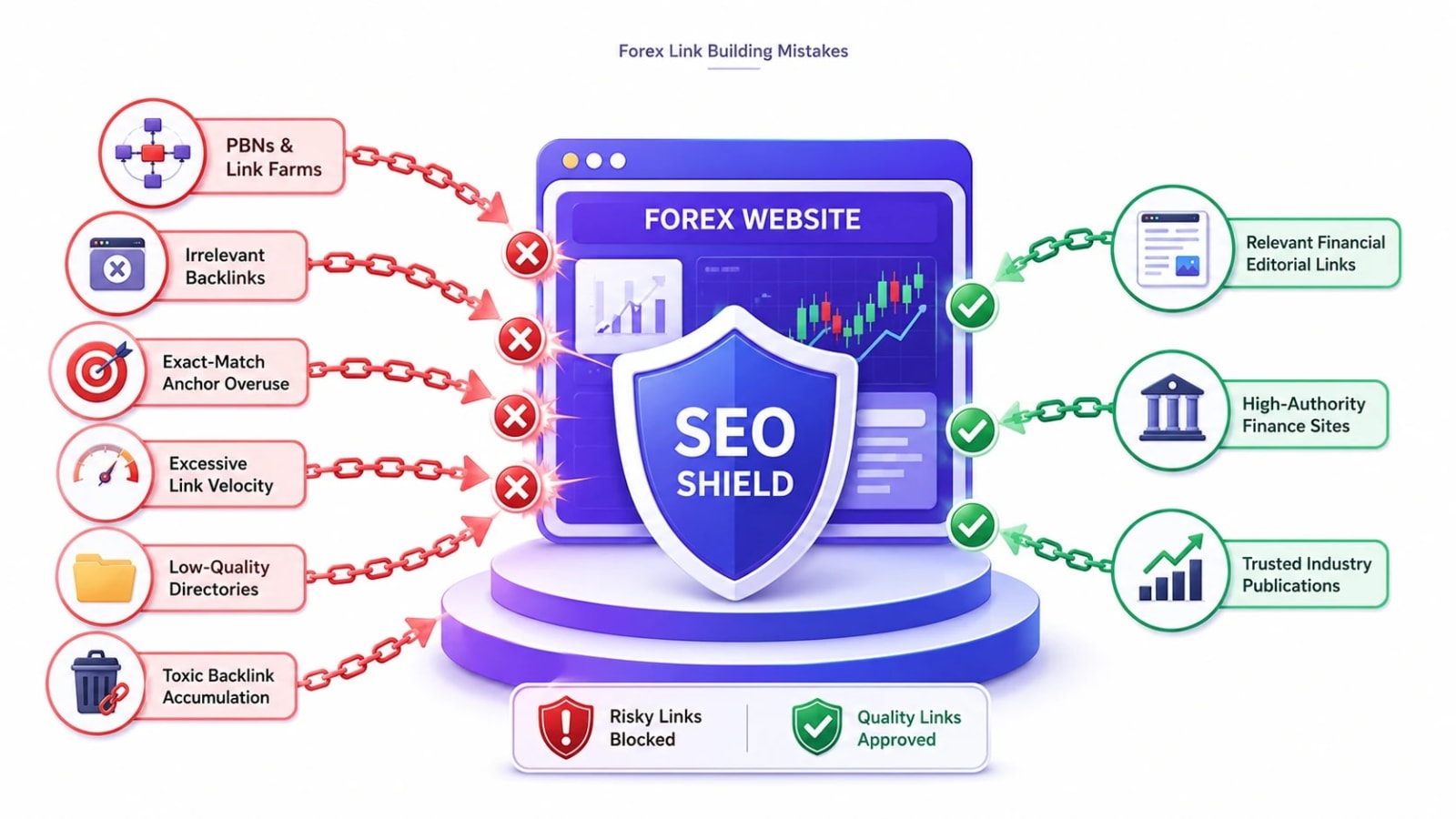
Even experienced SEO teams make costly errors when building links for forex sites. Google’s quality raters pay close attention to YMYL niches, and forex sits firmly in that category. One misstep can trigger a manual penalty or an algorithmic demotion that takes months to recover from.
Understanding where campaigns go wrong is just as important as knowing what to do right. Here are the most damaging mistakes forex marketers make with link building:
Buying links from link farms or PBNs: Private blog networks are heavily scrutinized in financial niches. Google’s spam team actively targets them, and forex sites are frequent victims of these sweeps.
Ignoring link relevance: A backlink from a cooking blog adds little value for a forex broker. Relevance to finance, trading, or economics is non-negotiable.
Over-optimizing anchor text: Repeatedly using exact-match anchors like “best forex broker” is a clear manipulation signal. A natural anchor profile mixes branded, generic, and partial-match terms.
Chasing volume over quality: One link from a respected financial publication outperforms fifty links from low-authority directories. Always prioritize domain authority and editorial standards.
Neglecting link velocity: Acquiring hundreds of links in a short window looks unnatural. Steady, consistent growth is far safer and more sustainable for forex sites.
Skipping link audits: Toxic backlinks accumulate over time, especially in competitive niches where negative SEO is a real threat. Regular audits protect your site’s standing.
Avoiding these mistakes protects your investment and keeps your forex site building authority that compounds over time, rather than collapsing under the weight of a penalty.
Content Types That Attract Forex Backlinks Naturally
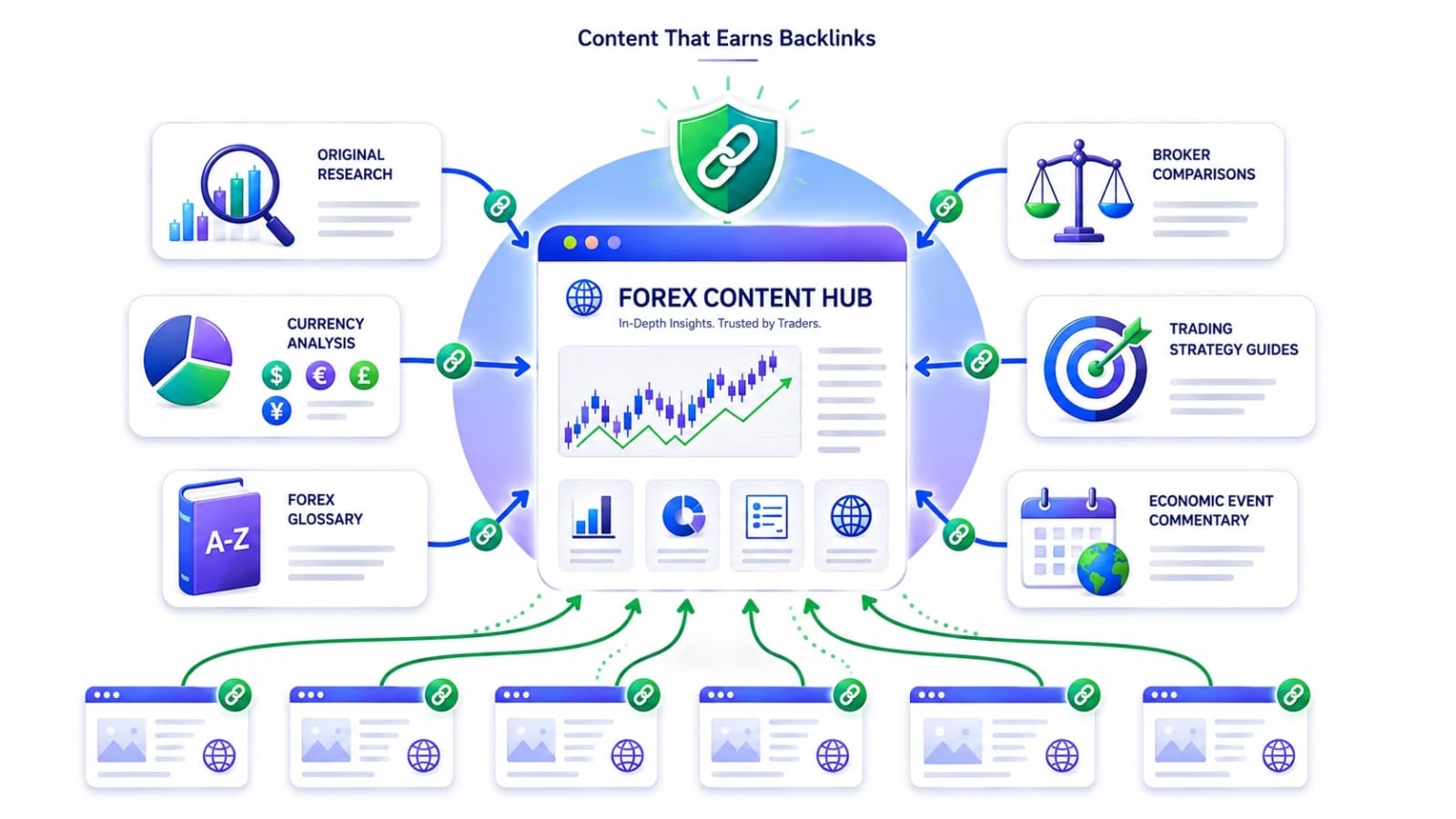
The most durable link-building strategy is one where content does much of the heavy lifting. When you publish resources that traders, journalists, and finance bloggers genuinely want to reference, backlinks arrive with far less outreach effort. For forex sites, certain content formats consistently earn editorial mentions and organic links.
Currency pair analysis reports: In-depth breakdowns of major or exotic pairs, backed by data, attract links from trading communities and financial news outlets.
Forex glossaries and terminology guides: Beginners constantly search for definitions. A well-structured glossary becomes a reference page that other sites link to repeatedly.
Original research and surveys: Polling retail traders about their habits or compiling proprietary data gives journalists a reason to cite your site.
Broker comparison tools and tables: Interactive or regularly updated comparison content earns links from review sites and affiliate marketers who find your data useful.
Trading strategy explainers: Step-by-step guides covering strategies like carry trades, scalping, or breakout trading attract links from educators and forum moderators.
Economic calendar content: Commentary on major economic events, such as central bank decisions or non-farm payroll releases, generates timely link opportunities from news aggregators.
Content Type | Link Potential | Best For |
|---|---|---|
Original Research | Very High | News outlets, finance blogs |
Forex Glossary | High | Educational sites, forums |
Broker Comparison | High | Affiliate and review sites |
Strategy Guides | Medium | Trading communities, blogs |
Economic Event Commentary | Medium | News aggregators, newsletters |
Publishing content that serves a genuine informational need is the most Google-friendly approach to link acquisition. In a niche as competitive as forex, content quality also signals brand trust to both users and potential linking partners.
Building Authority in Regulated Forex Markets
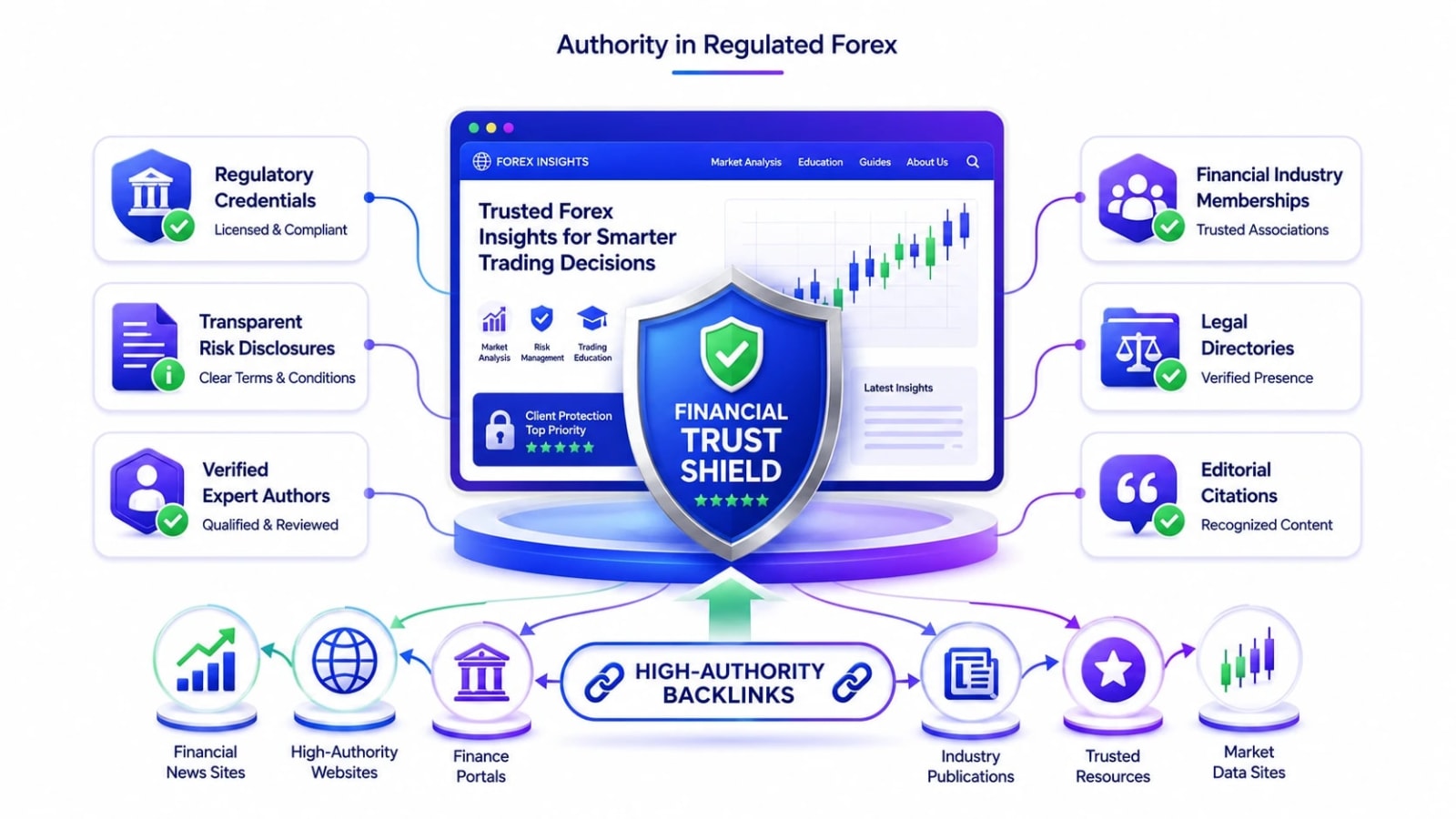
Regulatory compliance is not just a legal obligation for forex brands; it is also an SEO advantage. Sites that visibly demonstrate trustworthiness through licensing disclosures, risk warnings, and transparent ownership tend to attract more authoritative links from partners who vet their sources carefully.
Here is how forex brands can build authority while staying inside regulatory boundaries:
Display regulatory credentials prominently: Licensing information from bodies like the FCA, ASIC, or CySEC on every page signals credibility to both users and potential link partners.
Publish transparent risk disclosures: Sites that include clear risk warnings are treated more favorably by financial journalists who need trustworthy sources to cite.
Pursue citations in regulatory and legal directories: Listings in financial watchdog databases and legal directories carry strong authority signals for YMYL sites.
Contribute to regulated industry bodies: Sponsoring events or contributing to publications produced by recognized financial associations builds both links and brand authority.
Feature verifiable author credentials: Google values expertise signals heavily in financial content. Authors with verifiable trading or finance credentials attract more editorial links.
Trust Signal | Impact on Link Building | Difficulty to Implement |
|---|---|---|
Regulatory License Display | High | Low |
Credentialed Authors | High | Medium |
Industry Body Membership | Medium | Medium |
Risk Disclosures | Medium | Low |
Regulatory Directory Citations | Medium | Low |
Authority in regulated markets is earned slowly, but it compounds. The forex brands that invest in genuine trust signals today will find it significantly easier to attract high-quality editorial links tomorrow, without relying on tactics that carry long-term risk.
Conclusion
Link building and SEO for forex is a long game that rewards patience, precision, and a genuine commitment to quality. The niche is competitive, heavily regulated, and closely scrutinized by Google’s quality systems, so shortcuts tend to backfire badly.
The most successful forex brands build authority by combining relevant, high-quality backlinks with credible on-page content, strong trust signals, and a clear understanding of what their target audience is actually searching for. Every element of the strategy needs to work together, from keyword selection to content production to outreach.
If your forex brand is ready to build a backlink profile that drives real organic growth, start with a focused, niche-aware strategy built on editorial quality rather than volume. Working with a specialist link-building team that understands the nuances of YMYL niches, like Marketing Lad, can accelerate that process significantly.
Start by auditing your current backlink profile, identifying your strongest content assets, and targeting the financial publications and communities where your audience already spends time. The results will follow.
Frequently Asked Questions
Most forex sites begin seeing measurable ranking improvements within three to six months of a consistent link building campaign. In highly competitive currency trading keywords, it can take nine to twelve months for significant organic traffic gains, depending on your domain’s existing authority and content quality.
Aim for backlinks from sites with a Domain Authority or Domain Rating above 50, especially from finance, trading, or economics-related publications. Relevance matters as much as raw authority scores in YMYL niches, so a highly relevant DR 45 finance site will often outperform a generic DR 70 site.
Yes, when done correctly. Guest posting on genuine, editorially managed financial publications remains one of the most effective forex link-building tactics. The key is targeting sites with real audiences, strong editorial standards, and topical relevance to trading or finance, rather than sites that accept any submission.
There is no fixed number, as it depends heavily on keyword competitiveness and your competitors' authority. Analyzing the backlink profiles of the top three ranking pages for your target keywords gives the most accurate benchmark. Quality and relevance consistently matter more than total link count in forex SEO.
Yes, and the consequences in this niche can be severe. Google applies heightened scrutiny to financial sites under its YMYL guidelines. Tactics like buying links, using private blog networks, or building links at an unnatural velocity can trigger manual actions or algorithmic penalties that are difficult and time-consuming to recover from.