SEO for lead generation is no longer a nice-to-have strategy. It is a core growth engine for businesses that want to attract qualified prospects without paying for every click. When executed correctly, SEO drives compounding returns, putting your brand in front of buyers at the exact moment they are searching for solutions like yours.
Why SEO Is One of the Highest-ROI Lead Generation Channels
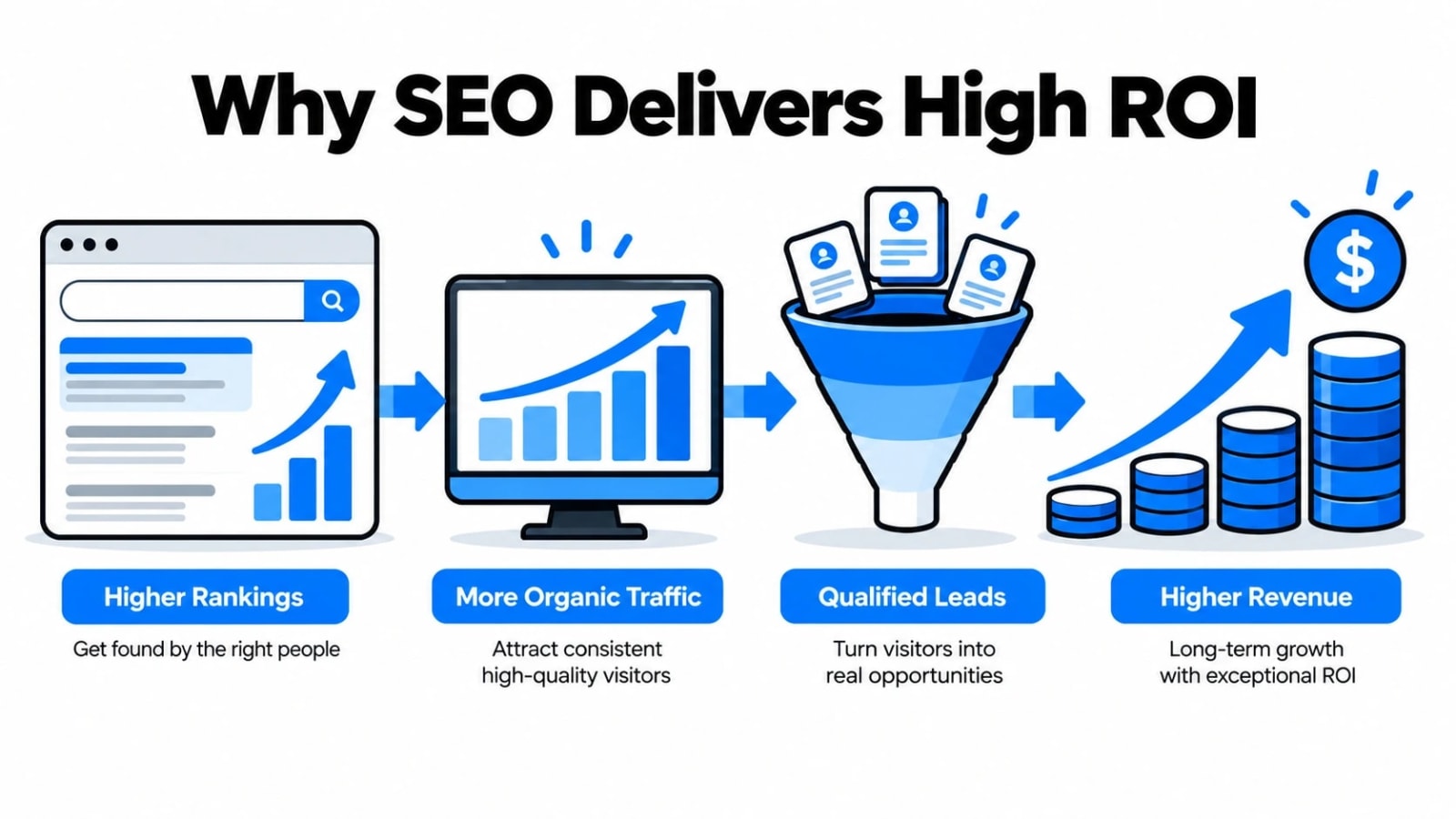
Paid advertising delivers fast results, but the moment your budget stops, so does your traffic. SEO works differently. The content you publish today, the backlinks you earn this quarter, and the technical optimizations you implement right now continue generating leads months and even years down the line. That compounding effect is what makes organic search one of the strongest return-on-investment channels available to any business.
Consider what happens when well-optimized content ranks on the first page of Google for a high-intent keyword. It captures consistent traffic from searchers who are actively looking for information, comparisons, or vendors in your space. Those visitors cost you nothing per click after the initial investment in content and link building. Compare that to paid search, where every single click carries a price tag that tends to rise over time as competition increases.
The data backs this up. Studies consistently show that organic search drives more traffic than any other single channel for most websites. More importantly, organic visitors tend to convert at strong rates because they arrive with intent. They searched for something specific, found your content, and engaged with it on their own terms. That is a fundamentally different dynamic than interrupting someone with a display ad.
There is also the trust factor. Ranking organically signals authority and credibility in a way that paid placements simply cannot replicate. Buyers, particularly in B2B markets, are sophisticated. They recognize paid ads for what they are, and they often skip past them to review organic results first. Earning those top organic positions communicates that your business is a recognized, trustworthy source in your industry.
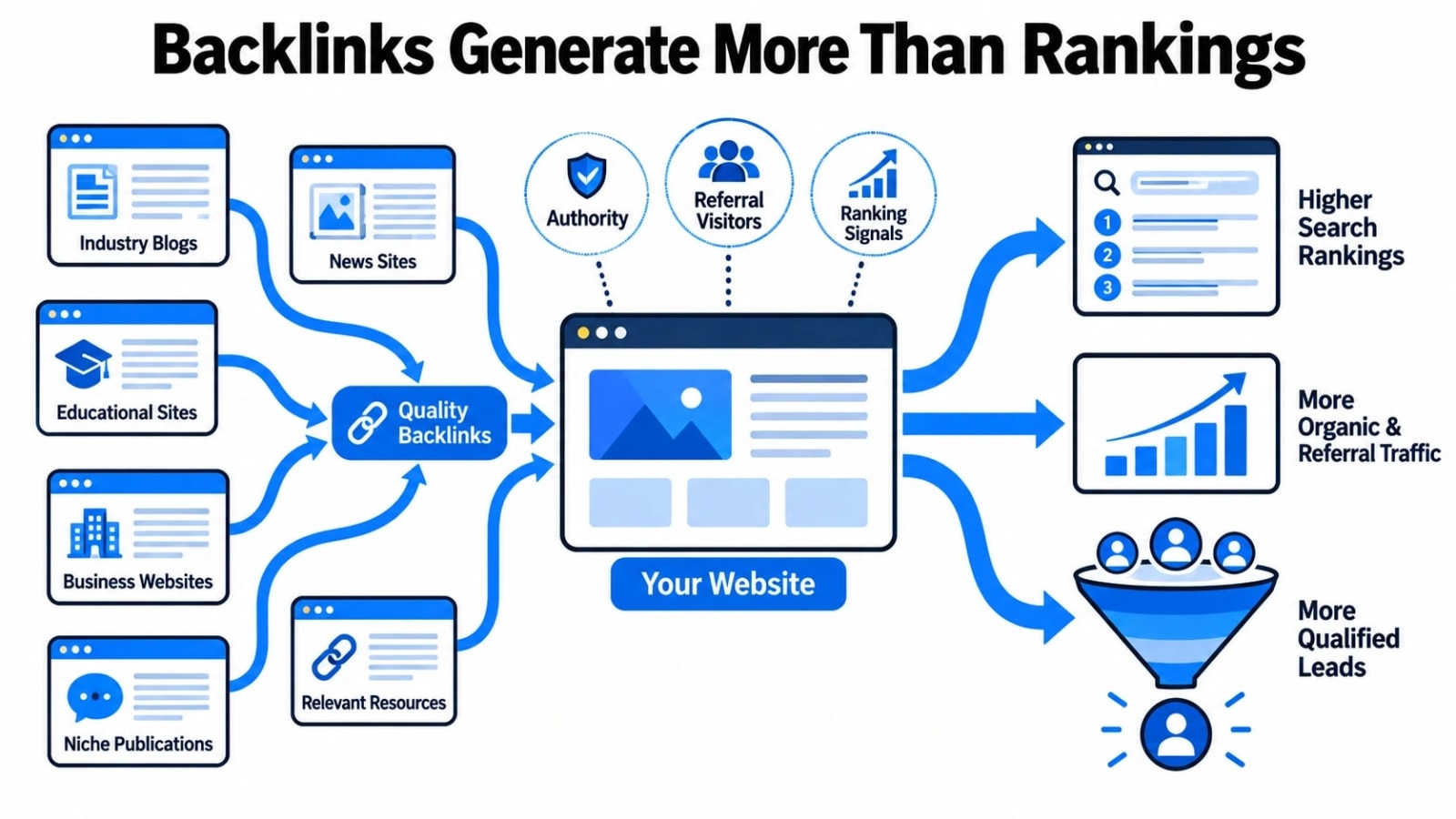
For companies investing in link building as part of their SEO strategy, the ROI case becomes even stronger. High-quality backlinks from authoritative domains do not just boost rankings. They send referral traffic from relevant audiences, expand brand visibility, and build the kind of domain authority that makes every future piece of content rank faster and more effectively.
To understand SEO for Lead Generation: Strategies That Work, it helps to compare what you see in the data and what action you need to take next.
Keyword Strategy Built Around Lead Intent, Not Just Search Volume
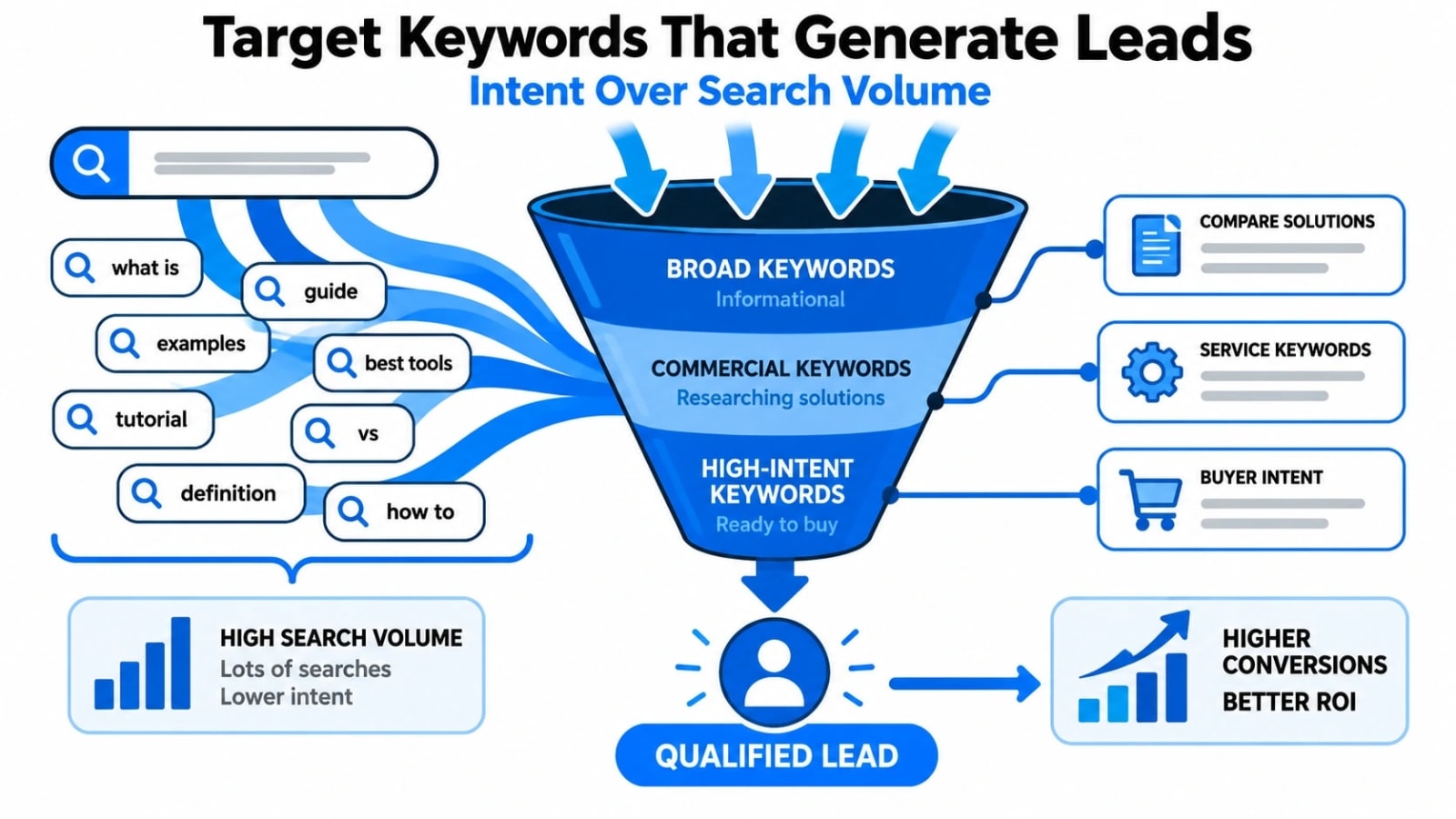
One of the most common mistakes businesses make when building an SEO strategy for lead generation is chasing search volume without considering intent. A keyword attracting fifty thousand monthly searches is worthless if the people searching for it have no interest in buying what you sell. Volume is a metric. Intent is what converts.
Lead generation SEO requires a different lens for keyword research. Instead of asking how many people search for a term, start by asking what a searcher is trying to accomplish when they type that query. Keywords generally fall into a few intent categories: informational, navigational, commercial, and transactional. For lead generation, your focus should be weighted heavily toward commercial and transactional intent, with informational content used strategically to build awareness at the top of the funnel.
Commercial intent keywords are those that signal a buyer is evaluating options. Phrases like “best CRM software for small business,” “link building services pricing,” or “agency vs in-house SEO comparison” all indicate a searcher who is actively in research mode and moving toward a purchase decision. These are the keywords that belong at the heart of your lead generation content strategy.
Transactional intent keywords go one step further. They signal that a searcher is ready to act. Queries containing words like “hire,” “buy,” “get a quote,” or “free trial” often convert at a much higher rate than broader informational terms. Ranking for these terms requires strong on-page optimization, clear calls to action, and the kind of domain authority that comes from a consistent link-building effort over time.
Long-tail keywords deserve special attention in any lead generation-focused SEO strategy. While they attract lower individual search volumes, they are highly specific, face less competition, and tend to attract searchers who are further along in the buying process. A query like “B2B link building agency for SaaS companies” may generate a fraction of the traffic of a broader term, but the visitors it brings are far more likely to become leads.
Mapping your keywords to specific stages of your sales funnel allows you to create content that meets prospects where they are, guiding them naturally toward conversion rather than simply generating traffic that bounces without taking action.
Content Types That Convert Organic Visitors Into Leads
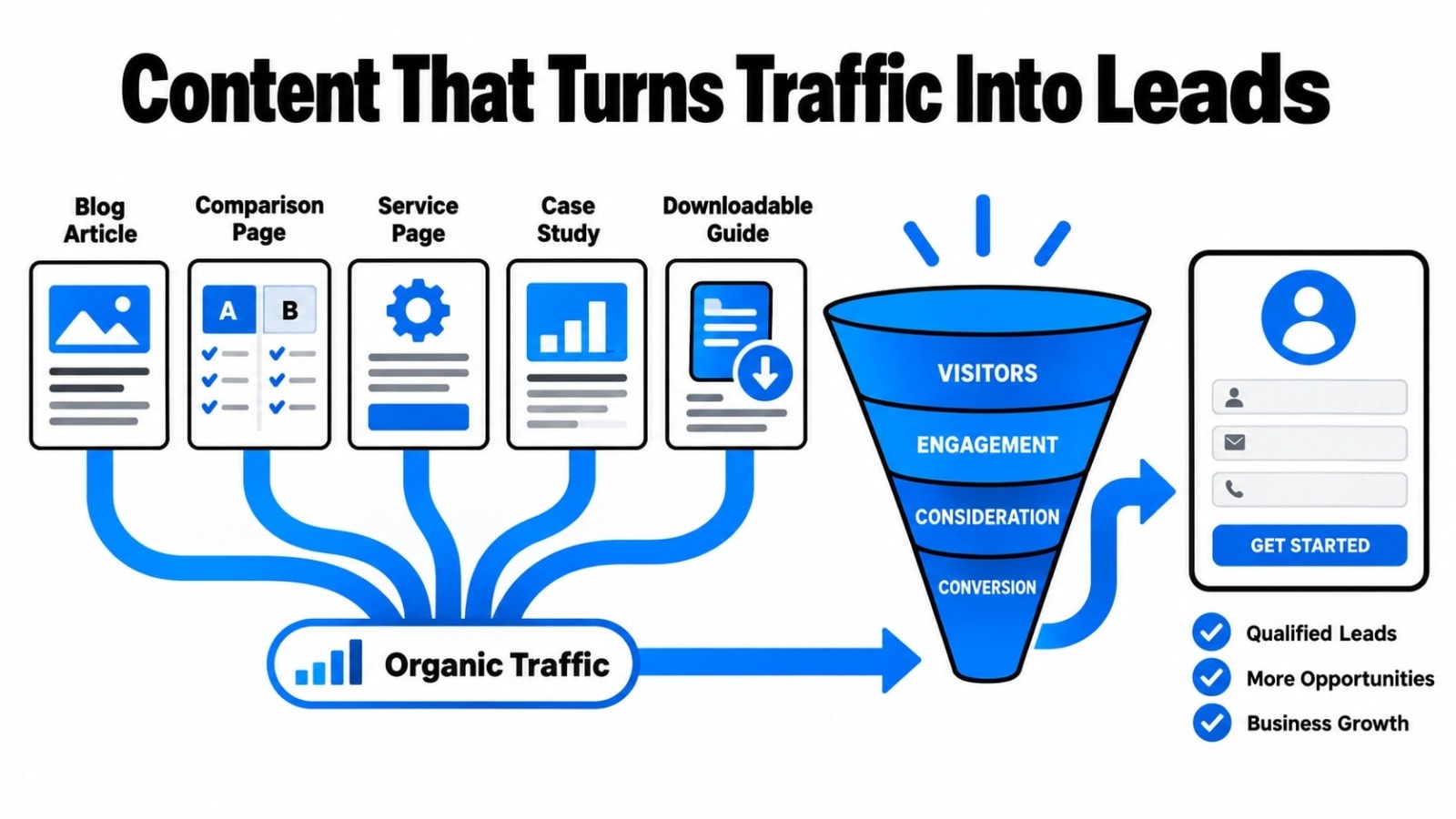
Not all content earns leads at the same rate. Blog posts that answer broad informational questions attract traffic, but the visitors who convert are typically those who find content that speaks directly to a problem they are actively trying to solve. The formats that perform best for lead generation are those that create a natural next step, whether that is downloading a resource, requesting a consultation, or signing up for a tool.
For B2B prospect research, Snov.io can help businesses find relevant leads based on targeted criteria. Knowing which content types do that work efficiently is the difference between a site that ranks and a site that grows a pipeline.
Landing pages built around a single offer, comparison pages that help buyers make a decision, and case studies that demonstrate proven results consistently outperform generic articles for lead capture. Comparison pages, in particular, attract visitors who are already deep in the decision process. A visitor reading a detailed comparison has usually moved past curiosity and into evaluation mode. Case studies add another layer by building trust, which reduces the friction that stops a qualified visitor from submitting a form or booking a call.
Supporting formats also play a role at different stages of the funnel:
Long-form guides: Capture top-of-funnel visitors and nurture them with internal links toward conversion-focused pages.
Free tools and calculators: Require an email to deliver results, creating a low-friction lead capture moment.
Webinar registration pages: Attract mid-funnel visitors who want to learn before committing to a purchase.
FAQ and glossary pages: Rank for high-volume informational queries and feed visitors into deeper, conversion-focused content through strategic CTAs.
Content Type
Funnel Stage
Primary Lead Action
Avg. Conversion Potential
Comparison Pages
Bottom
Demo request / Sign-up
High
Case Studies
Bottom
Contact form / Consultation
High
Free Tools / Calculators
Middle
Email capture
Medium-High
Long-Form Guides
Top
Newsletter / Content upgrade
Medium
FAQ / Glossary Pages
Top
Internal link to offer page
Low-Medium
On-Page SEO Elements That Directly Affect Lead Conversion Rates
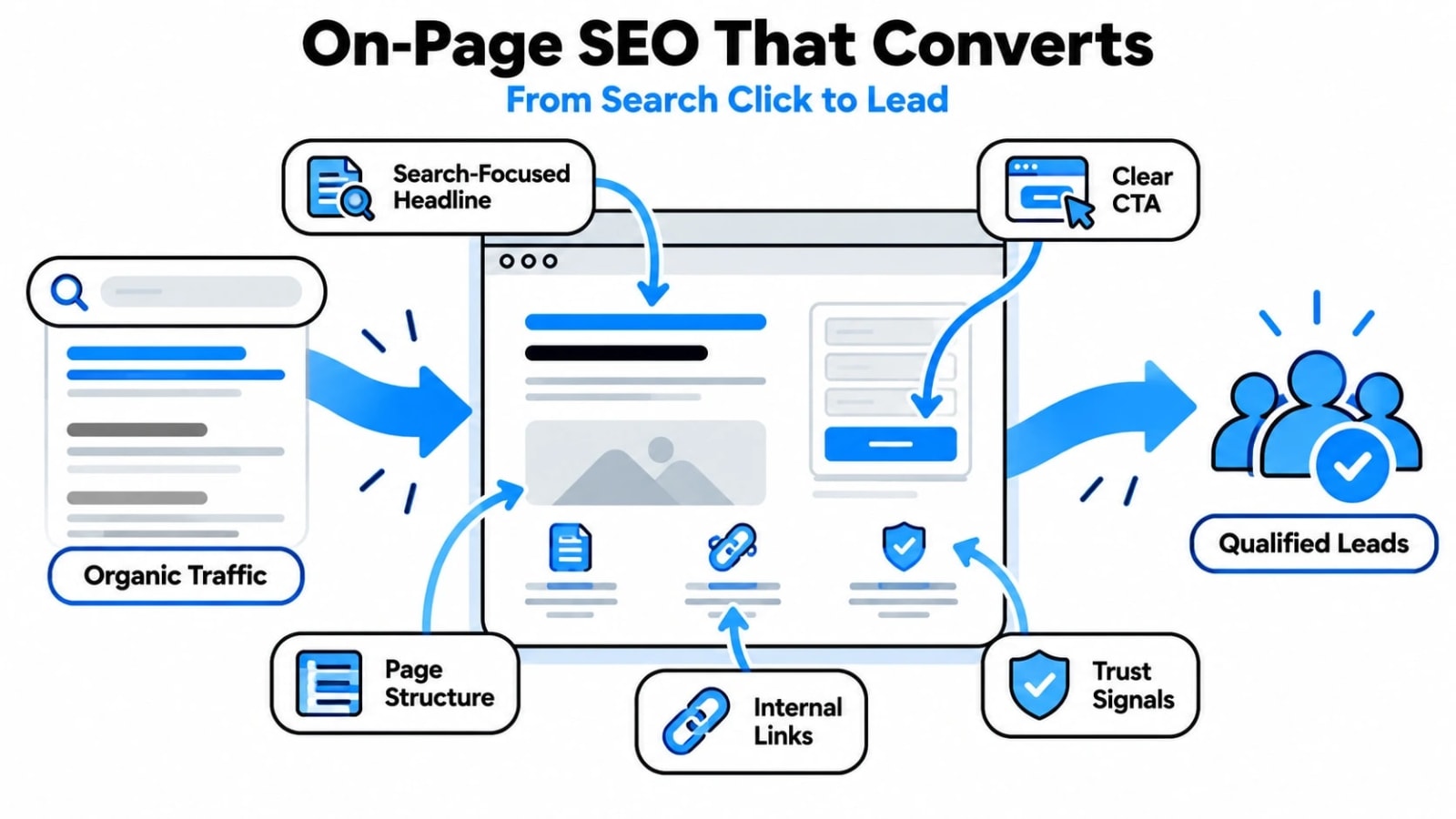
On-page SEO is often treated purely as a ranking exercise, but every element that affects how a page reads also affects whether a visitor takes action. Title tags and meta descriptions set the expectation before someone clicks. If the page then fails to deliver on that promise within the first few seconds, the visitor leaves. Matching your title and meta description to the specific intent behind a search query reduces bounce rates and increases the time users spend engaging with your content, both of which support lead generation indirectly by keeping the right people on the page.
Page structure is equally important. Headers should guide a reader naturally toward a logical conclusion, which on a lead-generation page is usually a call to action. Placing CTAs above the fold, within the body of long-form content, and at the end of a page ensures that a visitor never has to scroll far to take the next step. Load speed also matters significantly. Research from Google has shown that as page load time increases from one second to three seconds, the probability of a visitor bouncing increases by 32 percent. A slow page loses leads before they even read a word.
Title tags: Include the primary keyword and a clear value signal to match intent.
Meta descriptions: Write them as a micro-pitch, not just a summary.
Header hierarchy (H1, H2, H3): Guide the reader through a logical flow toward a CTA.
Internal linking: Connect informational pages to conversion-focused pages to move leads down the funnel.
Form placement: Test above-the-fold forms on high-intent pages against end-of-page placements.
Page speed: Compress images, minimize JavaScript, and use caching to stay under two seconds on mobile.
On-Page Element
SEO Impact
Conversion Impact
Optimized Title Tag
High
Medium (CTR improvement)
Clear CTA Placement
Low
High
Page Load Speed
High
High
Internal Linking Structure
High
Medium
Mobile Responsiveness
High
High
How Backlinks Drive Lead Generation Beyond Rankings
Backlinks are widely understood as a ranking factor, but their contribution to lead generation goes further than search position alone. When a high-authority website in your industry links to your content, it sends referral traffic composed of people who are already interested in the topic you cover. That audience is pre-qualified. They arrive on your site with context and at least some level of trust, because a source they already read or respect has pointed them in your direction. This referral traffic often converts at rates that rival or exceed traffic from organic search.
The quality of the linking source matters more than the quantity of links when the goal is lead generation. A single backlink from a well-read industry publication can send hundreds of engaged visitors over time, many of whom are decision-makers or buyers. This is why strategic link building, the kind focused on earning placements in relevant, credible publications, produces compounding returns. It builds authority in Google’s eyes while simultaneously creating a direct traffic channel that operates independently of algorithm changes.
Backlinks also strengthen on-site credibility signals. Visitors who arrive from a reputable external source and then see additional trust indicators, such as recognizable logos, detailed case studies, or strong testimonials, are more likely to convert. Building links that drive lead generation requires a deliberate approach:
Target publications your ideal buyers actually read, not just sites with high domain authority scores.
Pitch data-driven content and original research, which earns more placements and more authoritative links.
Secure links to conversion-focused pages, not just the homepage or blog, so referral traffic lands where it can take action.
Build relationships with editors and contributors in your space to create recurring link opportunities over time.
Link Source Type
Ranking Value
Referral Lead Potential
Trust Signal to Visitor
Industry Publication
High
High
Strong
Niche Blog (Relevant Audience)
Medium
Medium-High
Medium
General News Site
High
Low-Medium
Medium
Directory / Listing Site
Low
Low
Weak
Partner / Client Site
Medium
Medium
Strong
Technical SEO Fixes That Remove Barriers to Lead Generation
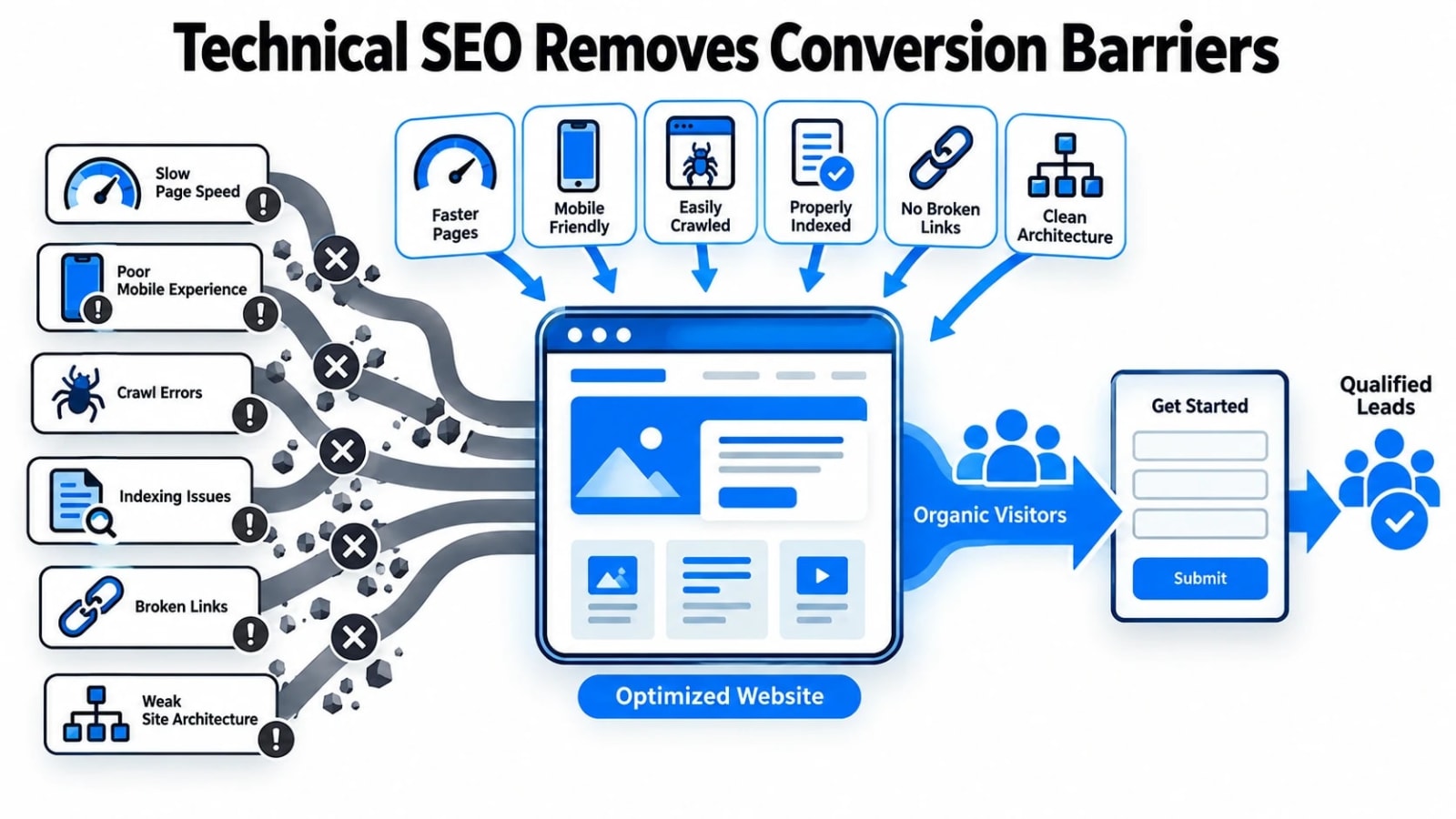
Even the most compelling content and the strongest backlink profile will fail to generate leads
ads if your website has technical problems working against it. Technical SEO is the foundation that allows everything else to perform. When pages load slowly, forms break on mobile, or crawlers cannot index your key landing pages, you lose leads before a visitor ever reads a single word.
The good news is that most technical barriers are fixable, and the impact on lead generation is often immediate once they are addressed. Here are the most critical areas to audit and resolve:
Page speed optimization: Pages that take longer than three seconds to load see dramatically higher bounce rates. Compress images, minify CSS and JavaScript, enable browser caching, and use a content delivery network to keep load times under two seconds, especially on landing pages with lead capture forms.
Mobile responsiveness: More than half of all organic search traffic comes from mobile devices. If your forms are difficult to fill out, your CTAs are too small to tap, or your layout breaks on smaller screens, you are losing a significant portion of potential leads. Test every lead-capture page on multiple device sizes.
Crawlability and indexation: Use Google Search Console to confirm your most important lead generation pages are being crawled and indexed. A mistakenly applied noindex tag or a blocked resource in your robots.txt file can remove a high-converting page from search results entirely.
Core Web Vitals: Google uses Largest Contentful Paint, Interaction to Next Paint, and Cumulative Layout Shift as ranking signals. Poor scores on these metrics push your pages down in results and create a frustrating user experience that reduces form submissions.
HTTPS and site security: Visitors are far less likely to submit personal information on a site flagged as insecure. Ensure your SSL certificate is active and all pages are served over HTTPS, particularly any page containing a contact form or download gate.
Broken links and redirect chains: Internal links pointing to 404 pages waste crawl budget and confuse users. Redirect chains slow down page loads. Audit these regularly using a crawl tool and fix or update them promptly.
Structured data markup: Adding schema markup for FAQs, reviews, and business information can earn rich results in the SERPs, which increases click-through rates and brings more qualified visitors to your lead generation pages.
The table below shows how common technical issues directly affect lead generation outcomes and what priority level to assign each fix:
Technical Issue
Impact on Lead Generation
Fix Priority
Slow page load time
Higher bounce rates, fewer form submissions
Critical
Poor mobile experience
Lost leads from mobile-first audiences
Critical
Indexation errors
Key pages invisible in search results
Critical
Poor Core Web Vitals
Lower rankings and poor user experience
High
Missing HTTPS
Reduced trust, fewer form completions
High
Broken internal links
Wasted crawl budget, frustrated users
Medium
No structured data
Missed rich result opportunities in SERPs
Medium
Running a technical audit at least once per quarter keeps these issues from silently eroding your lead generation performance. Pair your audit findings with conversion data to prioritize fixes that will have the greatest measurable impact on the pages generating the most organic traffic.
Conclusion
SEO for lead generation is not a single tactic but a connected system where keyword strategy, content, on-page optimization, backlinks, and technical health all work together toward one outcome: converting organic visitors into real business opportunities. When each piece is aligned with the intent of your ideal customer, SEO stops being a traffic channel and becomes one of the most reliable, cost-efficient sources of pipeline you can build. The brands that treat SEO as a long-term investment rather than a short-term experiment are the ones that consistently outperform competitors without depending on paid acquisition to keep leads flowing.
Start by auditing where your current strategy falls short, whether that is in keyword intent alignment, content that fails to capture information, pages that load too slowly on mobile, or a backlink profile that has not kept pace with your competitors. Fix the foundations first, then build upward with content and links that compound in value over time. If you need authoritative backlinks that actually move rankings and support your lead generation goals, Marketing Lad can help you acquire them from sites that matter.
Frequently Asked Questions
How long does it take for SEO to start generating leads?
Most businesses begin to see meaningful lead generation results from SEO within three to six months, depending on the competitiveness of their industry and the current state of their website. New sites with no authority may take longer, while established domains targeting less competitive keywords can see movement sooner.
What type of content generates the most leads from organic traffic?
Bottom-of-funnel content, such as comparison pages, case studies, pricing pages, and service-specific landing pages, tends to convert organic visitors into leads at the highest rate. These formats attract visitors who are close to making a decision and are actively looking for reasons to choose a specific solution or provider.
Is local SEO important for lead generation?
Yes, especially for service-based businesses that operate in specific geographic areas. Optimizing your Google Business Profile, building local citations, and targeting location-specific keywords can drive highly qualified leads from people searching for services nearby, often with strong purchase or contact intent already established.
How do backlinks specifically contribute to lead generation?
Backlinks improve the authority and rankings of your lead generation pages, placing them in front of more qualified searchers. They also drive direct referral traffic from relevant third-party sites, bringing visitors who already trust the source linking to you, which typically results in higher engagement and stronger conversion rates on your pages.
Should I focus on SEO or paid ads for lead generation?
Tags:#5 Best Free Link Building Tools to Help You Build Backlinks#Keyword Strategy#Organic Traffic#SEO for Lead Generation
Shahid Shahmiri is a digital marketer who helps online businesses grow with smart marketing tactics that improve sales and leads. He is passionate and driven to grow businesses online and is responsible for analyzing marketing, SEO, growth and managing promotional and media channels.