
On this page13
- What Makes a Guest Posting Marketplace Worth Using
- How Guest Posting Marketplaces Work: The Order Process Explained
- Best Guest Posting Marketplaces Ranked and Compared
- Pricing Realities: What You Actually Get at Each Budget Level
- Red Flags That Signal a Low-Quality Marketplace
- How Marketing Lad Approaches Guest Post Placement
- How to Get Maximum ROI From Any Guest Posting Marketplace
- Niche vs. General Guest Posting Marketplaces: Which Delivers Better Results
- How to Evaluate a Publisher Site Before Buying a Placement
- Guest Posting Marketplace Comparison at a Glance
- Building a Sustainable Guest Posting Strategy Beyond One-Off Placements
- Conclusion
- Frequently Asked Questions
Table of Contents
How Guest Posting Marketplaces Work: The Order Process Explained
Pricing Realities: What You Actually Get at Each Budget Level
Niche vs. General Guest Posting Marketplaces: Which Delivers Better Results
Building a Sustainable Guest Posting Strategy Beyond One-Off Placements
Guest posting remains one of the most reliable ways to build authoritative backlinks, drive referral traffic, and strengthen a site’s standing in search results. But with dozens of platforms competing for your budget, knowing which guest posting marketplaces actually deliver quality placements is harder than it looks. This guide cuts through the noise, comparing and ranking the best options available today so you can spend less time evaluating and more time building.
What Makes a Guest Posting Marketplace Worth Using
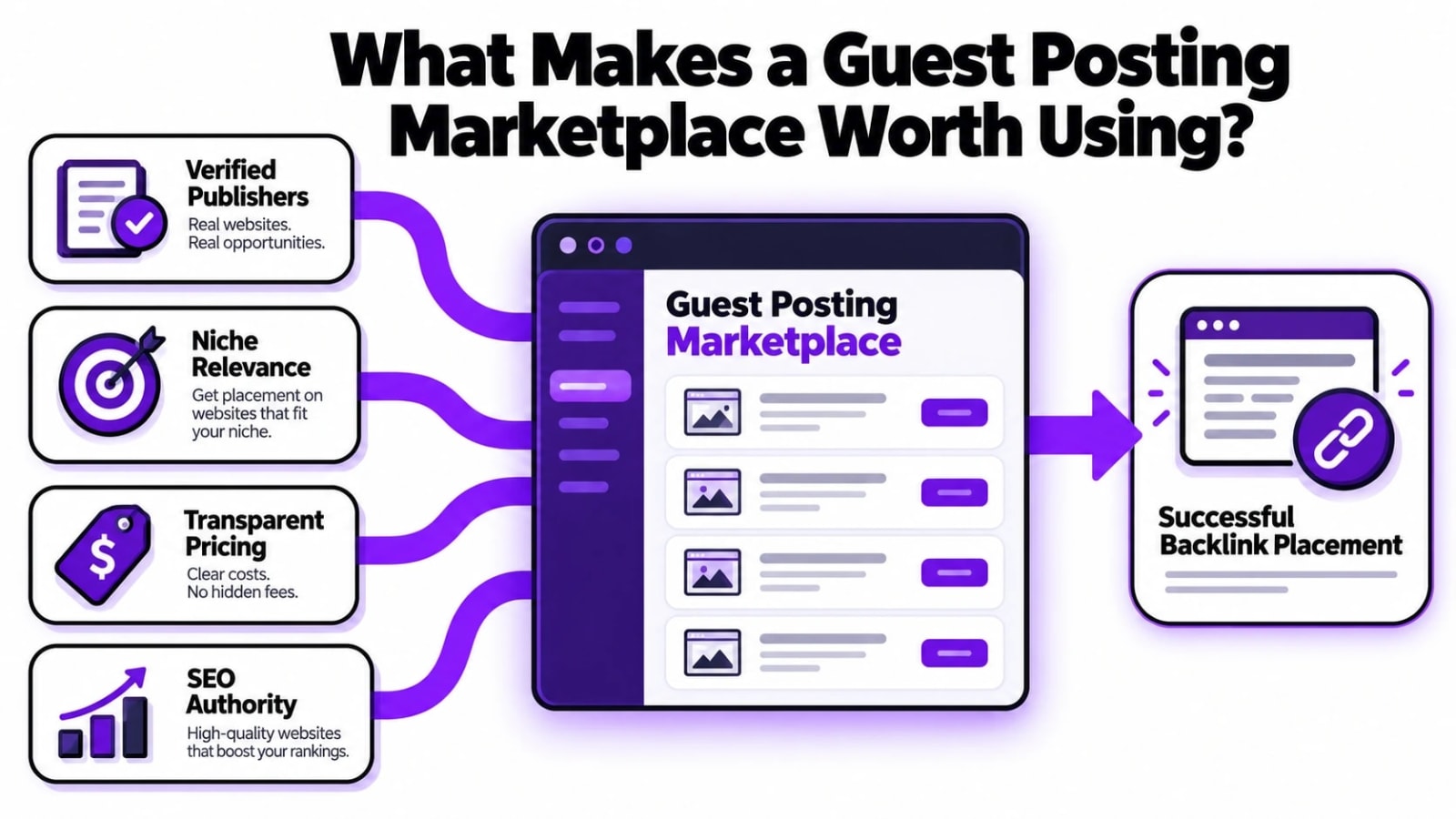
Not every platform that calls itself a guest posting marketplace deserves that title. The best ones share a consistent set of qualities that separate them from low-quality link farms or directories masquerading as outreach tools.
Publisher vetting standards: A trustworthy marketplace screens the sites in its inventory. This means checking domain authority, organic traffic, spam scores, and niche relevance before any site goes live in the catalog. Platforms that accept every submission without review often end up with a bloated, low-quality inventory that produces weak backlinks.
Transparent site metrics: You should be able to filter publishers by domain rating, traffic estimates, niche, and country before placing an order. Marketplaces that hide these details make it impossible to evaluate whether a placement is worth the price.
Content quality controls: Whether you supply the article or the platform writes it, the content needs to meet editorial standards. Sites that publish thin, keyword-stuffed articles risk Google penalties, and any backlink from them carries that same risk to your domain.
Clear pricing without hidden fees: Reputable platforms list their prices upfront, including whether content creation is included or costs extra. Surprise fees at checkout are a red flag worth taking seriously.
Turnaround times and order tracking: Good platforms communicate realistic timelines and let you track your order from submission to live placement. Lack of visibility into the process often leads to delays and disputes.
Customer support: When something goes wrong, a responsive support team matters. Look for platforms with documented revision policies, replacement guarantees if a link goes down, and real humans available to handle issues.
How Guest Posting Marketplaces Work: The Order Process Explained
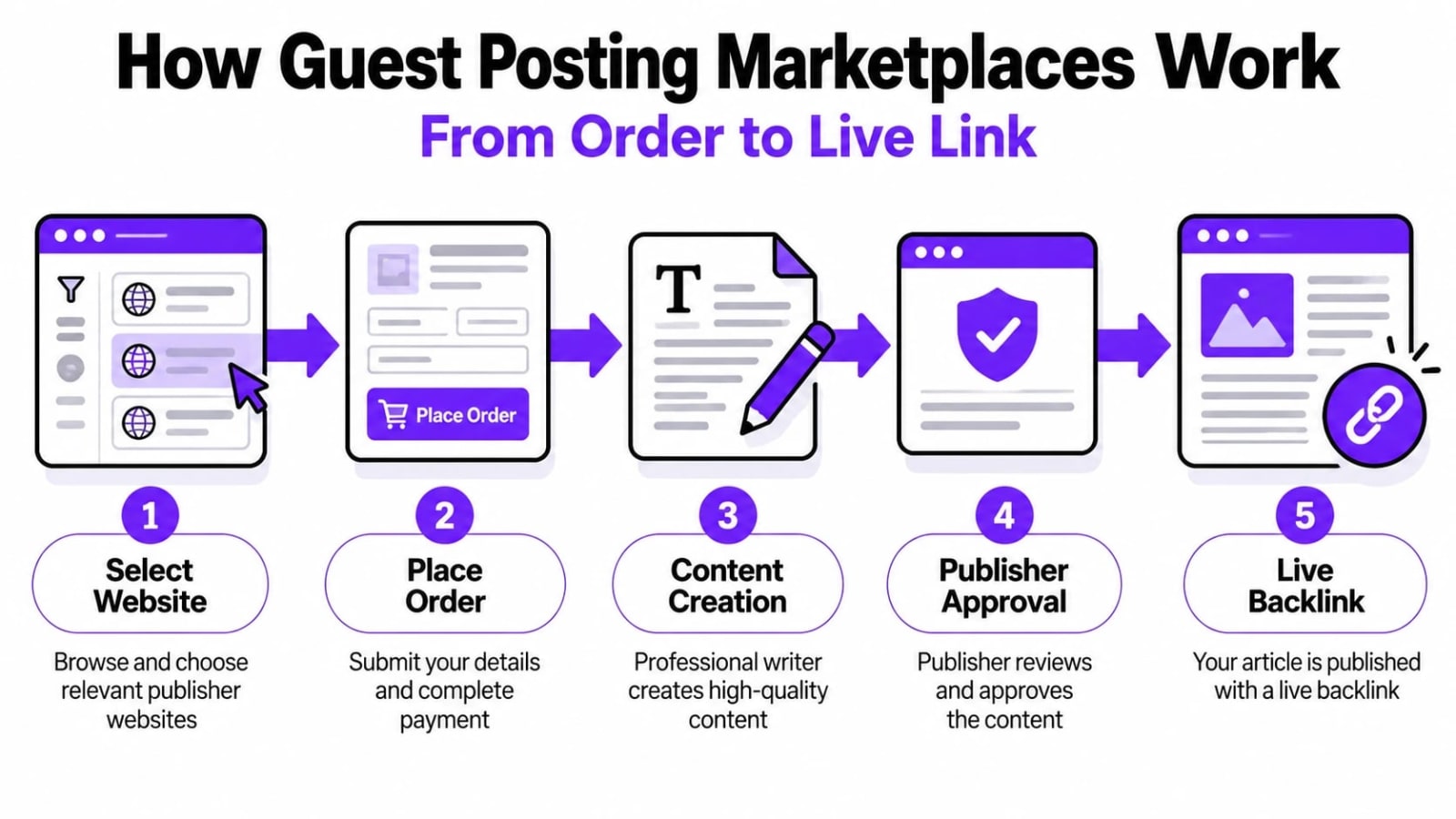
If you have never used a guest posting marketplace before, the process is more straightforward than most people expect. Here is a typical order flow across the leading platforms.
Step 1: Browse or search the publisher catalog. Most platforms give you access to a searchable database of publisher sites. You can filter by niche, domain authority, organic traffic, geography, and price. Some platforms also let you save favorites or request custom placements not listed in the public catalog.
Step 2: Select a site and configure your order. Once you choose a publisher, you specify the target URL the backlink should point to, your preferred anchor text, and any topic guidelines for the article. Some platforms also ask whether you want to supply the article yourself or have the marketplace write it.
Step 3: Content creation and editorial review. If the platform handles writing, an assigned writer produces the article based on your brief. The publisher then reviews it against their editorial guidelines. This step can take anywhere from a few days to two weeks, depending on the platform and the publisher's workload.
Step 4: Publication and live link delivery. Once the article is approved and published, the platform notifies you and provides a live URL. Many platforms offer a reporting dashboard where you can confirm the link is indexed and verify anchor text placement.
Step 5: Post-placement monitoring. Some higher-tier platforms include link monitoring as part of their service, alerting you if a placed link goes offline. Others leave this responsibility to the buyer, making third-party monitoring tools a worthwhile addition to your workflow.
Best Guest Posting Marketplaces Ranked and Compared
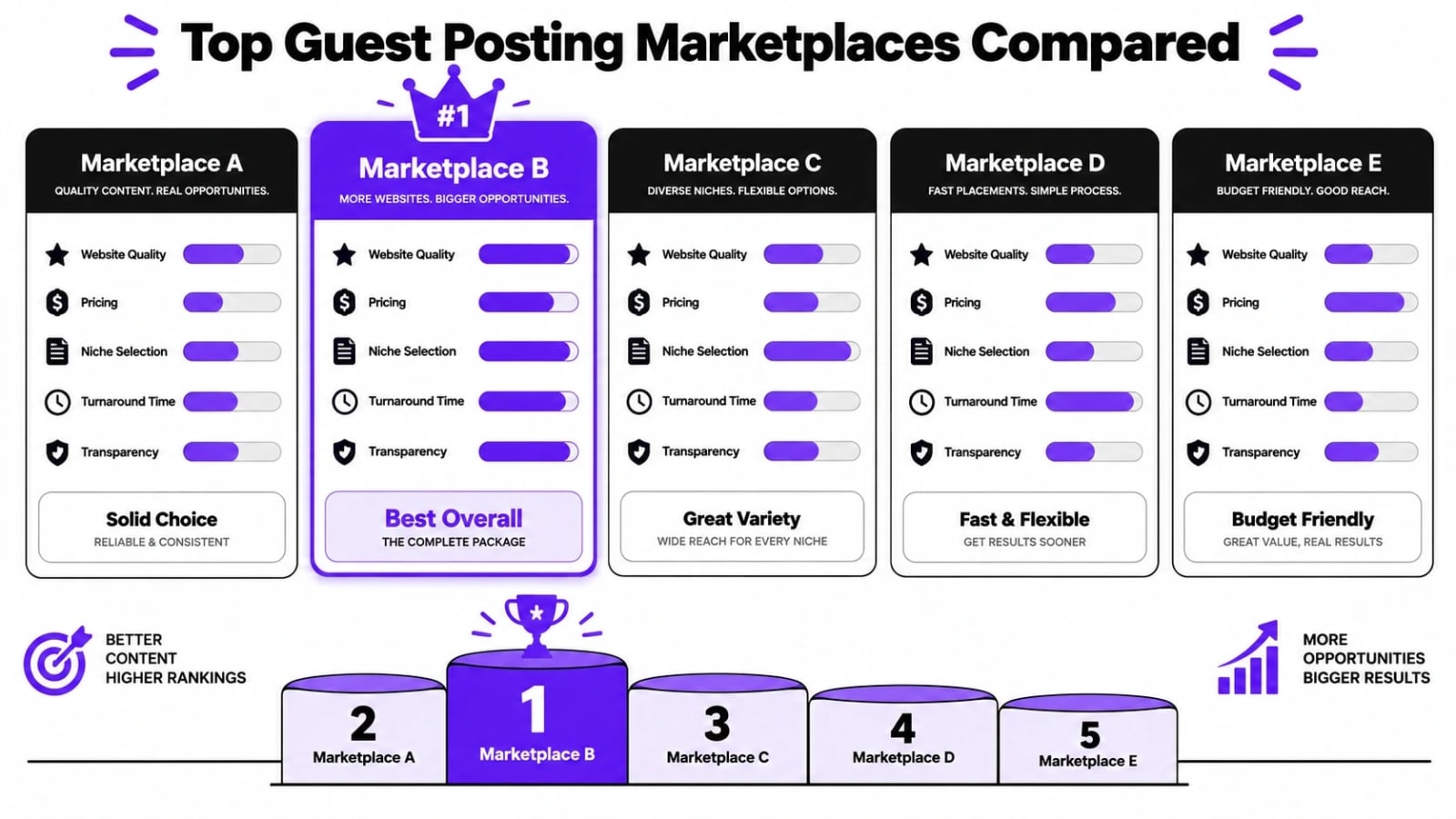
We evaluated the platforms below based on publisher quality, pricing transparency, content standards, the order process, and overall reliability. Each one serves a slightly different use case, so the right choice depends on your budget, niche, and volume requirements.
The sections that follow break down each platform in detail, covering what it does well, where it falls short, and which types of link-building campaigns it suits best. Whether you are running a lean campaign for a single site or managing placements across a large client portfolio, at least one of these marketplaces will match your needs.
1. Adsy
Adsy operates as a two-sided marketplace connecting content buyers with publishers across a wide range of niches. Buyers can filter sites by domain authority, traffic, language, and category, and the platform handles content creation as an optional add-on. Adsy’s inventory spans thousands of sites, making it a solid choice for campaigns that need volume across multiple verticals.
Best for: Buyers who want self-serve access to a large publisher database without committing to a managed service. Pricing starts around $15 per placement at the entry level, with mid-range options running $80 to $200 for sites with stronger metrics.
Watch out for: Wide quality variance across the catalog. Vetting individual sites manually before ordering is strongly recommended, as the platform accepts a broad range of publishers with inconsistent editorial standards.
2. Collaborator
Collaborator is a transparent guest posting and sponsored content marketplace popular in European and CIS markets but increasingly used for English-language campaigns. Publishers list their own prices and editorial requirements, and buyers can communicate directly with site owners before placing an order. This level of direct access is relatively rare among marketplaces and helps reduce miscommunication around content requirements.
Best for: Buyers who want direct publisher relationships and appreciate pricing set by the sites themselves rather than a platform markup. Placements typically range from $20 to $400 depending on the site’s audience size and niche.
Watch out for: The catalog skews toward European publishers, so English-language campaigns targeting US or UK audiences may find fewer premium options than on competing platforms.
3. Links Garden
Links Garden positions itself as a curated marketplace focused on genuine editorial placements rather than mass-market link selling. The platform emphasizes traffic quality over raw domain authority scores, which is a meaningful distinction in an industry where inflated DR figures are common. Orders go through an editorial matching process before being forwarded to publishers.
Best for: Mid-range budgets seeking better-than-average traffic quality without moving all the way into agency-managed pricing. Most placements fall between $60 and $350.
Watch out for: Smaller inventory compared to larger platforms means fewer options in highly specific niches. Turnaround times can be longer than self-serve alternatives because of the additional editorial matching step.
4. FatJoe
FatJoe is a well-established link-building service that offers guest posting as a core service, alongside blogger outreach and niche edits. The platform is particularly popular with agencies managing multiple client campaigns, as it offers white-label reporting and bulk order discounts. FatJoe’s in-house team writes content, ensuring a baseline of quality consistency across orders.
Best for: Agencies and high-volume buyers who want a managed experience without full agency pricing. Guest post packages typically start around $120 and scale upward based on domain authority targets.
Watch out for: Because FatJoe manages outreach on your behalf, you have less visibility into specific sites before placement than with self-serve platforms. Some buyers find the site selection less targeted than manual filtering allows.
5. Authority Builders
Authority Builders focuses exclusively on high-quality guest post placements on sites with real organic traffic. The platform is notable for its strict no-PBN policy and its insistence on placing content only on sites that have demonstrated genuine readership. The platform checks every site in the catalog for traffic trends, niche consistency, and content quality before listing it.
Best for: Buyers who prioritize link quality over volume and want confidence that every placement is on a legitimate, traffic-driven site. Pricing starts around $150 and rises to $600 or more for premium placements.
Watch out for: The higher price floor makes Authority Builders less accessible for budget-conscious campaigns. It is not the right fit if you need a high number of placements at low cost.
6. SERP Empire (Guest Post Service)
SERP Empire offers a guest posting service as part of a broader suite of SEO tools. The platform lets buyers filter placements by DR, traffic, and niche, and includes content writing in the package price. It appeals particularly to smaller businesses and solo operators who want an all-in-one solution without managing multiple vendors.
Best for: Smaller campaigns and individual site owners who want simplicity and bundled content creation. Most placements range from $50 to $250.
Watch out for: The platform’s publisher inventory is smaller than dedicated marketplaces like Adsy or Collaborator, which may limit options for campaigns targeting very specific niches or geographic markets.
Pricing Realities: What You Actually Get at Each Budget Level
Guest post pricing varies wildly across marketplaces, and understanding what each budget tier actually delivers helps you avoid overpaying for average placements or underpaying and getting burned. Most marketplaces operate across three general price bands, and the quality signals shift significantly as you move up. Knowing what to expect at each level means fewer surprises when your order comes back.
At the lower end of the market, placements in the $15 to $80 range typically come from sites with thin editorial standards, recycled content, and domain authority scores that look decent on paper but carry little actual weight with search engines. These sites often accept almost any submission, which is precisely why their link value is limited. Mid-range placements between $80 and $300 represent a more balanced category, where you start seeing genuine editorial review, real traffic, and niche-relevant audiences. This is where most serious link-building campaigns find their core volume.
Premium placements above $300 unlock access to publications with established readerships, strict content requirements, and stronger topical authority. These are worth budgeting for when targeting competitive keywords or building authority in a saturated niche. The table below breaks down what each tier typically delivers across the most important metrics.
Budget Tier | Typical Price Range | Average DR | Editorial Standards | Real Traffic | Best Use Case |
|---|---|---|---|---|---|
Entry Level | $15 to $80 | DR 20 to 40 | Minimal | Low to none | PBN-style volume, not recommended |
Mid Range | $80 to $300 | DR 40 to 65 | Moderate | Moderate | Core link-building campaigns |
Premium | $300 to $800+ | DR 65 to 90+ | Strict | High | Competitive niches, authority building |
Red Flags That Signal a Low-Quality Marketplace
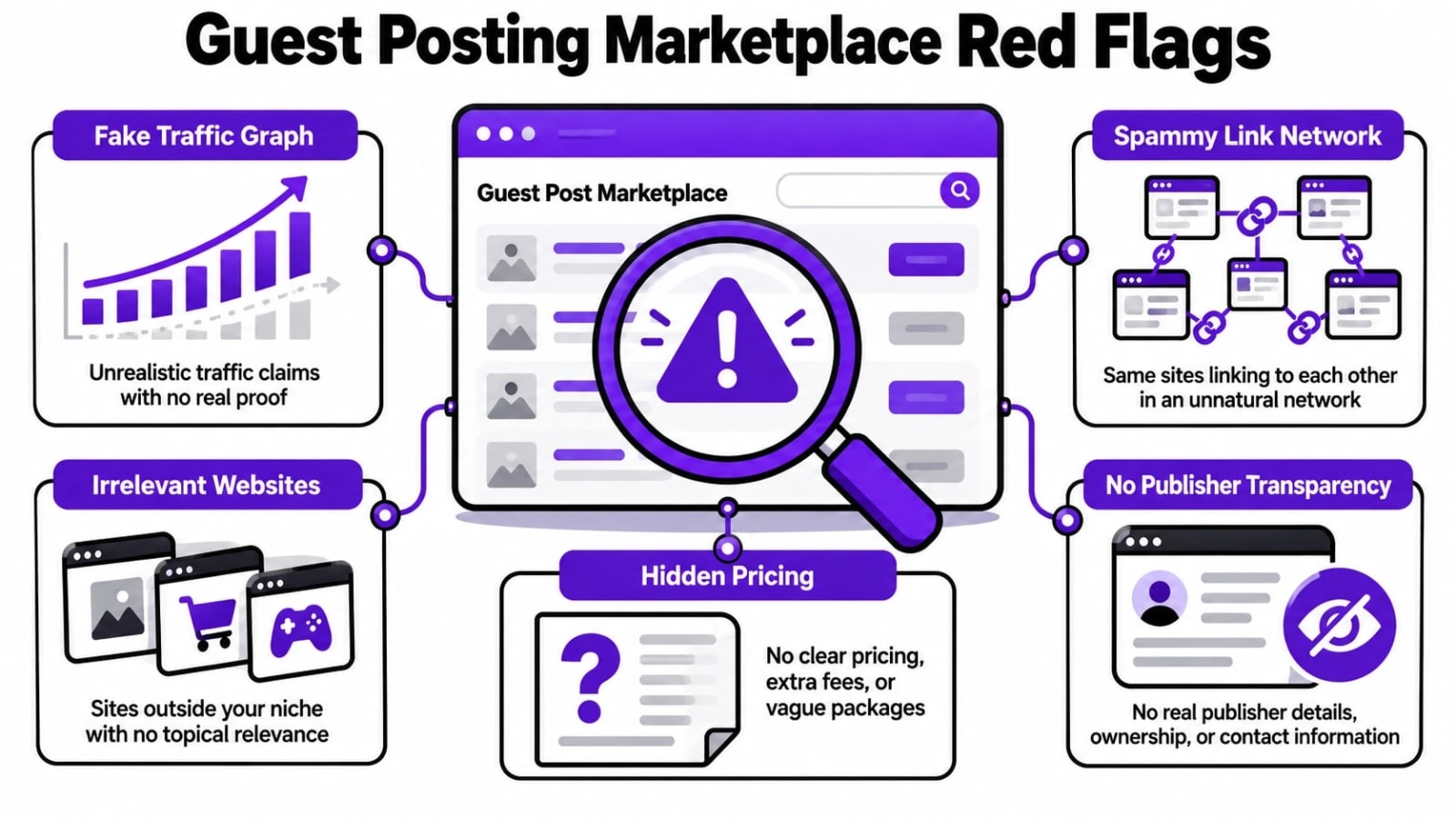
Not every guest posting marketplace operates with transparency or genuine quality control. Some platforms have built their entire business model around selling links on sites that exist purely for that purpose, with no real audience, no organic traffic, and editorial standards that amount to little more than a spell check. Spotting these platforms before you spend your budget is a skill worth developing early in any link-building strategy.
The most reliable red flags appear before you even place an order. If a marketplace cannot show you sample content from the sites it works with, or if the listed sites all share similar design templates and publish content across completely unrelated topics, that is a strong signal of a network-style operation. Unusually fast turnaround times, like guaranteed placements within 24 hours across hundreds of sites, also suggest a lack of real editorial involvement. Genuine publishers take time to review and properly integrate content.
Watch for these specific warning signs when evaluating any marketplace:
Sites with high DR but near-zero organic traffic, which often indicates manipulated metrics
No visible rejection policy or quality threshold for submitted content
Placements offered on sites covering wildly different niches with no clear focus
No live examples or URLs from completed orders available for review
Prices that seem impossibly low for the domain authority claimed
Platforms that discourage questions about site ownership or traffic data
How Marketing Lad Approaches Guest Post Placement
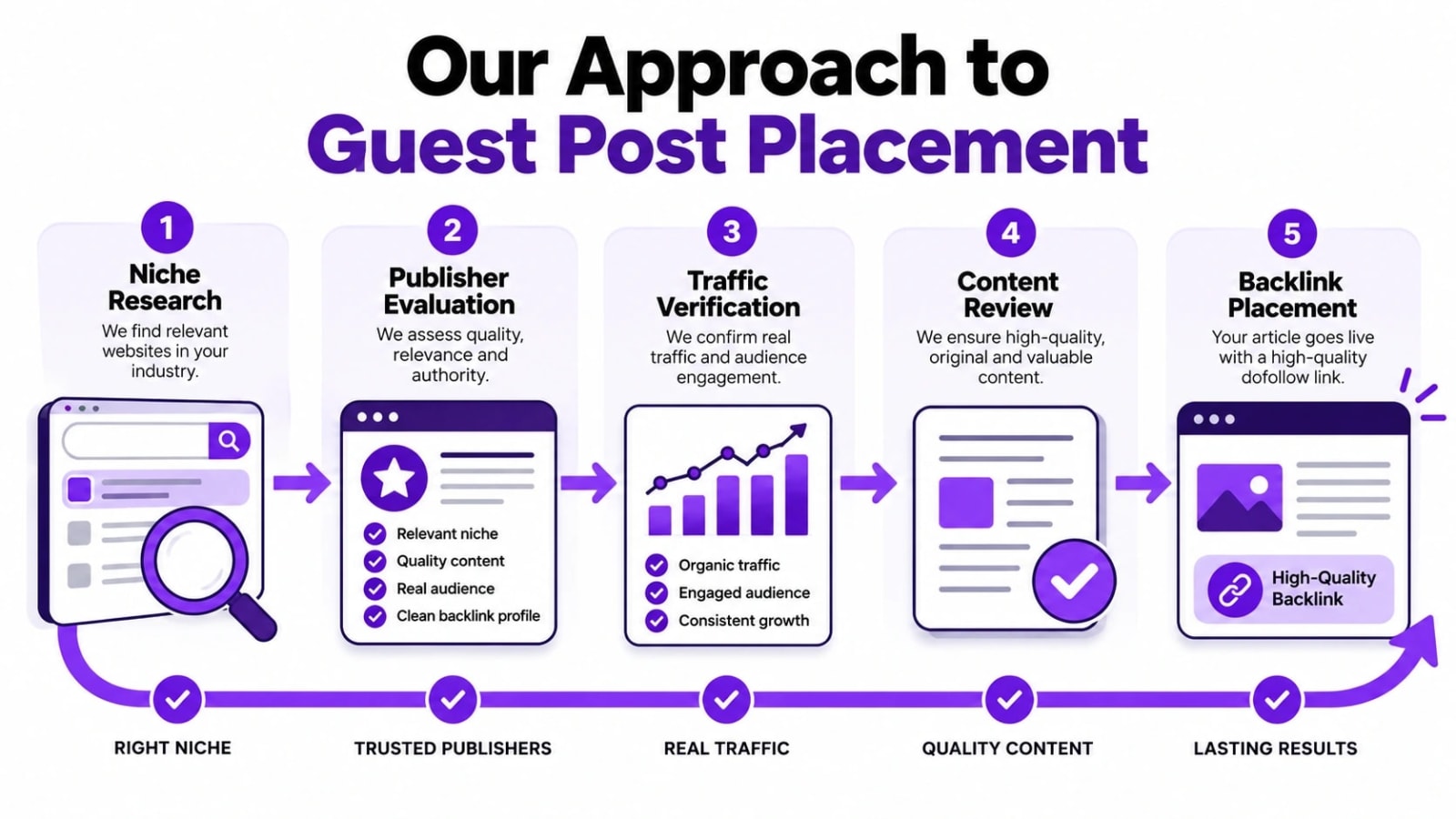
Marketing Lad takes a different approach to guest posting compared to standard marketplace platforms. Rather than operating as a directory where brands browse and self-select placements, Marketing Lad builds outreach-driven relationships with publishers in specific niches, which means the sites available for placement have been vetted for real traffic, editorial credibility, and topical alignment before any client order is placed. This manual vetting process filters out the noise that clutters most open marketplaces.
Every placement through Marketing Lad undergoes a relevance check against the client’s niche and link profile, ensuring each guest post contributes meaningfully to their overall SEO strategy rather than just adding link volume. The content is written to meet the target publication's standards, not a generic template, which improves both acceptance rates and the long-term value of each link. Clients get transparency on metrics, live URLs after publication, and placements on sites where real readers actually spend time.
How to Get Maximum ROI From Any Guest Posting Marketplace
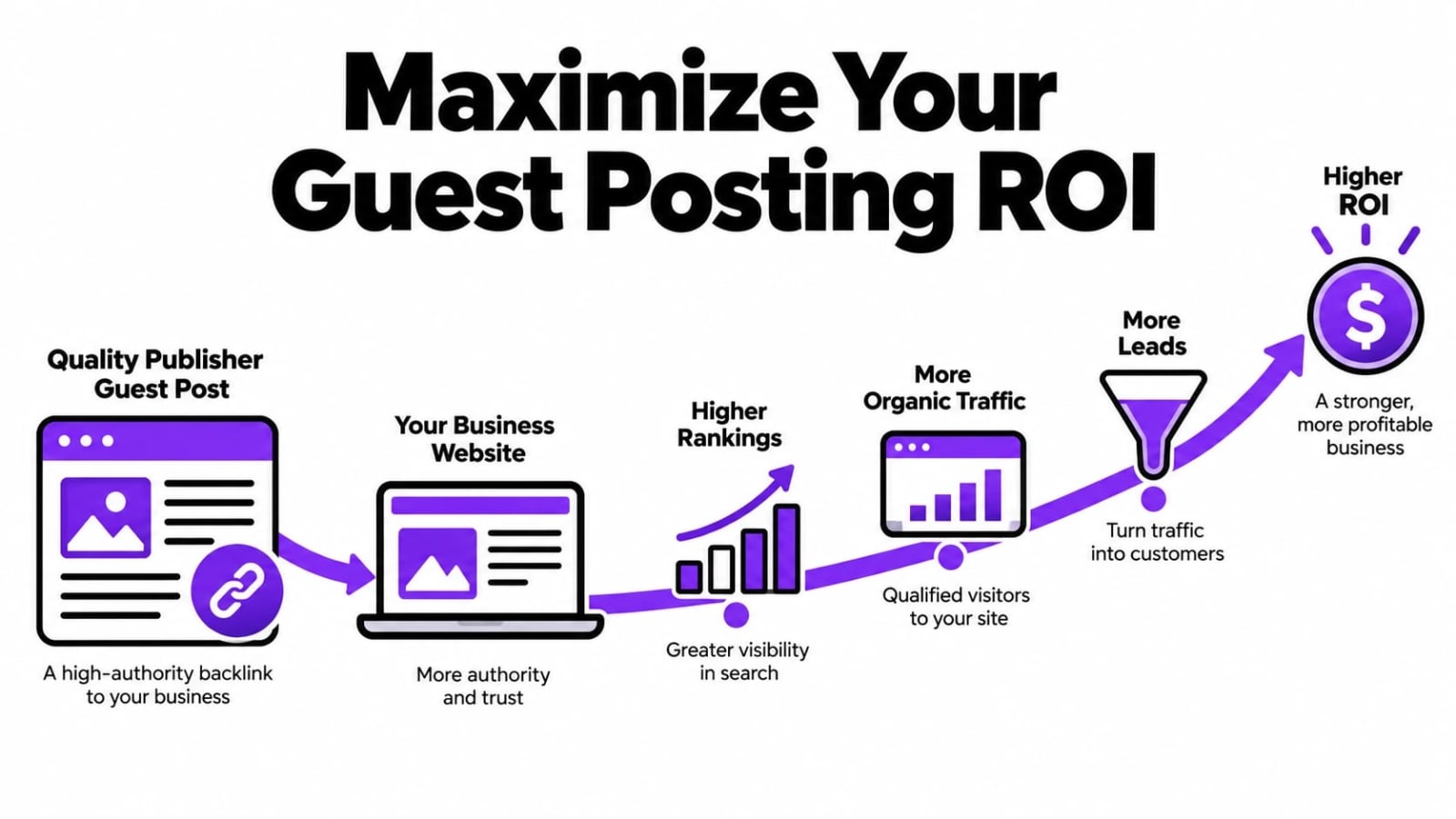
Choosing the right marketplace is only half the equation. How you use it determines whether your investment compounds over time or produces a flat return. The biggest mistake brands make is treating guest posting as a one-time activity rather than a structured, ongoing part of their content and link-building strategy. A single placement rarely moves the needle in competitive niches, but a consistent cadence of well-placed posts on relevant, authoritative sites builds measurable authority over months.
Before placing any order, audit your existing link profile to identify gaps in topical coverage and anchor text diversity. Guest posts work best when they fill specific gaps rather than duplicating the link patterns you already have. Brief your content team or the marketplace’s writers with enough context about your target audience to produce something genuinely useful, since thin or generic content gets buried by editors or produces no referral engagement even when it does get published.
Apply these practices consistently to improve returns from any marketplace you use:
Prioritize niche relevance over raw DR scores when selecting publisher sites
Vary your anchor text naturally across a mix of branded, partial match, and generic terms
Link to inner pages and not just your homepage to distribute authority more effectively
Track post-publication traffic and ranking changes to identify which placements perform best
Build a repeating monthly order schedule rather than sporadic bursts of activity
Request sites with genuine social media presence or newsletter audiences for added referral value
Niche vs. General Guest Posting Marketplaces: Which Delivers Better Results
One of the most overlooked decisions when choosing a guest posting marketplace is whether to use a niche-specific platform or a broad general one. Both have their place, but the right choice depends heavily on your goals, industry, and the type of authority you want to build.
General marketplaces give you volume and variety. You can place links across dozens of categories, test different verticals, and build a mixed backlink profile relatively quickly. However, the trade-off is relevance. A link from a general lifestyle blog rarely carries the same topical authority as one from a site dedicated entirely to your industry.
Niche marketplaces, on the other hand, focus on specific industries such as health, finance, SaaS, legal, or real estate. Publishers on these platforms tend to have better audience alignment, stricter content standards, and more engaged readership. Google increasingly rewards topical relevance, so a link from a highly relevant niche site often outperforms a link from a high-DA general blog.
Choose general marketplaces when: you need broad link diversity, are building a new site’s baseline authority, or are testing multiple niches simultaneously.
Choose niche marketplaces when you operate in a competitive vertical, want stronger topical signals, or target a specific audience segment.
Consider both when your content strategy spans multiple topics and you want volume and relevance working together.
The smartest approach combines both, using general platforms for volume and niche platforms for authority signals that directly support your target keywords.
How to Evaluate a Publisher Site Before Buying a Placement
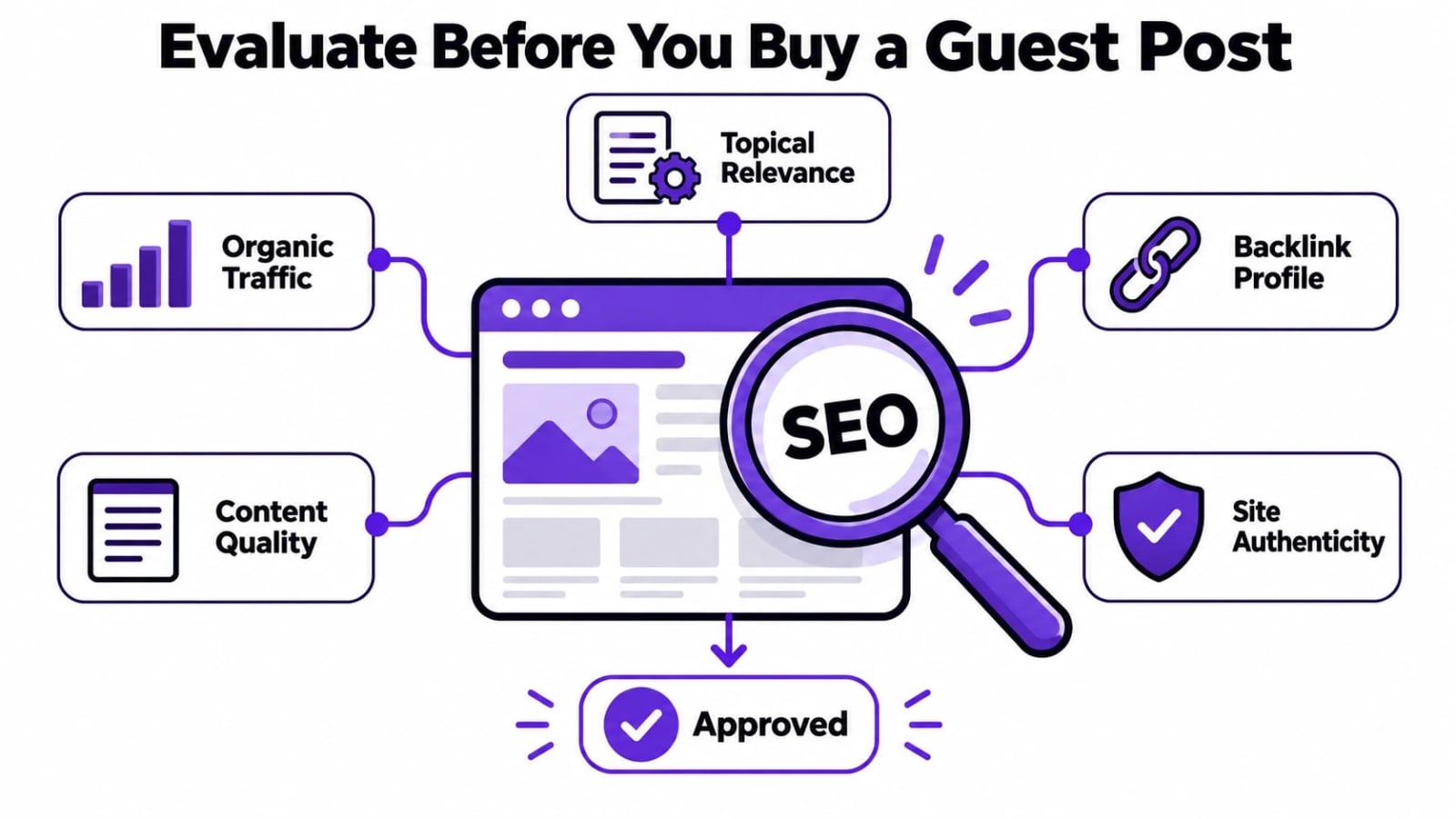
Not every site in a marketplace is worth your budget. Marketplaces list publishers by the hundreds, and quality varies enormously even among sites with similar DR or DA scores. Knowing what to look for before committing to a placement can save you money and protect your backlink profile.
Start with traffic verification. A site with a DR of 45 but fewer than 500 monthly visitors is almost certainly a PBN or a site that has lost organic traction. Use independent traffic tools to cross-reference any traffic data the marketplace provides.
Next, audit the site's content. Read several recent articles. Ask yourself whether they are written for real readers or purely for link placement. Thin content, keyword stuffing, excessive outbound links, and unrelated sponsored posts are all warning signs that the site exists to sell links rather than serve an audience.
Check the link profile: If the site has thousands of referring domains but minimal organic traffic, something is wrong.
Review the niche consistency: A site that covers finance, travel, pet care, and tech simultaneously is a link farm, not a real publication.
Look at the content calendar: Sporadic publishing or a sudden surge of posts in the past few months can signal artificial inflation.
Verify indexation: Search Google for the site’s most recent articles. If they are not indexed, your link will carry no value.
Check domain history: Expired domains relaunched as link sellers often carry penalties from their previous owners.
Taking ten minutes to do this due diligence on each publisher can be the difference between a link that moves rankings and one that does nothing or actively harms your profile.
Guest Posting Marketplace Comparison at a Glance
With so many platforms available, a side-by-side view helps clarify where each marketplace sits in terms of value, quality controls, and best use cases. The table below summarizes the most important factors buyers should weigh when making a final decision.
Marketplace Type | Quality Control | Average Cost Range | Best For | Main Risk |
|---|---|---|---|---|
Self-serve platforms | Minimal, buyer-led | $30 to $150 | High-volume campaigns | Inconsistent quality |
Managed services | High, editorial review | $200 to $800+ | Authority building | Higher upfront cost |
Niche-specific platforms | Medium to high | $100 to $500 | Topical relevance | Limited publisher pool |
Full-service agencies | Very high, vetted | $300 to $1,500+ | Competitive industries | Budget intensive |
Freelance outreach | Variable | $50 to $300 | Budget-conscious buyers | No accountability |
Use this comparison as a starting framework. The right marketplace for one business may be completely wrong for another, so always match the platform type to your specific SEO stage, budget, and link-building objectives.
Building a Sustainable Guest Posting Strategy Beyond One-Off Placements
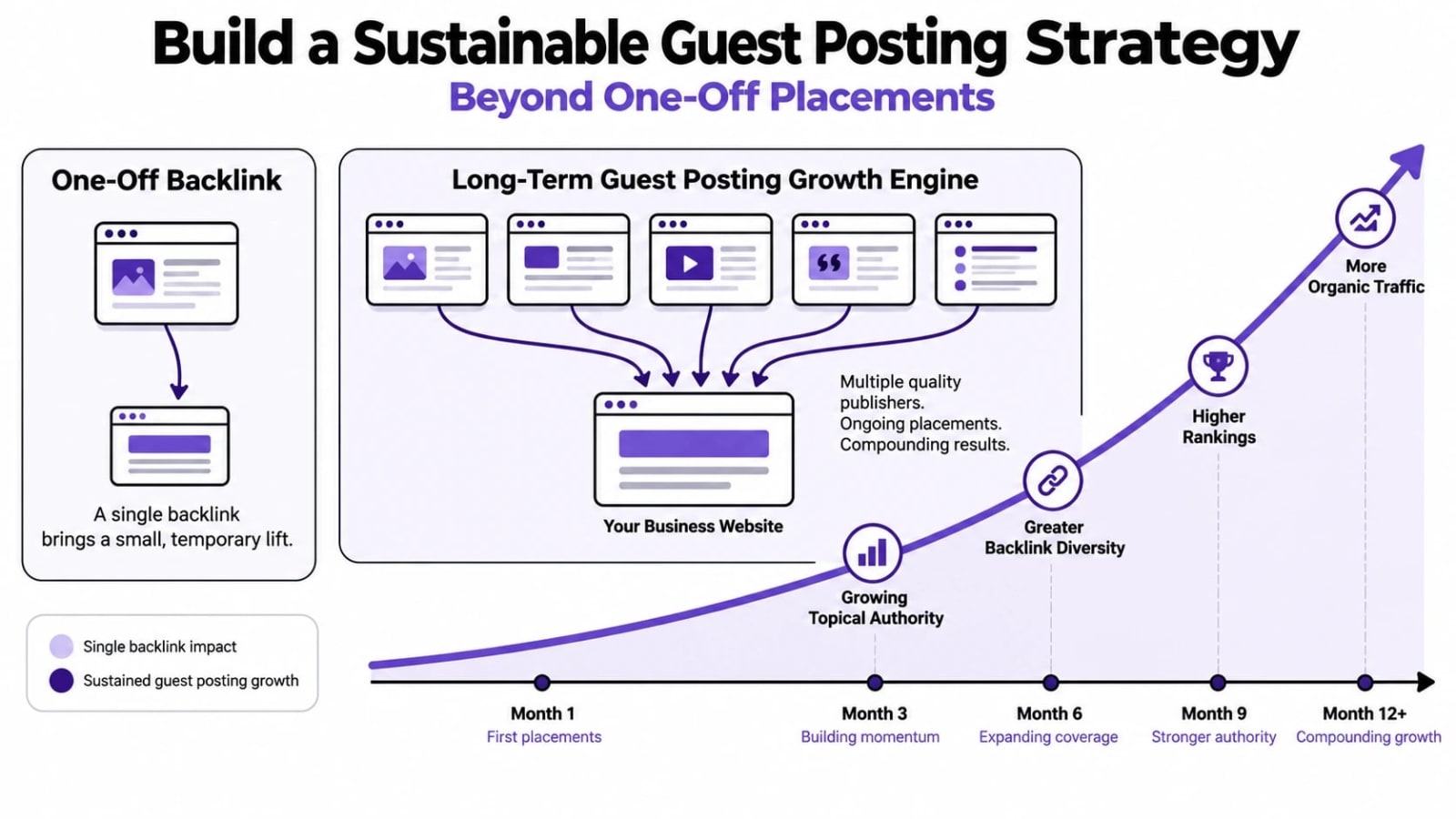
Most businesses treat guest posting as a transactional exercise. They buy a few links, check the rankings, and repeat. That approach rarely produces lasting results. The sites that gain meaningful authority from guest posting treat it as an ongoing relationship-building and content strategy, not a one-time transaction.
Sustainability in guest posting comes from consistency and diversification. Placing ten links per month across a mix of DR ranges, content types, and domains builds a natural-looking profile that accumulates value over time. A single burst of activity followed by months of inactivity looks artificial to both Google and to any analyst reviewing your link history.
Set a monthly link-building budget: Even modest consistent investment outperforms irregular large spends.
Diversify anchor text intentionally: Mix branded anchors, naked URLs, generic phrases, and partial-match keywords to avoid over-optimization.
Build repeat relationships with publishers: Sites that have featured your content once are often open to future placements, sometimes at better rates.
Align guest posts with your content funnel: Each placement should support a page that serves a specific stage of your buyer’s journey.
Track placement performance over 90 days: Rankings rarely shift overnight. Give placements time before deciding whether they worked.
Pair guest posting with other link-building tactics: Digital PR, resource page outreach, and broken link building complement guest posts and create a more resilient profile.
A long-term guest posting strategy produces compounding returns. Each new placement adds to a growing network of relevant, authoritative inbound links that reinforce your domain’s standing across every keyword cluster you target.
Conclusion
Choosing the right guest posting marketplace comes down to three things: quality verification, niche relevance, and alignment with your budget and goals. Not every platform deserves your money, and not every inexpensive placement is a waste. The best results come from buyers who do their homework on publishers, set realistic expectations for timelines, and treat link-building as a sustained investment rather than a shortcut. Whether you use a self-serve platform for volume or a managed service for premium placements, the fundamentals remain the same: real sites, real content, real audiences.
If you are ready to move beyond guesswork and start acquiring links that move the needle, a team that understands editorial standards and publisher relationships makes a measurable difference. Marketing Lad specializes in placing content on vetted, relevant publications so that every link you earn contributes to genuine, lasting authority. Start with a clear strategy, choose your platforms carefully, and build consistently.
Frequently Asked Questions
A guest posting marketplace is a self-serve platform where you browse and purchase placements directly. A link-building agency manages the entire process, from site selection to content creation and outreach. Agencies typically offer more vetting and accountability, while marketplaces offer more control and transparency over individual placements.
There is no fixed number, as results depend on your niche competitiveness, current domain authority, and link quality. Most SEOs recommend at least ten to fifteen quality placements over three months before expecting measurable ranking changes. Competitive industries require much more consistent effort before you see significant movement.
They can be safe if you use platforms that enforce real editorial standards and avoid sites that exist purely to sell links. The risk increases with low-cost, low-quality placements on obvious link farms. Prioritizing relevance, real traffic, and genuine editorial content keeps your link profile well within acceptable practices.
Providing your own content gives you full control over quality, relevance, and anchor text placement. Marketplace-written content varies widely in quality, and some platforms produce generic posts that add little topical value. If you have in-house writing capabilities, supplying your own article almost always produces a stronger, more contextually relevant placement.