
On this page23
- What Is Real Estate Link Building?
- Why Link Building Matters for Real Estate SEO
- How Google Evaluates Real Estate Backlinks
- Real Estate Link Building Strategy Framework
- 25 Proven Real Estate Link Building Strategies
- Strategy Comparison Table
- Which Strategies Should You Prioritize?
- Local Link Building for Realtors
- Best Sources of Local Real Estate Backlinks
- Local Link Building Checklist
- Content That Naturally Earns Real Estate Backlinks
- Digital PR for Real Estate
- Digital PR Campaign Ideas
- Competitor Backlink Analysis
- Link Building Outreach Framework
- Outreach Email Templates
- Backlinks You Should Avoid
- AI Search and the Future of Real Estate Link Building
- Real Estate Link Building Checklist
- Common Real Estate Link Building Mistakes
- Recommended Tools
- Final Thoughts
- Frequently Asked Questions
Ranking a real estate website isn’t easy anymore. Whether you’re a realtor, brokerage, property developer, property management company, or real estate investor, you’re competing against thousands of local businesses, national listing portals, and authoritative property websites for the same search traffic.
Publishing great property listings alone won’t help you rank on Google. Even a well-designed website with fast loading speeds and helpful content can struggle to appear on the first page if it lacks authority.
This is where real estate link building becomes one of the most important parts of your SEO strategy.
High-quality backlinks act as trust signals. When respected local organizations, industry publications, news websites, universities, businesses, or relevant blogs link to your website, Google gains more confidence in your expertise. Over time, those signals can improve keyword rankings, increase organic traffic, strengthen local visibility, and bring in qualified buyers and sellers.
Not all backlinks provide the same value.
A single editorial backlink from a respected local newspaper or real estate association can be far more valuable than hundreds of low-quality directory links. Modern link building is no longer about collecting as many links as possible. It’s about earning relevant, trustworthy mentions that support your overall authority.
Real estate link building is the process of earning backlinks from relevant, trustworthy websites to improve a real estate website’s authority, local search visibility, and Google rankings. It focuses on acquiring links from local organizations, industry websites, news publications, business directories, and authoritative content rather than low-quality or spammy sources.
Read More On SEO Tasks: The Complete Checklist for Building Rankings That Last
What Is Real Estate Link Building?

Real estate link building is the process of acquiring high-quality backlinks from websites that are relevant to the property industry or your local market. These links help search engines understand that your website is trustworthy, authoritative, and deserving of higher rankings.
A backlink is simply a hyperlink from another website pointing to yours.
For example:
- A local newspaper links to your housing market report.
- A Chamber of Commerce includes your business in its member directory.
- A mortgage company recommends your first-time buyer guide.
- A university links to your neighborhood research.
- A local business mentions your relocation guide.
Each of these backlinks acts as a vote of confidence.
The more trustworthy those votes are, the more authority your website can build.
Unlike ecommerce or SaaS businesses, real estate SEO depends heavily on location-based authority. Google wants to recommend businesses that are trusted within the communities they serve. That means backlinks from organizations in your target city often carry more value than unrelated links from websites on the other side of the world.
Good real estate link building combines several disciplines:
- Local SEO
- Digital PR
- Content marketing
- Community involvement
- Relationship building
- Industry networking
- Technical SEO
The goal isn’t simply to increase your backlink count. It’s to build a natural backlink profile that reflects genuine authority in your market.
Example
Imagine two real estate agencies in Dubai.
Agency A has 600 backlinks purchased from random blogs, coupon sites, and low-quality directories.
Agency B has only 85 backlinks, but they come from:
- Local newspapers
- Government resources
- Chamber of Commerce
- Mortgage companies
- Architecture blogs
- Interior design magazines
- Universities
- Community organizations
Agency B is far more likely to earn Google’s trust because its backlinks demonstrate relevance, credibility, and real-world authority.
That is what successful real estate link building looks like.
Why Link Building Matters for Real Estate SEO

Real estate is one of the most competitive local SEO industries.
Every city contains hundreds or even thousands of businesses competing for searches like:
- Homes for sale
- Apartments for rent
- Luxury real estate
- Commercial property
- Property investment
- Realtors near me
- Property management services
Without authority, even excellent content may struggle to rank.
Backlinks help bridge that gap by strengthening your site’s reputation in Google’s eyes.
Some of the biggest benefits include:
Higher Organic Rankings
Backlinks remain one of Google’s strongest ranking signals. Quality links help search engines discover your pages, understand their importance, and rank them more competitively for valuable real estate keywords.
Better Local SEO Performance
Local backlinks from newspapers, community organizations, chambers of commerce, and city-focused websites reinforce your geographic relevance. This can improve your visibility for searches tied to specific neighborhoods, cities, or regions.
Increased Trust and Credibility
People are more likely to trust a real estate business that is referenced by respected local publications, industry associations, and established organizations. These endorsements strengthen both SEO and brand perception.
More Referral Traffic
Not every backlink exists solely for rankings. A link from a popular neighborhood blog, local news site, or relocation guide can send highly targeted visitors who are actively looking for property information.
Stronger Brand Authority
Consistent mentions across reputable websites position your business as a recognized authority in the real estate market. Over time, this recognition contributes to better engagement, higher conversion rates, and improved search performance.
Improved Visibility in AI Search
Modern search experiences increasingly rely on authoritative sources when generating AI-powered answers. Brands that are frequently cited by trusted websites are more likely to be recognized as reliable entities, increasing their chances of appearing in AI-driven search results.
How Google Evaluates Real Estate Backlinks

Many people still believe that SEO is about getting as many backlinks as possible. That approach worked years ago, but modern search algorithms focus far more on quality, relevance, and trust than raw numbers.
Google doesn’t assign the same value to every backlink. A single editorial link from a respected local newspaper or real estate association can carry more weight than hundreds of links from unrelated, low-quality websites.
If you want your real estate SEO campaign to succeed, you need to understand what makes a backlink valuable.
1. Topical Relevance
The linking website should relate to your industry, local market, or audience.
For example, backlinks from these sources are highly relevant:
- Real estate blogs
- Mortgage companies
- Property investment websites
- Interior design publications
- Construction companies
- Architecture magazines
- Local business websites
- Relocation services
- Home improvement blogs
- Real estate software companies
Google understands that businesses within the same ecosystem naturally reference one another.
A backlink from a cooking blog to your real estate website doesn’t make much sense. A backlink from a property valuation company or local housing publication does.
2. Local Relevance
Real estate is heavily location-dependent.
If your agency serves Miami, Dubai, London, Sydney, or Toronto, backlinks from organizations within those cities can send strong local trust signals.
Examples include:
- City newspapers
- Local business associations
- Community organizations
- Neighborhood blogs
- Chamber of Commerce websites
- Local universities
- Municipal business directories
- Charity event websites
These links help Google associate your business with a specific geographic area.
3. Website Authority
Authority matters because reputable websites have already earned Google’s trust.
While metrics like Domain Rating (DR), Domain Authority (DA), and Authority Score are useful indicators, they should never be the only factor when evaluating a backlink opportunity.
Instead, ask questions such as:
- Is this website respected in its industry?
- Does it publish original content?
- Does it receive real organic traffic?
- Is it frequently updated?
- Does it have an engaged audience?
A relevant website with moderate authority often provides more value than a high-authority website with no connection to real estate.
4. Editorial Placement
Editorial backlinks are among the most valuable because they are earned rather than manufactured.
For example, if a journalist references your housing market report within an article, that backlink carries significantly more weight than one placed in a random footer or author bio.
Google values links that exist because they genuinely help readers.
The most powerful placements include:
- News articles
- Industry research
- Expert interviews
- Original studies
- Case studies
- Resource pages
- Comprehensive guides
5. Anchor Text
Anchor text is the clickable text that contains the backlink.
A natural backlink profile includes a healthy mix of anchor text types.
Examples include:
Branded
Marketing Lad
URL
marketinglad.io
Generic
Learn more
Visit this guide
Keyword-rich
Real estate SEO strategies
Property management marketing guide
Avoid forcing exact-match keywords into every backlink. Natural anchor text appears more authentic and reduces the risk of over-optimization.
6. Context Around the Link
Google evaluates the surrounding content as much as the link itself.
For example, imagine your website receives a backlink inside an article discussing:
- Housing prices
- Buying property
- Local neighborhoods
- Investment opportunities
- Mortgage advice
That backlink is highly contextual.
Now imagine the same link appears inside an article about cryptocurrency or pet care. Even if the website has authority, the relevance is much weaker.
Context helps search engines understand why your website deserves the reference.
7. Organic Traffic
A website with genuine visitors is generally a stronger source than one that exists solely for selling backlinks.
Before pursuing a link opportunity, consider whether the website:
- Ranks for keywords
- Receives steady search traffic
- Publishes helpful content
- Attracts real readers
- Has active engagement
Links from websites with real audiences can deliver both SEO value and referral traffic.
8. Link Placement
Where your backlink appears also influences its value.
The strongest placements include:
- Within the main article content
- Inside relevant guides
- Research reports
- Resource pages
- Editorial recommendations
Less valuable placements include:
- Sidebars
- Footers
- Blogrolls
- Sitewide links
- Spammy author boxes
Links placed naturally within high-quality content tend to perform best.
9. Link Diversity
A healthy backlink profile includes links from many different sources.
Rather than collecting dozens of links from one website, aim to earn backlinks from a wide range of trusted domains.
For example:
- Local news websites
- Real estate associations
- Business organizations
- Universities
- Mortgage companies
- Contractors
- Home inspection businesses
- Interior designers
- Local bloggers
- Community websites
This diversity makes your backlink profile appear more natural and resilient.
10. Freshness
Google appreciates websites that continue earning new backlinks over time.
A natural growth pattern signals that your business remains active and relevant.
Instead of acquiring hundreds of backlinks in one month and then stopping, focus on building links consistently throughout the year.
Steady growth is more sustainable and looks far more authentic.
Good vs. Poor Real Estate Backlinks
| Factor | High-Quality Backlink | Low-Quality Backlink |
|---|---|---|
| Relevance | Real estate or local website | Unrelated niche |
| Authority | Trusted publication | Spam website |
| Traffic | Real organic visitors | Little or no traffic |
| Placement | Editorial content | Footer or sidebar |
| Context | Property-related article | Random topic |
| Anchor Text | Natural and branded | Repeated exact-match keywords |
| Local Value | Local organization or business | Foreign unrelated directory |
| Link Type | Earned editorial link | Paid spam link |
| User Value | Helps readers | Exists only for SEO |
| Long-Term Impact | Improves authority and rankings | Can harm trust over time |
Quick Backlink Quality Checklist
Before pursuing any backlink, ask yourself:
- Is the website relevant to real estate or my local market?
- Does it receive genuine organic traffic?
- Would I still want this link if Google didn’t exist?
- Does the website publish original, helpful content?
- Is the backlink placed naturally within the article?
- Could this link send referral traffic?
- Would my potential clients trust this website?
If you answer “yes” to most of these questions, it’s likely a worthwhile opportunity.
Real Estate Link Building Strategy Framework

Building backlinks without a clear plan often leads to wasted time and inconsistent results. Instead of chasing random opportunities, successful real estate businesses follow a structured process that focuses on relevance, authority, and long-term growth.
The framework below provides a repeatable system you can use whether you’re a solo realtor, a brokerage, or an SEO agency managing multiple clients.
Step 1: Define Your SEO Goals
Start by identifying what you want your link-building campaign to achieve.
Common objectives include:
- Ranking for competitive real estate keywords
- Improving local search visibility
- Increasing qualified organic traffic
- Building brand authority
- Generating more buyer and seller leads
- Supporting new service pages or neighborhood guides
Clear goals help you prioritize the right types of backlinks.
Step 2: Analyze Your Competitors
Study the websites already ranking for your target keywords.
Look for patterns such as:
- Which websites link to multiple competitors?
- What type of content attracts backlinks?
- Which local organizations mention them?
- Are they earning links through research, digital PR, or guest posting?
Competitor research often uncovers opportunities you can replicate or improve upon.
Step 3: Audit Your Existing Backlink Profile
Before building new links, understand what you already have.
Review:
- Referring domains
- Anchor text distribution
- Lost backlinks
- Toxic or spammy links
- Link diversity
- High-performing pages
This helps identify strengths, weaknesses, and quick wins like reclaiming broken or lost backlinks.
Step 4: Create Link-Worthy Content
High-quality content is the foundation of sustainable link building.
Focus on resources that other websites genuinely want to reference, such as:
- Local housing market reports
- Neighborhood guides
- Investment calculators
- Cost-of-living comparisons
- School district guides
- Interactive maps
- Home-buying checklists
- Original research and surveys
The more useful your content is, the easier outreach becomes.
Step 5: Build a Prospect List
Create a database of websites that could realistically link to your content.
Include categories such as:
- Local newspapers
- Business associations
- Industry blogs
- Mortgage lenders
- Home inspectors
- Architects
- Interior designers
- Universities
- Community organizations
- Local influencers
Organize prospects by relevance, authority, and outreach priority.
Step 6: Personalize Your Outreach
Avoid generic mass emails.
Instead:
- Mention the recipient by name.
- Reference a recent article or project.
- Explain why your content adds value.
- Keep the email concise.
- Offer something useful rather than simply asking for a link.
Relationship-focused outreach consistently outperforms template-heavy campaigns.
Step 7: Track Results
Monitor the performance of your campaign using key metrics such as:
- New referring domains
- Organic traffic
- Keyword rankings
- Local Pack visibility
- Referral traffic
- Leads generated
- Conversions from organic search
Tracking helps you identify which tactics deliver the best return on investment.
Step 8: Reclaim and Maintain Links
Link building doesn’t end once a backlink goes live.
Regularly check for:
- Broken backlinks
- Removed mentions
- Changed URLs
- Lost referring domains
- Redirect issues
Reclaiming existing links is often faster and more cost-effective than earning new ones.
25 Proven Real Estate Link Building Strategies

Not every backlink opportunity is worth pursuing. The best real estate SEO campaigns focus on links that improve rankings, drive referral traffic, and strengthen local authority.
The 25 strategies below are used by successful real estate agencies, property developers, and SEO professionals because they create long-term value rather than short-term gains.
For each strategy, you’ll find:
- Difficulty
- Estimated Cost
- Time to Earn Links
- SEO ROI
- Best For
1. Build Local Business Citations
Difficulty: Easy
Cost: Low
Time: 1-2 weeks
ROI: High
Best For: Every real estate business
Business citations are one of the easiest ways to strengthen your local SEO foundation. While many citations are nofollow, they still help search engines verify your business information and improve trust.
List your business on reputable platforms such as:
- Google Business Profile
- Bing Places
- Apple Business Connect
- Yelp
- Better Business Bureau
- Local Chamber directories
- City business directories
- Realtor associations
Make sure your Name, Address, and Phone Number (NAP) remain identical across every listing.
Pro Tip: Prioritize quality over quantity. Fifty accurate citations are better than hundreds of inconsistent ones.
2. Join Your Local Chamber of Commerce
Difficulty: Easy
Cost: Medium
Time: 1 week
ROI: Very High
Best For: Realtors and brokerages
Most Chambers of Commerce provide member profiles that include backlinks.
These websites often have:
- Strong authority
- Local relevance
- High trust
- Long lifespan
Besides SEO benefits, membership can also generate networking opportunities and local referrals.
3. Sponsor Community Events
Difficulty: Medium
Cost: Medium
Time: 2-6 weeks
ROI: High
Best For: Local agencies
Community sponsorships naturally earn backlinks from:
- Event websites
- Charity pages
- Community organizations
- Local newspapers
Examples include:
- School sports teams
- Charity runs
- Local festivals
- Housing exhibitions
- Community clean-up drives
These links are highly relevant because they demonstrate real local involvement.
4. Earn Local News Coverage
Difficulty: Medium
Cost: Low
Time: 2-8 weeks
ROI: Very High
Best For: Established businesses
Journalists constantly need expert opinions about housing trends.
Offer commentary on:
- Mortgage rate changes
- Local housing prices
- Rental demand
- Luxury property trends
- First-time buyer statistics
- Commercial developments
Even one backlink from a respected local newspaper can outperform dozens of ordinary blog links.
5. Publish Original Housing Market Reports
Difficulty: Medium
Cost: Medium
Time: Monthly
ROI: Excellent
Best For: Agencies with market data
Original research consistently earns backlinks because other websites prefer citing fresh statistics instead of repeating existing information.
Examples:
- Monthly housing reports
- Rental market analysis
- Neighborhood growth reports
- Investment opportunities
- Property appreciation trends
Include:
- Charts
- Maps
- Infographics
- Downloadable PDFs
These assets make your content easier to reference.
6. Create Comprehensive Neighborhood Guides
Difficulty: Medium
Cost: Medium
Time: 2-4 weeks
ROI: Excellent
Best For: Local SEO
Neighborhood guides naturally attract backlinks because they’re useful long after publication.
Include sections covering:
- Schools
- Transportation
- Parks
- Restaurants
- Crime statistics
- Property prices
- Walkability
- Lifestyle
- Shopping
- Healthcare
The more comprehensive the guide, the more likely it is to be referenced by bloggers, relocation websites, and local businesses.
7. Build Relationships with Mortgage Companies
Difficulty: Easy
Cost: Free
Time: Ongoing
ROI: High
Mortgage brokers frequently publish educational resources.
Collaborate by:
- Writing guest articles
- Co-authoring home-buying guides
- Sharing calculators
- Producing webinars
- Publishing joint research
These partnerships often result in valuable contextual backlinks.
8. Partner with Home Inspectors
Difficulty: Easy
Cost: Free
Time: 2-4 weeks
ROI: High
Home inspectors serve the same audience as real estate agents.
Consider creating:
- Home inspection checklists
- Buying guides
- Maintenance resources
- Educational videos
Each collaboration creates opportunities for reciprocal exposure without exchanging links unnaturally.
9. Work with Interior Designers
Difficulty: Medium
Cost: Low
Time: Ongoing
ROI: Medium
Interior designers regularly showcase completed projects.
If you’ve worked together on property staging or renovations, request a mention within:
- Project portfolios
- Case studies
- Blog posts
- Resource pages
The backlink appears naturally while showcasing real collaboration.
10. Guest Post on Relevant Real Estate Websites
Difficulty: Medium
Cost: Low to Medium
Time: 2-6 weeks
ROI: High
Guest posting still works when the focus is quality rather than volume.
Target websites covering:
- Real estate investing
- Home improvement
- Property management
- Mortgage advice
- Construction
- Local business
- Finance
- Interior design
Avoid publishing on websites built solely for selling backlinks.
A useful guest article should educate readers first while naturally introducing your expertise.
11. Create Interactive Mortgage Calculators
Difficulty: High
Cost: Medium
Time: 3-6 weeks
ROI: Excellent
Useful tools naturally attract backlinks because they’re referenced repeatedly.
Ideas include:
- Mortgage calculator
- Affordability calculator
- Rental yield calculator
- Property tax estimator
- Closing cost calculator
- Investment ROI calculator
Interactive resources tend to earn links for years after publication.
12. Publish First-Time Home Buyer Resources
Difficulty: Easy
Cost: Low
Time: 2 weeks
ROI: High
Buying property can feel overwhelming, especially for first-time buyers.
Create detailed resources covering:
- Budget planning
- Mortgage approval
- Legal documents
- Closing process
- Common mistakes
- Moving checklist
Educational content is frequently referenced by financial advisors, mortgage companies, and local organizations.
13. Launch an Annual Real Estate Statistics Page
Statistics pages consistently attract backlinks because writers need reliable numbers to support their articles.
Include:
- Average property prices
- Rental yields
- Population growth
- Housing demand
- Market trends
- Investment returns
Update the page every year to keep it relevant.
Fresh data encourages repeat backlinks.
14. Offer Expert Quotes to Journalists
Become the person reporters contact when covering housing stories.
Provide insights about:
- Market trends
- Investment opportunities
- Interest rates
- Luxury properties
- Rental demand
Expert commentary often results in editorial backlinks from trusted publications.
15. Build Resource Pages Worth Linking To
Instead of writing another generic blog post, create pages people bookmark.
Examples include:
- Complete relocation guides
- School comparison resources
- Utility setup checklist
- Home buying timeline
- Seller preparation checklist
Evergreen resources continue attracting backlinks long after they’re published.
16. Appear on Real Estate and Business Podcasts
Difficulty: Medium
Cost: Free
Time: 2-6 weeks
ROI: High
Podcast guest appearances are one of the most underused link-building opportunities in the real estate industry.
Many podcast websites publish:
- Episode pages
- Speaker profiles
- Show notes
- Resource links
- Transcripts
These pages often include backlinks to your website.
Talk about topics such as:
- Housing market trends
- Investment strategies
- Buying your first home
- Commercial real estate
- Local market insights
- Property technology
- Luxury real estate
Unlike a one-time guest post, a podcast appearance also helps build your personal brand and authority.
Pro Tip: Start with local business podcasts before targeting national real estate shows.
17. Launch Digital PR Campaigns
Difficulty: High
Cost: Medium
Time: 1-3 months
ROI: Excellent
Digital PR is one of the fastest ways to earn high-authority editorial backlinks.
Instead of asking for links, create stories that journalists want to cover.
Examples include:
- “Most Affordable Neighborhoods in Dallas”
- “Top Cities for First-Time Buyers”
- “Fastest Growing Property Markets”
- “Best Cities for Remote Workers”
- “Average Home Prices Across 100 Cities”
- “Luxury Housing Trends Report”
Include:
- Original research
- Charts
- Interactive maps
- Infographics
- Expert commentary
If your data is useful, journalists, bloggers, and industry publications will naturally reference your research.
Why it works
News websites rarely link to promotional content, but they frequently cite original data.
18. Find Broken Link Opportunities
Difficulty: Medium
Cost: Low
Time: Ongoing
ROI: High
Thousands of real estate websites contain broken external links.
When you find one, you can suggest your own relevant content as a replacement.
For example:
A property investment blog links to an outdated housing statistics page that no longer exists.
You publish a better, updated version.
Then you politely contact the website owner and recommend replacing the broken link.
Everyone benefits:
- Readers get updated information.
- Website owners fix broken pages.
- You earn a quality backlink.
Broken link building works particularly well with:
- Universities
- Government resources
- Housing blogs
- Real estate associations
- Local directories
19. Resource Page Outreach
Difficulty: Medium
Cost: Free
Time: 2-6 weeks
ROI: High
Many organizations maintain resource pages that recommend useful websites.
Examples:
- Home-buying resources
- Moving checklists
- Community information
- Local services
- Financial planning
- Housing assistance
If you’ve created genuinely helpful content, contact the webmaster and explain why it deserves inclusion.
Resource pages usually remain online for years, making these backlinks highly valuable.
20. Reclaim Unlinked Brand Mentions
Difficulty: Easy
Cost: Free
Time: 1-2 weeks
ROI: Very High
Sometimes websites mention your company but forget to include a link.
For example:
“ABC Realty recently published an excellent report about property prices.”
If there’s no backlink, simply reach out and thank the author before asking if they could add a link for readers who want to learn more.
Because they already know your brand, these requests often have a high success rate.
21. Recover Lost Backlinks
Difficulty: Easy
Cost: Free
Time: Ongoing
ROI: High
Backlinks disappear for many reasons:
- Website redesigns
- Deleted pages
- Broken redirects
- Updated content
- Domain changes
Use SEO tools to identify lost backlinks every month.
If the page still exists or has moved, politely ask the website owner to restore the link or update the URL.
Recovering lost links is usually easier than earning brand-new ones.
22. Earn Links Through Real Estate Associations
Difficulty: Easy
Cost: Membership Fees
Time: 1-2 weeks
ROI: High
Industry organizations often provide member directories with trusted backlinks.
Examples include:
- National Realtor Associations
- Local Realtor Boards
- Property Management Associations
- Commercial Property Organizations
- Real Estate Investment Groups
- Home Builder Associations
Beyond SEO, these memberships also improve credibility with potential clients.
23. Publish Interactive Local Maps
Difficulty: High
Cost: Medium
Time: 4-8 weeks
ROI: Excellent
Interactive tools attract significantly more backlinks than standard blog posts.
Ideas include:
- School district maps
- Crime rate maps
- Walkability maps
- Public transport maps
- Investment opportunity maps
- Rental price maps
- Flood zone maps
- Future development maps
Interactive content gives bloggers and journalists something unique to reference instead of linking to generic articles.
24. Replicate Competitor Backlinks
Difficulty: Medium
Cost: SEO Tool Subscription
Time: Ongoing
ROI: High
Your competitors have already shown you what works.
Use backlink analysis tools to answer questions like:
- Which directories list them?
- Which blogs mention them?
- What guest posts have they published?
- Which local organizations link to them?
- What research earned backlinks?
Rather than copying blindly, improve on the original.
For example:
If your competitor published:
“Top 10 Neighborhoods”
Create:
“Complete Guide to 50 Neighborhoods with Maps, Schools, Property Prices, and Investment Scores.”
The better resource often earns even stronger backlinks.
25. Create Link-Worthy Evergreen Resources
Difficulty: Medium
Cost: Medium
Time: Ongoing
ROI: Excellent
Evergreen resources continue earning backlinks year after year.
Some of the best examples include:
- Home-buying checklists
- Seller preparation guides
- Property investment calculators
- Neighborhood comparison tools
- Mortgage terminology glossary
- Closing cost calculators
- Relocation guides
- Property maintenance calendars
- Annual market reports
- Interactive buying timelines
Instead of chasing backlinks every week, build assets that attract links naturally.
These become long-term SEO investments.
Strategy Comparison Table
| Strategy | Difficulty | Cost | ROI | Best For |
|---|---|---|---|---|
| Local Citations | Easy | Low | High | Local SEO |
| Chamber of Commerce | Easy | Medium | Very High | Local Authority |
| Community Sponsorships | Medium | Medium | High | Brand Awareness |
| Local News Coverage | Medium | Low | Excellent | Authority |
| Market Reports | Medium | Medium | Excellent | Digital PR |
| Neighborhood Guides | Medium | Medium | Excellent | Local Rankings |
| Mortgage Partnerships | Easy | Free | High | Relationship Building |
| Home Inspector Partnerships | Easy | Free | High | Local Links |
| Interior Designer Collaboration | Medium | Low | Medium | Referral Traffic |
| Guest Posting | Medium | Low | High | Authority Growth |
| Interactive Calculators | High | Medium | Excellent | Evergreen Links |
| First-Time Buyer Guides | Easy | Low | High | Educational Content |
| Statistics Pages | Medium | Low | Excellent | Natural Backlinks |
| Expert Commentary | Medium | Free | High | PR Coverage |
| Resource Pages | Medium | Free | High | Long-Term Links |
| Podcasts | Medium | Free | High | Brand Building |
| Digital PR | High | Medium | Excellent | Editorial Links |
| Broken Link Building | Medium | Low | High | Outreach Campaigns |
| Resource Outreach | Medium | Free | High | Relevant Links |
| Brand Mention Reclamation | Easy | Free | Very High | Quick Wins |
| Lost Link Recovery | Easy | Free | High | Link Maintenance |
| Real Estate Associations | Easy | Medium | High | Trust Signals |
| Interactive Maps | High | Medium | Excellent | Linkable Assets |
| Competitor Replication | Medium | Tool Cost | High | Scalable Growth |
| Evergreen Resources | Medium | Medium | Excellent | Sustainable SEO |
Which Strategies Should You Prioritize?
If you’re just getting started, focus on:
- Local business citations
- Google Business Profile
- Chamber of Commerce listings
- Neighborhood guides
- Guest posting
- First-time buyer resources
- Brand mention reclamation
If your website already has some authority, invest more heavily in:
- Original research
- Housing market reports
- Digital PR
- Interactive tools
- Data-driven content
- Podcast appearances
- Competitor backlink analysis
The most successful real estate SEO campaigns combine quick wins with long-term authority-building assets, creating a backlink profile that continues to grow naturally over time.
Local Link Building for Realtors

If you only remember one thing from this guide, make it this:
For most real estate businesses, local backlinks are often more valuable than generic high-authority backlinks.
Google wants to recommend businesses that are trusted within the communities they serve. If your website consistently earns backlinks from local organizations, newspapers, schools, businesses, and community groups, those links reinforce your geographic relevance.
For example, imagine you’re trying to rank for:
- Homes for sale in Austin
- Dubai Marina apartments
- London property investment
- Toronto real estate agent
A backlink from a local newspaper or Chamber of Commerce in your target city is far more meaningful than a generic link from an unrelated international blog.
Think of local backlinks as digital recommendations from your community.
Why Local Links Matter
Local backlinks help search engines understand:
- Where your business operates
- Which communities do you serve
- Whether local organizations trust your business
- How established your brand is within a region
These signals can strengthen your visibility in both traditional organic search results and Google’s Local Pack.
Best Sources of Local Real Estate Backlinks
1. Local Newspapers
Many newspapers regularly cover topics such as:
- Housing market updates
- New developments
- Infrastructure projects
- Property investment
- Interest rate changes
- Community growth
Become a trusted source by providing expert commentary whenever journalists need local insights.
2. Chamber of Commerce
Membership directories typically include:
- Business profile
- Website link
- Contact information
- Company description
These backlinks are trusted because they come from recognized business organizations.
3. Local Business Associations
Examples include:
- Small business organizations
- Realtor boards
- Builders associations
- Investor clubs
- Property management groups
Networking often leads to collaboration, referrals, and natural backlinks.
4. Local Universities and Colleges
Educational institutions frequently publish:
- Community resources
- Housing guides
- Student accommodation pages
- Local business partnerships
- Internship opportunities
If you produce valuable relocation or housing resources, universities may reference your content.
5. Community Organizations
Examples:
- Charities
- Local sports clubs
- Volunteer organizations
- Cultural associations
- Neighborhood councils
Supporting community initiatives often results in editorial mentions and backlinks.
6. Local Bloggers
Search for bloggers covering:
- Lifestyle
- Parenting
- Food
- Community events
- Home improvement
- Local news
Many collaborate with local businesses when the content provides value to their readers.
7. Local Directories
Focus on directories with editorial standards instead of submitting to every directory you find.
Examples include:
- City business directories
- Tourism websites
- Local chambers
- Industry directories
- Professional associations
Avoid low-quality directories created solely for SEO.
Local Link Building Checklist
Google Business Profile
Chamber of Commerce
Local business associations
Local newspapers
Community organizations
Universities
Schools
Home builders
Mortgage companies
Interior designers
Home inspectors
Local bloggers
Property management companies
Local podcasts
Charity organizations
Completing this checklist creates a strong foundation for local SEO.
Content That Naturally Earns Real Estate Backlinks

The easiest backlink to earn is the one you don’t have to ask for.
Some content naturally attracts links because it helps journalists, bloggers, businesses, and homeowners answer common questions.
Instead of creating dozens of average blog posts, focus on publishing a few exceptional resources that people genuinely want to reference.
Below are some of the highest-performing content formats for real estate websites.
Housing Market Reports
Monthly or quarterly reports are among the most linkable assets in the industry.
Include:
- Median home prices
- Average rent
- Inventory levels
- Market trends
- Sales volume
- Buyer demand
- Neighborhood comparisons
Local media outlets and bloggers often reference this type of data.
Neighborhood Guides
A complete neighborhood guide can attract backlinks for years.
Include:
- Schools
- Crime rates
- Parks
- Restaurants
- Public transport
- Healthcare
- Shopping
- Property prices
- Rental demand
- Lifestyle information
The more comprehensive your guide, the more useful it becomes.
Relocation Guides
People moving to a new city often search for practical information before choosing a property.
Helpful topics include:
- Cost of living
- Public transport
- Best neighborhoods
- Schools
- Healthcare
- Utilities
- Banking
- Internet providers
Businesses serving newcomers may naturally link to these resources.
Interactive Calculators
Useful tools attract backlinks because they provide ongoing value.
Examples:
- Mortgage calculator
- Rental yield calculator
- Property affordability calculator
- Closing cost calculator
- Stamp duty calculator
- Investment ROI calculator
Interactive tools often become evergreen link magnets.
Original Research
Original data is difficult to copy and highly valuable to publishers.
Ideas include:
- Housing affordability survey
- Homebuyer preferences
- Rental trends
- Investment hotspots
- Luxury property demand
- Migration patterns
When other websites cite your findings, they usually include a backlink.
School District Guides
Families often prioritize education when buying a home.
Create detailed guides covering:
- School ratings
- Enrollment
- Nearby housing
- Commute times
- Property prices
- Local amenities
These resources are frequently shared and referenced.
Moving Checklists
Simple resources can earn links, too.
Examples include:
- 30-day moving checklist
- Utility transfer checklist
- First-home checklist
- Home inspection checklist
- Closing day checklist
Because they’re practical, many blogs and relocation websites recommend them.
Investment Guides
Investors are constantly looking for reliable information.
Topics include:
- Rental property analysis
- Cash flow calculations
- Commercial real estate
- ROI comparisons
- Tax considerations
- Property financing
Evergreen investment content often attracts links from finance and business websites.
Statistics Pages
Statistics pages consistently earn backlinks because writers need credible numbers.
Update them every year with:
- Average home prices
- Rental rates
- Population growth
- Construction trends
- Housing inventory
- Mortgage rates
- Buyer demographics
Fresh statistics make your page a reliable citation source.
Interactive Maps
Visual resources stand out.
Examples include:
- Walkability maps
- School maps
- Investment maps
- Property price heatmaps
- Crime maps
- Future development maps
Interactive maps are particularly effective for attracting editorial backlinks.
Digital PR for Real Estate
Traditional link building often starts with asking for a backlink.
Digital PR takes a different approach.
Instead of requesting links, you create stories that journalists already want to cover.
This approach consistently earns some of the highest-quality backlinks available.
Why Digital PR Works
Journalists need:
- Fresh data
- Expert opinions
- Statistics
- Trends
- Local stories
- Visual assets
If your business provides these, backlinks become a natural by-product of media coverage.
Digital PR Campaign Ideas
Annual Housing Market Report
Compare:
- Price changes
- Rental growth
- Inventory levels
- Buyer demand
- Investment returns
Most Affordable Neighborhoods
Rank neighborhoods based on:
- Property prices
- Rental yields
- Amenities
- Schools
- Commute times
Local media frequently covers ranking-style content.
Best Cities for Remote Workers
Combine data such as:
- Internet speed
- Home prices
- Coworking spaces
- Green areas
- Cost of living
This appeals to business and lifestyle publications.
Luxury Property Trends
Analyze:
- Luxury sales
- Buyer demographics
- Market growth
- Investment demand
Luxury publications often look for this type of content.
Homebuyer Surveys
Survey homeowners about:
- Biggest buying challenges
- Preferred neighborhoods
- Financing concerns
- Property features
- Renovation budgets
Original survey data is highly linkable.
Expert Commentary
Offer journalists quotes about:
- Mortgage rate changes
- Housing affordability
- Investment trends
- Local developments
- Government policy
Many news articles include backlinks to expert sources.
Digital PR Tips
- Publish original data.
- Include downloadable charts.
- Add interactive maps.
- Write clear summaries.
- Make statistics easy to quote.
- Respond quickly to journalists.
- Build relationships instead of pitching only once.
Over time, journalists may begin contacting you directly for future stories.
Competitor Backlink Analysis

One of the fastest ways to improve your link-building strategy is to study the websites that already rank above you.
Instead of guessing where to get backlinks, analyze what has already worked for your competitors.
For example, if the top-ranking real estate agencies in your city have earned links from local newspapers, property blogs, and business associations, there’s a good chance those websites may also be interested in linking to your content.
The goal isn’t to copy competitors. It’s to understand their strategy and create something even more valuable.
What to Look For
Review your competitors’ backlink profiles and identify:
- High-authority referring domains
- Local business directories
- News mentions
- Guest posts
- Resource pages
- Industry associations
- Broken backlinks
- Unlinked brand mentions
- Linkable content that attracts the most backlinks
Questions to Ask
- Which pages earn the most backlinks?
- Which websites link to multiple competitors?
- What type of content attracts links?
- Are they using digital PR?
- Are they publishing original research?
- Which opportunities haven’t they explored?
Improve Instead of Copying
If a competitor published:
“10 Best Neighborhoods for Families”
Create:
“The Complete Guide to 50 Family-Friendly Neighborhoods with School Ratings, Property Prices, Crime Data, Parks, and Commute Times.”
The better resource often becomes the one that earns the backlinks.
Link Building Outreach Framework

Even outstanding content won’t attract backlinks if nobody knows it exists.
Outreach helps you introduce your content to website owners, editors, journalists, and bloggers who may genuinely find it useful.
The key is to focus on building relationships rather than asking for favors.
Step 1: Find Relevant Prospects
Build a list of websites that are genuinely related to your business.
Examples include:
- Real estate blogs
- Mortgage companies
- Home improvement websites
- Local newspapers
- Business associations
- Universities
- Property investment blogs
- Community organizations
Relevance should always come before authority.
Step 2: Research Before Contacting
Spend a few minutes reviewing each website.
Look for:
- Recent articles
- Author names
- Content style
- Audience
- Topics they cover
This allows you to send personalized emails instead of generic templates.
Step 3: Personalize Every Email
Mention something specific.
Examples:
- A recent article they published
- A shared local market
- A statistic from their research
- A podcast episode
- A community event they sponsored
Small details dramatically improve reply rates.
Step 4: Explain the Value
Don’t focus on why you want a backlink.
Instead, explain why their readers would benefit.
For example:
- Original market data
- Updated statistics
- Interactive calculators
- Comprehensive guides
- Useful checklists
Always lead with value.
Step 5: Follow Up
Many website owners simply miss the first email.
A polite follow-up after five to seven days is perfectly acceptable.
Avoid sending more than two follow-ups.
Outreach Email Templates
Template 1: Guest Post Pitch
Subject: Content idea for your real estate readers
Hi [Name],
I recently read your article on [Topic] and found it genuinely useful.
I have a content idea that I think would provide additional value to your audience:
[Proposed Article Title]
The article would include original insights, practical examples, and would be written exclusively for your website.
If you’re interested, I’d be happy to send an outline.
Thanks for your time, and I look forward to hearing from you.
Best regards,
[Your Name]
Template 2: Resource Page Outreach
Subject: Helpful resource for your readers
Hi [Name],
I came across your resource page about home buying and noticed you regularly recommend useful guides.
We recently published a comprehensive resource covering [Topic].
It includes updated information, original research, and practical advice that your readers may find valuable.
If you think it would improve your resource page, I’d be grateful if you considered including it.
Thanks for your time.
Template 3: Digital PR Outreach
Subject: New housing market data you may find useful
Hi [Name],
We’ve recently completed a study analyzing housing trends across [Location].
The report includes original statistics, charts, and expert commentary that may support future stories covering the local property market.
If you’d like access to the full report or additional data, I’d be happy to share it.
Best regards,
[Your Name]
Backlinks You Should Avoid
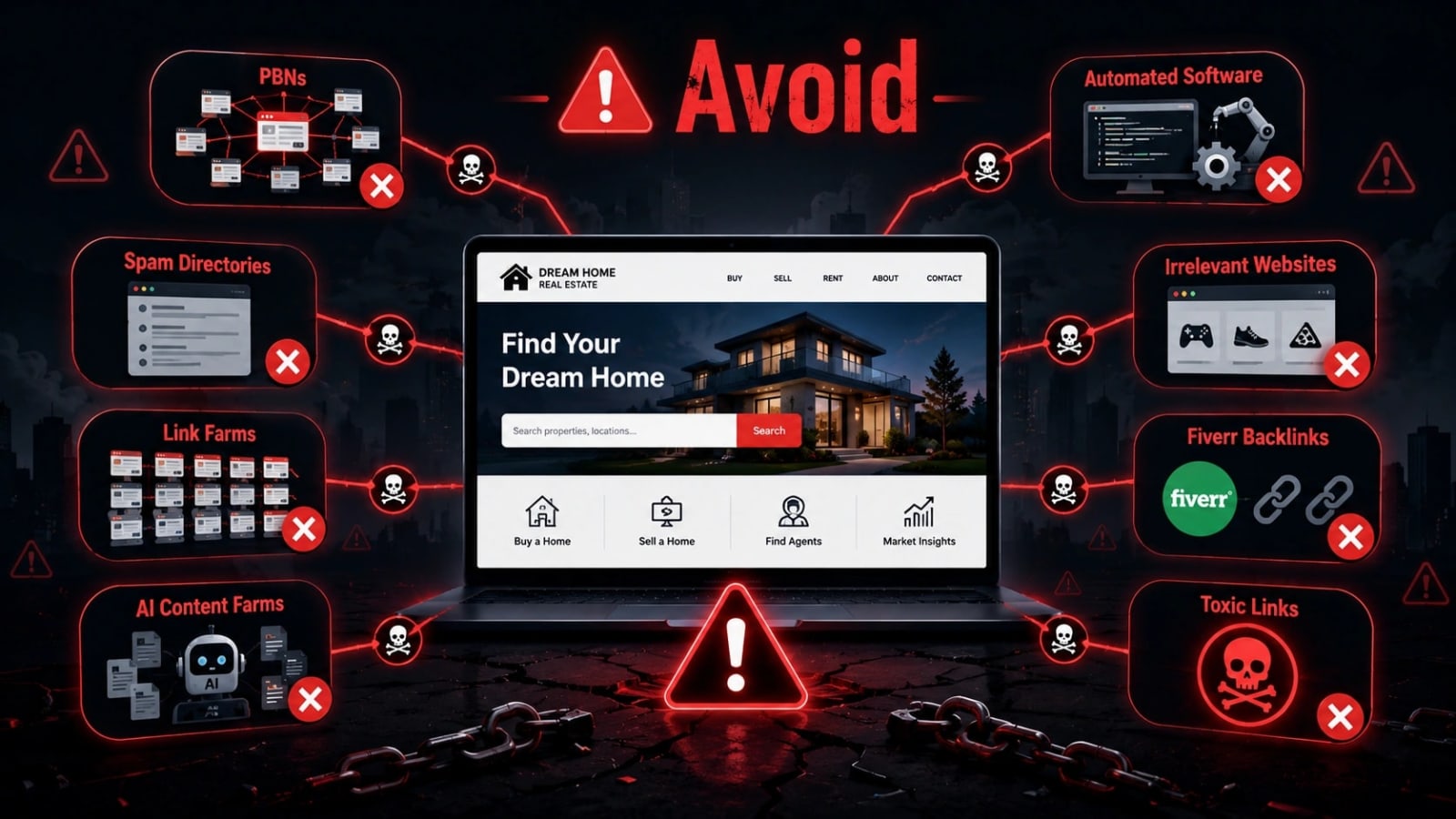
Not every backlink helps your rankings.
Poor-quality links can waste your budget and, in some cases, damage your website’s credibility.
Avoid these backlink sources.
Private Blog Networks (PBNs)
Networks built solely to manipulate rankings.
Spam Directories
Directories with no editorial review or real users.
Link Farms
Websites created only for buying and selling backlinks.
Automated Link Building Software
Large volumes of low-quality links are generated automatically.
Irrelevant Websites
A casino website linking to a real estate agency rarely provides value.
AI-Generated Content Farms
Low-quality websites publish thousands of articles with little editorial oversight.
Fiverr Backlink Packages
Packages promising hundreds or thousands of backlinks usually prioritize quantity over quality.
Excessive Reciprocal Linking
Occasional partnerships are natural.
Large-scale “I’ll link to you if you link to me” schemes are not.
Measuring Link Building Success
Link building should ultimately contribute to business growth, not just higher backlink counts.
Track metrics such as:
- Organic traffic
- Referring domains
- Keyword rankings
- Local Pack visibility
- Referral traffic
- Leads
- Contact form submissions
- Phone calls
- Property inquiries
- Revenue generated from organic search
Important KPIs
| Metric | Why It Matters |
|---|---|
| Referring Domains | Indicates backlink growth |
| Organic Traffic | Measures SEO performance |
| Keyword Rankings | Shows visibility improvements |
| Referral Traffic | Demonstrates backlink value |
| Local Rankings | Tracks geographic performance |
| Lead Generation | Connects SEO to business results |
| Conversion Rate | Measures visitor quality |
AI Search and the Future of Real Estate Link Building
AI-powered search experiences are changing how people discover information.
While backlinks remain important, search engines increasingly evaluate:
- Brand reputation
- Entity recognition
- First-hand expertise
- Original research
- Topical authority
- Consistent citations across the web
What This Means for You
Future-proof your strategy by creating assets that AI systems and search engines can confidently reference, such as:
- Original market reports
- Interactive tools
- Local guides
- Expert commentary
- Educational resources
- Data-driven studies
Backlinks are becoming part of a broader authority ecosystem rather than the only ranking signal.
Real Estate Link Building Checklist

Use this checklist to guide your campaign.
Research
- Identify target keywords.
- Analyze competitors.
- Audit existing backlinks.
- Find local opportunities.
Content
- Publish neighborhood guides.
- Create market reports.
- Build interactive tools.
- Update statistics pages.
Outreach
- Build prospect lists.
- Personalize emails.
- Follow up politely.
- Track responses.
Link Maintenance
- Monitor lost backlinks.
- Reclaim brand mentions.
- Fix broken pages.
- Review anchor text diversity.
Reporting
Track:
- New backlinks
- Referring domains
- Rankings
- Organic traffic
- Leads
- Conversions
Common Real Estate Link Building Mistakes
Avoid these common pitfalls:
- Prioritizing quantity over quality.
- Buying hundreds of cheap backlinks.
- Ignoring local SEO opportunities.
- Overusing exact-match anchor text.
- Publishing thin content.
- Sending generic outreach emails.
- Ignoring competitor analysis.
- Building links too quickly.
- Not updating evergreen content.
- Forgetting link maintenance.
- Chasing only high DR websites.
- Ignoring referral traffic.
- Relying only on guest posting.
- Not measuring ROI.
- Treating link building as a one-time project.
Recommended Tools
| Tool | Best Use |
|---|---|
| Ahrefs | Backlink analysis and competitor research |
| Semrush | SEO audits and backlink tracking |
| Moz | Domain authority and link metrics |
| Majestic | Trust Flow and Citation Flow analysis |
| Google Search Console | Monitor backlinks and search performance |
| Screaming Frog | Technical SEO and broken link detection |
| BuzzStream | Outreach management |
| Hunter.io | Find email addresses |
| Pitchbox | Outreach automation |
| Google Alerts | Brand mention monitoring |
Final Thoughts
Real estate link building is no longer about collecting the highest number of backlinks. It’s about earning trust from the websites that matter most to your audience and your local market.
The strongest backlink profiles are built through valuable content, meaningful relationships, and consistent outreach. A neighborhood guide that helps buyers, a housing report that journalists cite, or a local partnership that benefits the community can all contribute far more than dozens of low-quality links.
Start with a solid foundation by building local citations, joining reputable business organizations, and creating resources that people genuinely want to reference. As your authority grows, expand into digital PR, original research, interactive tools, and strategic outreach.
Treat link building as an ongoing investment rather than a one-time task. With patience and a focus on quality, you’ll build a backlink profile that improves rankings, attracts qualified traffic, and supports long-term growth for your real estate business.
Frequently Asked Questions
Backlinks help search engines evaluate your website’s credibility. High-quality links can improve rankings, increase organic traffic, and generate more qualified leads.
There is no fixed number. A smaller website with highly relevant local backlinks can outperform a larger site with hundreds of low-quality links.
For most real estate businesses, yes. Backlinks from local organizations, newspapers, and community websites strengthen geographic relevance and support local SEO.
Buying editorial placements on quality, relevant websites is different from purchasing bulk spam links. Focus on reputable publishers and avoid low-quality link schemes.
Most campaigns begin showing measurable SEO improvements within three to six months, although timelines vary depending on competition and website authority.
Citations mention your business details, while backlinks include clickable links to your website. Both support local SEO, but backlinks typically have a stronger impact on organic rankings.