Reels ads now reach over 2.35 billion Instagram users monthly, yet most advertisers still treat them like repurposed feed content and wonder why results fall flat. Short-form video ad placements are now among the highest-engagement surfaces across both Instagram and Facebook, making them a critical budget consideration in 2026. This guide covers how Reels ads work, the exact setup process, creative specs, targeting strategies, performance benchmarks, and the mistakes that drain budgets fast.
This article is written for brand marketers, performance advertisers, and agency teams who want measurable returns from Reels placements. Whether you are launching your first Reels campaign or auditing an existing one, every section below gives you specific, actionable guidance rooted in how the format actually behaves.
What Reels Ads Are and How They Differ from Other Ad Placements
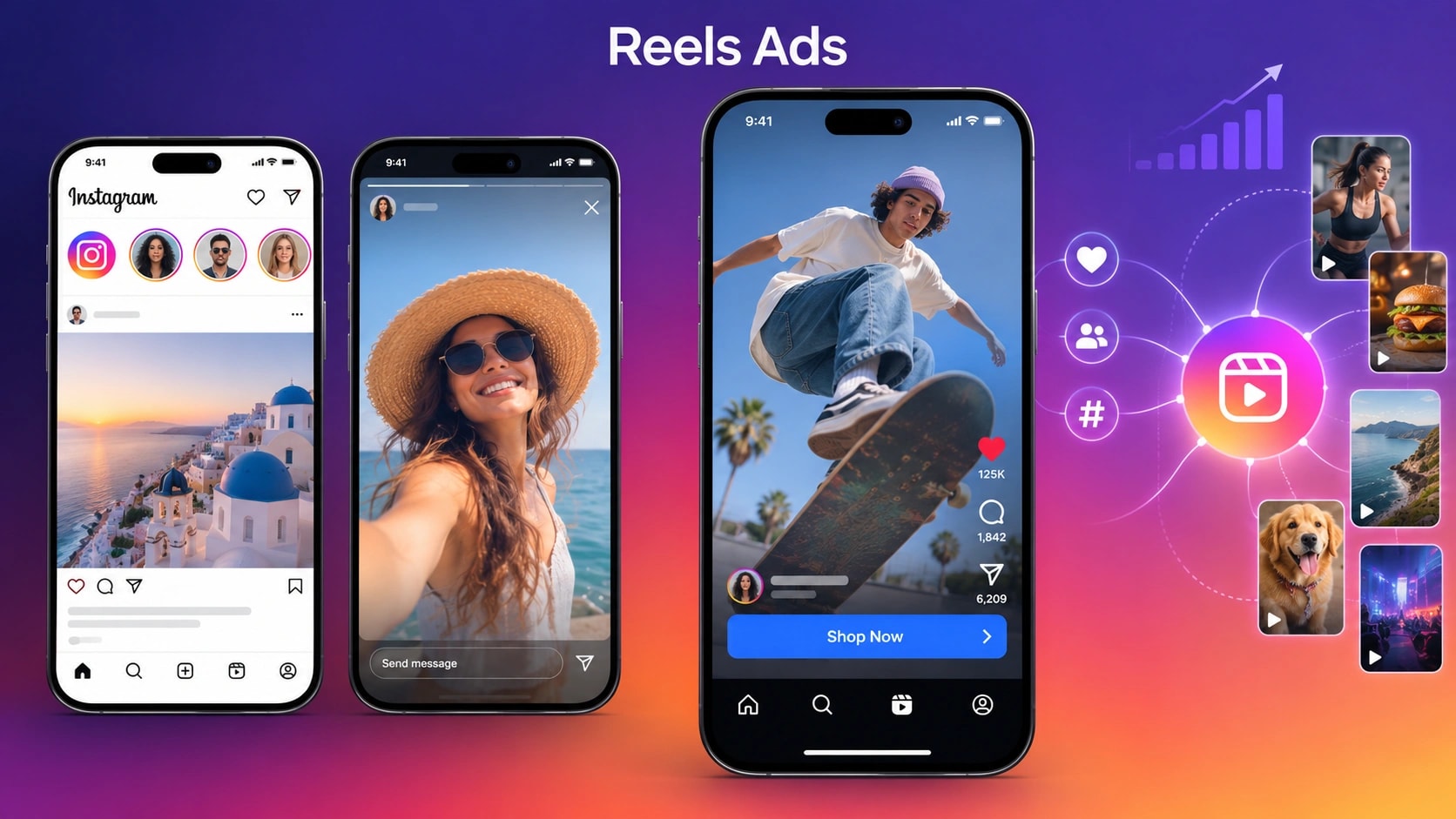
Reels ads are full-screen, vertical video ads that appear between organic Reels content in the Reels feed on both Instagram and Facebook. They are not the same as Stories ads or in-feed video ads. The distinction matters because users are in an active scrolling and discovery mindset when watching Reels. That mindset changes how ads must be structured to earn and hold attention.
Reels ads loop just like organic reels content. A poorly edited end frame will cause immediate drop-off rather than a clean exit. Advertisers who import a standard video ad without checking the loop point lose viewers at exactly the moment they could be reinforcing a CTA. Reels ads appear in the Instagram Reels feed, the Facebook Reels feed, and across both platforms when Advantage+ placements are enabled in Meta Ads Manager.
Feature
Reels Ads
Stories Ads
In-Feed Video Ads
Format
Full-screen vertical 9:16
Full-screen vertical 9:16
Square 1:1 or 4:5 vertical
Max Duration
60 seconds
15 seconds per card
Up to 60 seconds
Skip Behavior
Swipe up to skip
Tap to skip
Scroll past
Loop Capability
Yes, continuous loop
No
No
CTA Placement
Bottom overlay button
Swipe-up or button
Below video in feed
Average CPM Range
$6 to $14
$5 to $10
$8 to $16
Instagram Reels Ads vs. Facebook Reels Ads: Key Differences
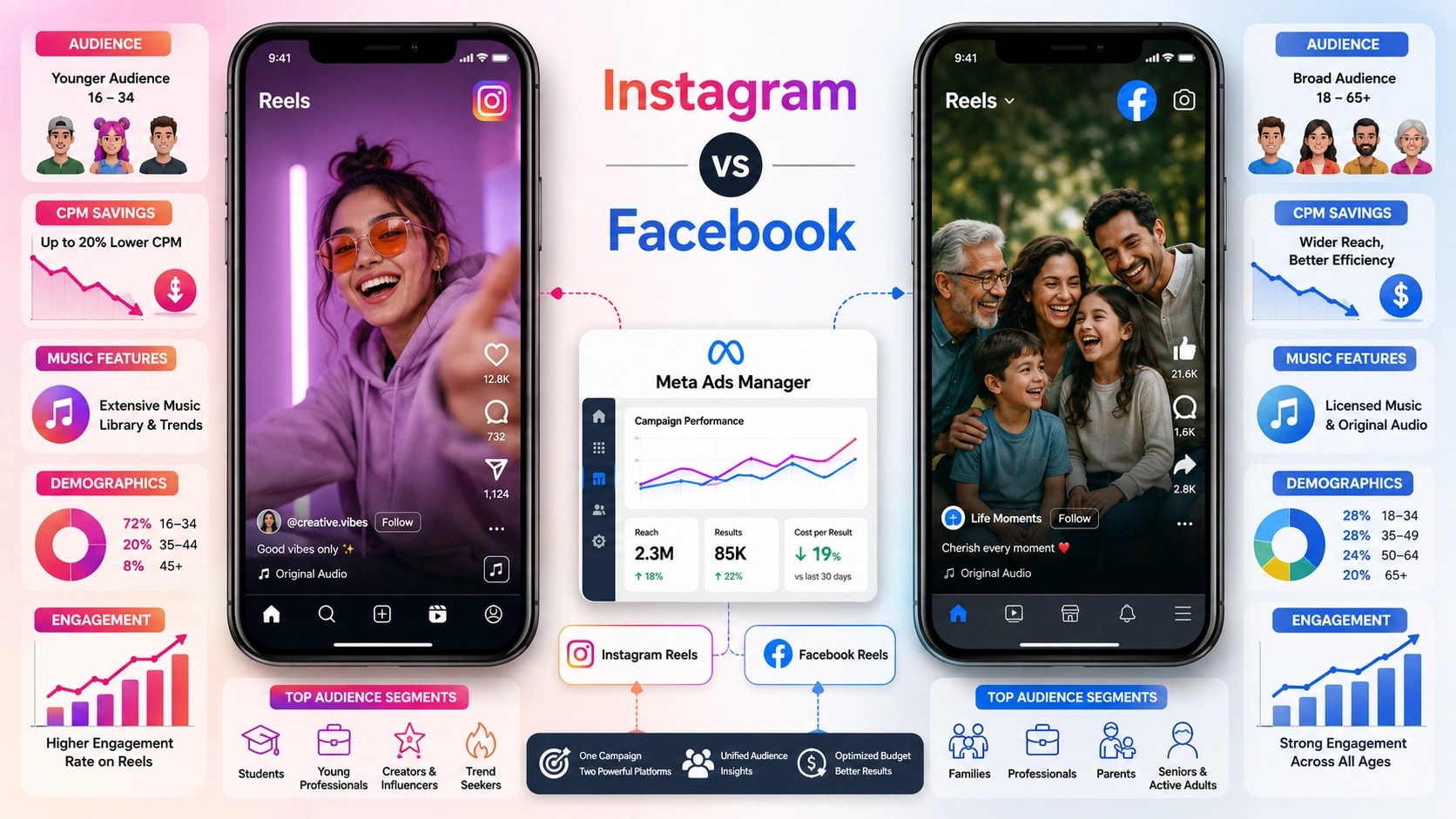
Instagram Reelsads skew toward younger audiences in the 18 to 34 age range. Facebook Reels ads tend to reach a broader 25 to 54 demographic. This difference affects creative tone, messaging style, and offer type. A direct-response ad for a premium software tool will likely perform differently on each platform even with identical targeting parameters.
Instagram Reels ads support music overlays natively and have tighter creative community standards around text-heavy visuals. Facebook Reels ads currently show lower CPMs than Instagram placements in most verticals, making them worth testing as a cost-efficiency option. Both platforms share the same Meta Ads Manager setup but perform differently. Running identical creatives across both without adjustment is a common budget mistake. Use placement asset customization in Meta Ads Manager to serve slightly different creative versions to each platform within the same campaign.
Organic Reels vs. Reels Ads: When Boosting Is Not Enough
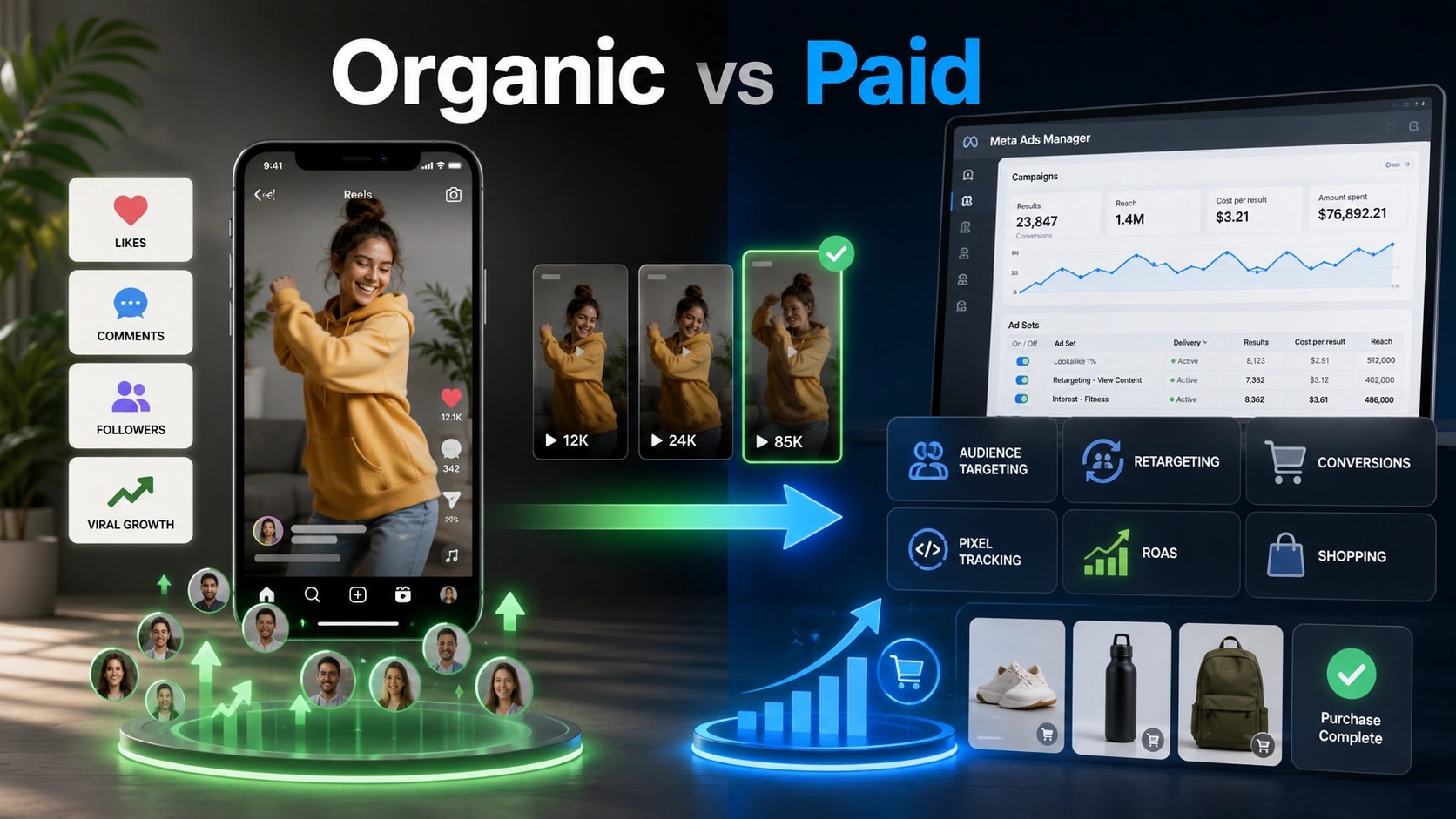
Boosting an existing organic reel gives limited targeting options. You can only select broad interest categories, not custom audiences or lookalikes. Running a proper Reels ad through Meta Ads Manager enables retargeting, conversion objectives, pixel-based audiences, and full A/B testing capabilities. The algorithm also treats boosted reels and Ads Manager reels differently in delivery. Ads Manager campaigns offer more predictable reach scaling over time.
Organic reels can validate creative concepts before paid spend. A reel with strong organic engagement signals it may perform well as a paid unit. However, avoid treating every high-performing organic reel as automatically ad-ready. Paid placements require a direct CTA and a clear value proposition in the first three seconds. Organic virality and paid conversion are driven by different viewer behaviors, and conflating the two wastes budget.
Technical Specs and Creative Requirements for Reels Ads
Getting specs wrong wastes every dollar spent on production. Creatives that are rejected or poorly displayed never get the chance to perform. Before uploading any video to Meta Ads Manager for a Reels placement, confirm it meets the following requirements.
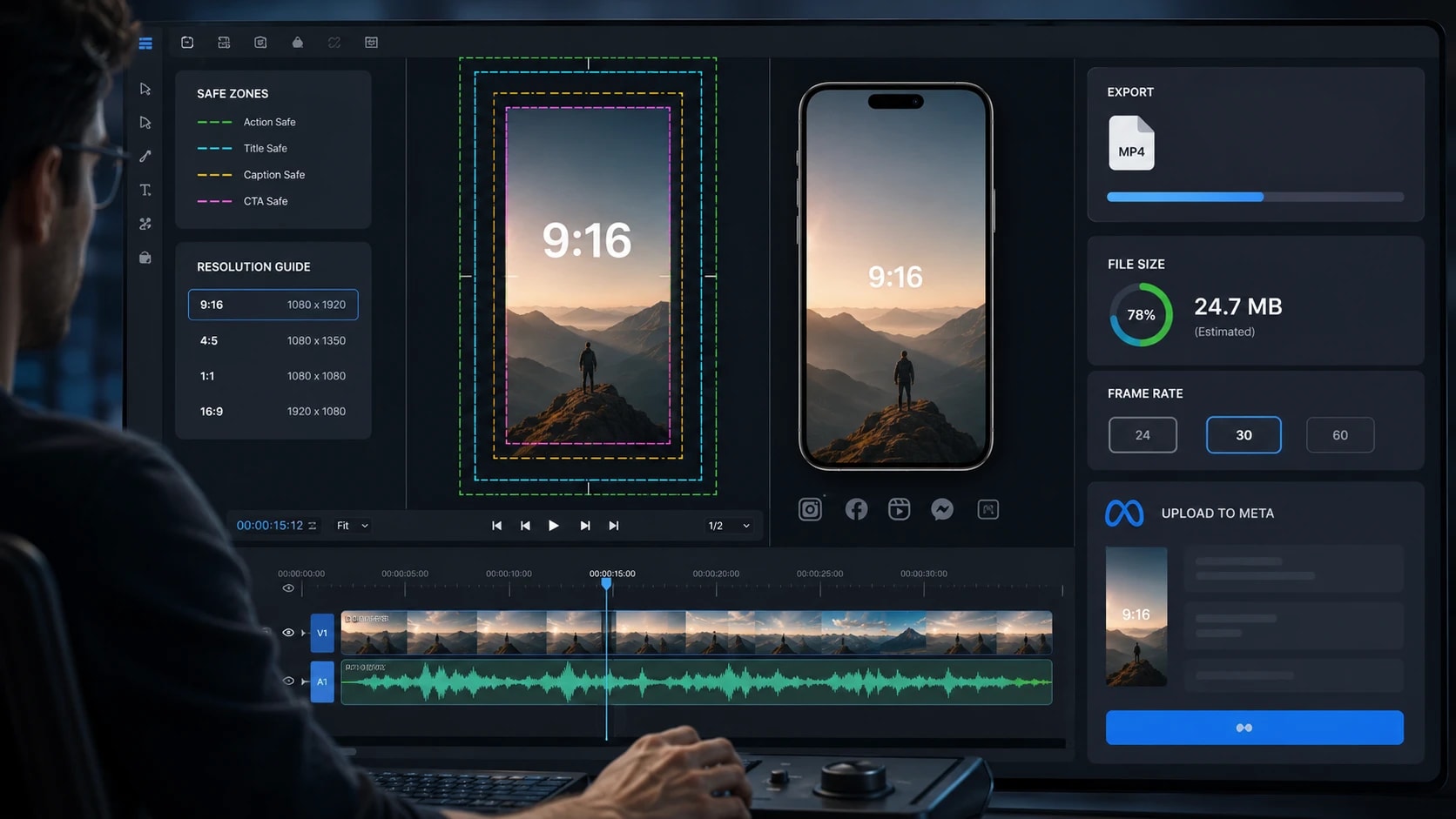
Aspect ratio: 9:16 vertical only
Minimum resolution: 1080 x 1920 pixels
Video length: 5 to 60 seconds on Instagram, up to 60 seconds on Facebook
File format: MP4 or MOV
Maximum file size: 4GB
Frame rate: 23 to 60 frames per second
Safe zone: Keep all text, logos, and CTAs within the center 80% of the frame
Audio: Stereo AAC audio at 128kbps or higher recommended
Safe zones matter more on Reels than on any other placement. UI elements on both Instagram and Facebook cover the top and bottom edges of the screen. Any text or CTA placed in those zones will be obscured. Unlike feed or Stories ads, Reels viewers have sound on by default. Design audio as a feature, not an afterthought. Captions are still recommended even with audio-on behavior, because many users watch in noisy environments or with partial volume.
Video Length Strategy: What Duration Actually Converts
Reels ads under 15 seconds consistently show higher completion rates. Every second beyond 15 requires an additional creative hook to retain viewers. The 3-second rule applies more strictly here than on any other placement. If the visual or audio hook fails to spark curiosity within the first 3 seconds, swipe rates spike immediately. This is the single most important rule in reels ad production.
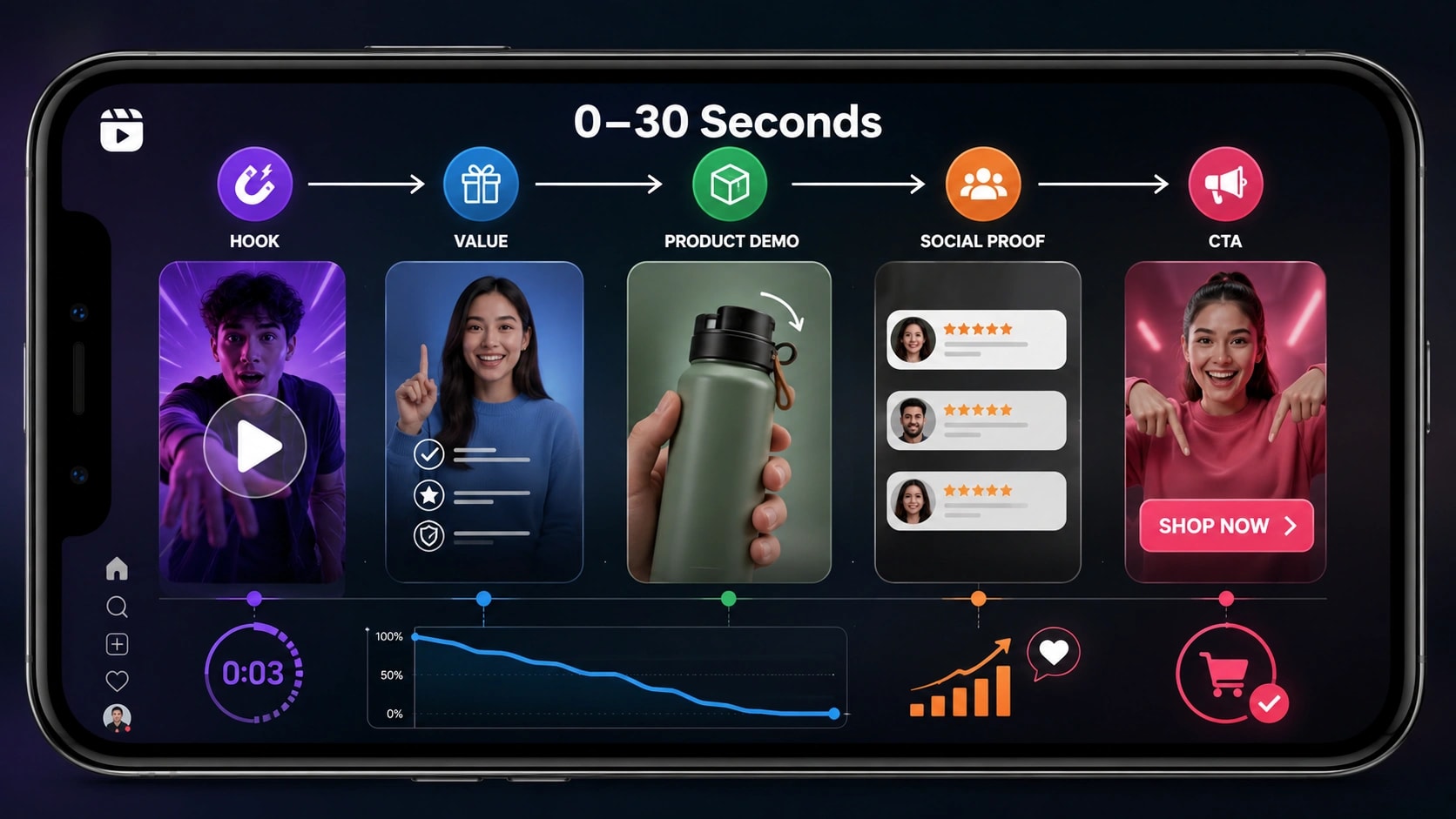
For conversion-focused campaigns covering product sales or lead generation, 15- to 30-second reels ads perform best. That window allows enough time to show the product, state the benefit, and deliver a clear CTA. For brand awareness campaigns, 6- to 10-second reel ads deliver strong recall at lower cost-per-view. Use the following timing structure as a starting framework:
0 to 3 seconds: Hook, present a problem or create a pattern interrupt
3 to 10 seconds: Value delivery, explain what it does and why it matters
10 to 25 seconds: Proof or product demonstration
25 to 30 seconds: CTA, direct instruction to click, shop, or sign up
Audio, Text Overlay, and Hook Design for Reels Ads
Original audio or licensed music performs better than silence. Voice-over with a direct statement outperforms background music alone for conversion campaigns. Text overlays should reinforce the spoken word, not repeat it verbatim. Use on-screen text to add a secondary benefit or urgency element that the voice-over does not state explicitly.
Hook formats that work consistently include bold statement openings such as “Most brands get this wrong,” direct address lines such as “If you run paid ads, watch this,” and visual contrast like a before-and-after split in the first frame. Avoid cluttered frames. Reels are consumed fast. One focal point per scene keeps attention anchored. The first frame acts like a thumbnail. Design it to stop the scroll even without motion, since some users preview reels before tapping play.
How to Set Up a Reels Ad Campaign in Meta Ads Manager
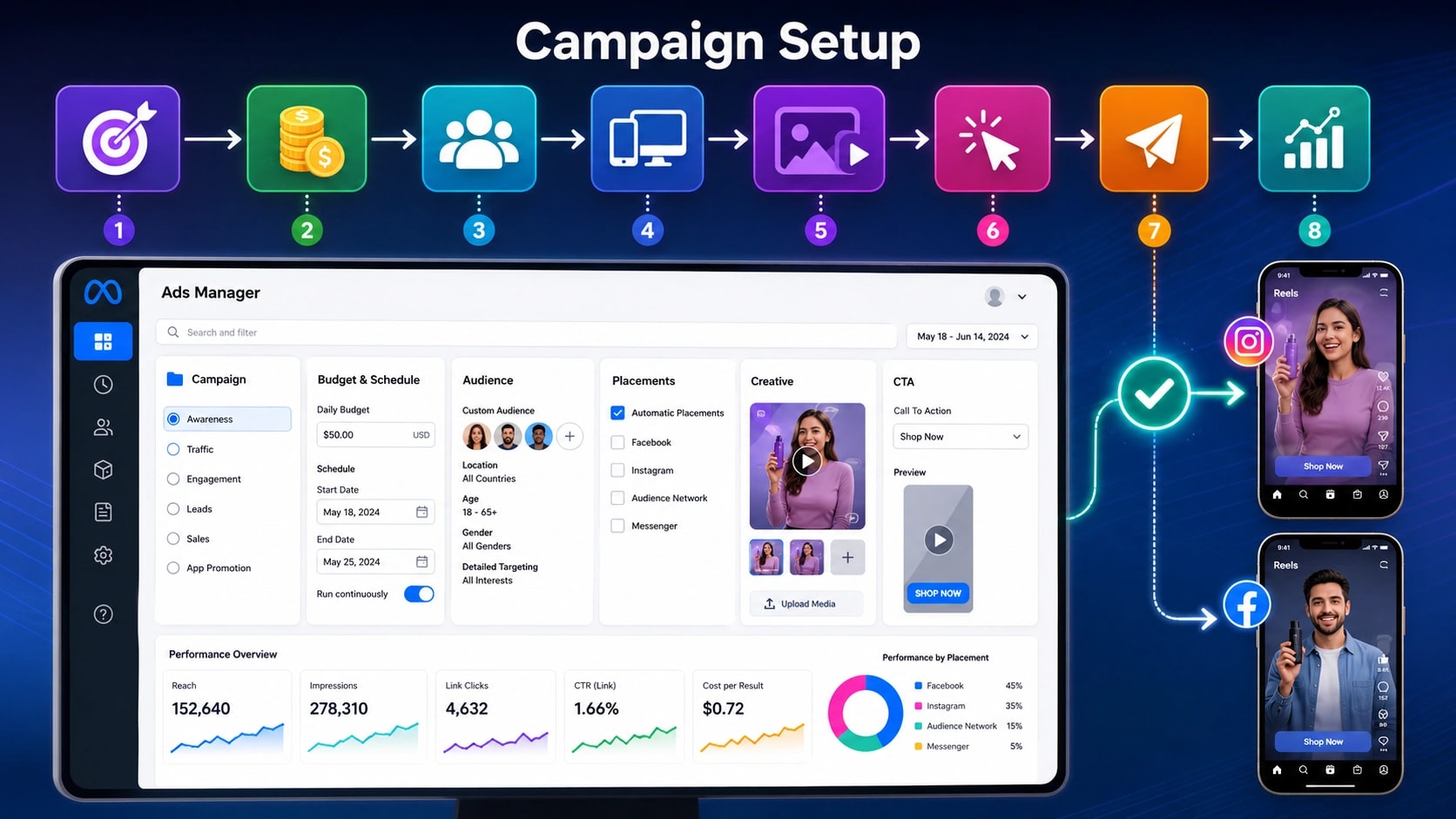
The setup process in Meta Ads Manager follows a clear sequence. Each decision point affects how the algorithm delivers your Reels ads and how results are reported. Follow the steps below to avoid common configuration errors that inflate costs during the learning phase.
Choose a campaign objective aligned with your goal: Awareness, Traffic, Engagement, Leads, or Conversions.
Set your daily or lifetime budget and campaign schedule
Define your audience at the ad set level using custom, lookalike, or interest-based targeting
Select placements manually by navigating to Ad Set, then Placements, then Manual Placements, and selecting Instagram Reels and/or Facebook Reels
Upload your 9:16 creative at the ad level
Add primary text and select your CTA button type
Review all settings in the ad preview and publish
Objective selection directly affects how Reels ads are optimized for delivery. Choosing Awareness will maximize reach and views. Choosing Conversions will optimize for pixel events such as purchases or form fills. Leaving Advantage+ placements active during initial testing makes it impossible to isolate Reels ad performance from other placements in reporting. Use manual placements during testing, then broaden to Advantage+ once you have a baseline for comparison.
Audience Targeting Strategies That Work Specifically for Reels Ads
Reels ads reach users who were not actively searching for your product. The creative must handle the education and persuasion work that search ads offload to intent. Cold audience targeting via interest stacking works well: combine behavioral interests with demographic filters to reach users most likely to recognize the problem your product solves. Keep cold audiences above 1 million to avoid rapid frequency spikes that drive up CPMs and cause creative fatigue within days.
Retargeting via Reels video views is one of the highest-converting sequences available in Meta advertising. Create a custom audience of users who watched 50% or more of a previous Reels ad, then serve them a follow-up ad with a stronger offer or more specific proof. Lookalike audiences built from buyer lists or high-value website visitors consistently outperform broad interest targeting for direct-response Reels campaigns. Always exclude existing customers from acquisition campaigns to prevent wasted spend and incorrect ROAS reporting.
Budgeting, Bidding, and Cost Benchmarks for Reels Ads
Average CPM for Instagram Reels ads ranges from $6 to $14 depending on vertical, audience size, and creative quality score. Ecommerce and finance verticals sit at the higher end of that range. Facebook Reels ads typically show CPMs 20 to 40% lower than Instagram in the same audience, making them valuable for awareness campaigns where reach volume matters more than placement prestige.
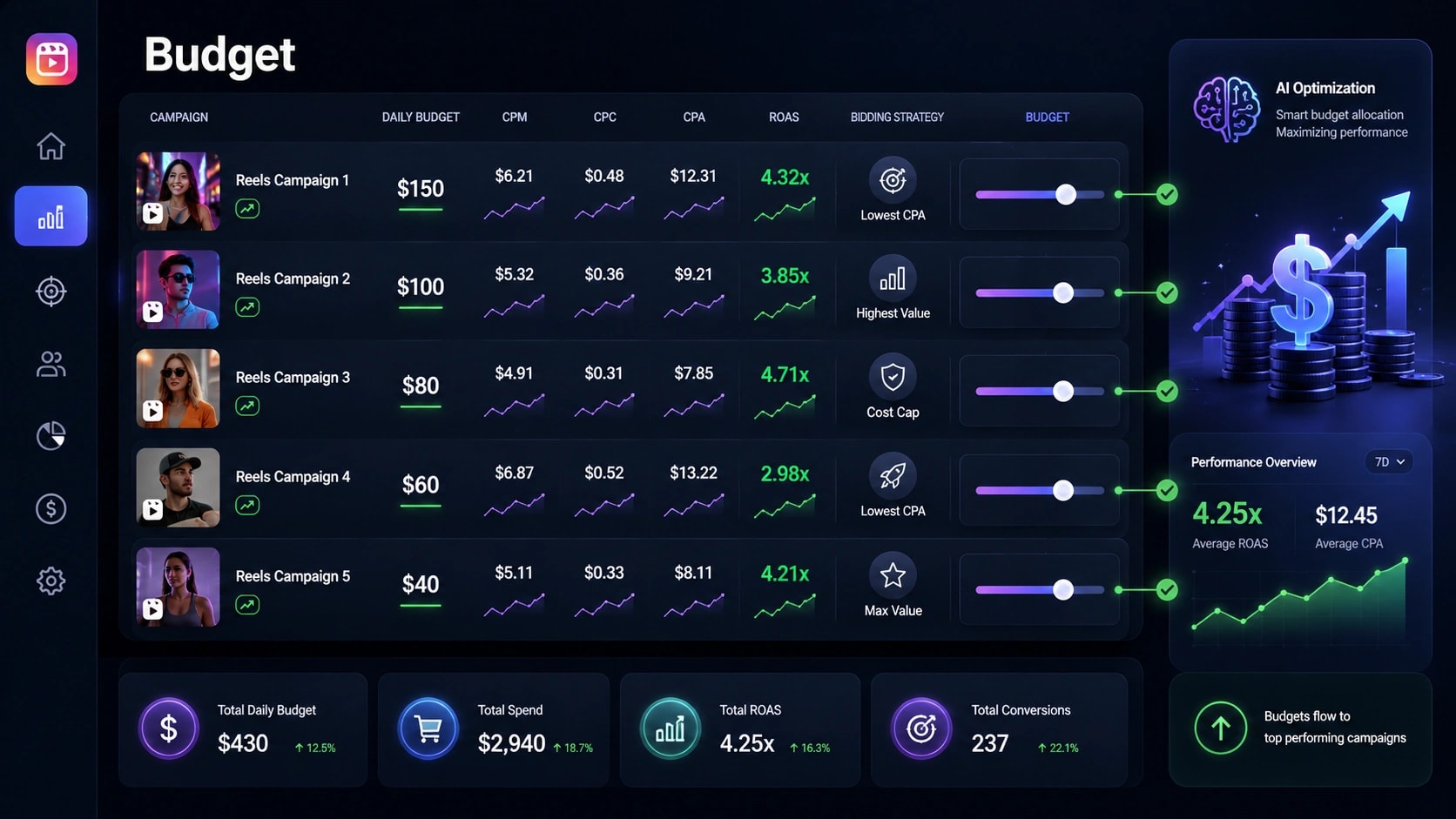
Start with a daily budget of $30 to $50 minimum per ad set during the testing phase. This gives the algorithm enough data to exit the learning phase within seven days. Use Lowest Cost automatic bidding during testing. Switch to Cost Cap only once you have a proven CPA baseline from at least 50 conversion events. Avoid pausing and restarting campaigns too frequently. Each restart resets the learning phase and inflates CPMs. Let campaigns run a minimum of five to seven days before making any changes.
Measuring Reels Ad Performance: Metrics That Actually Matter
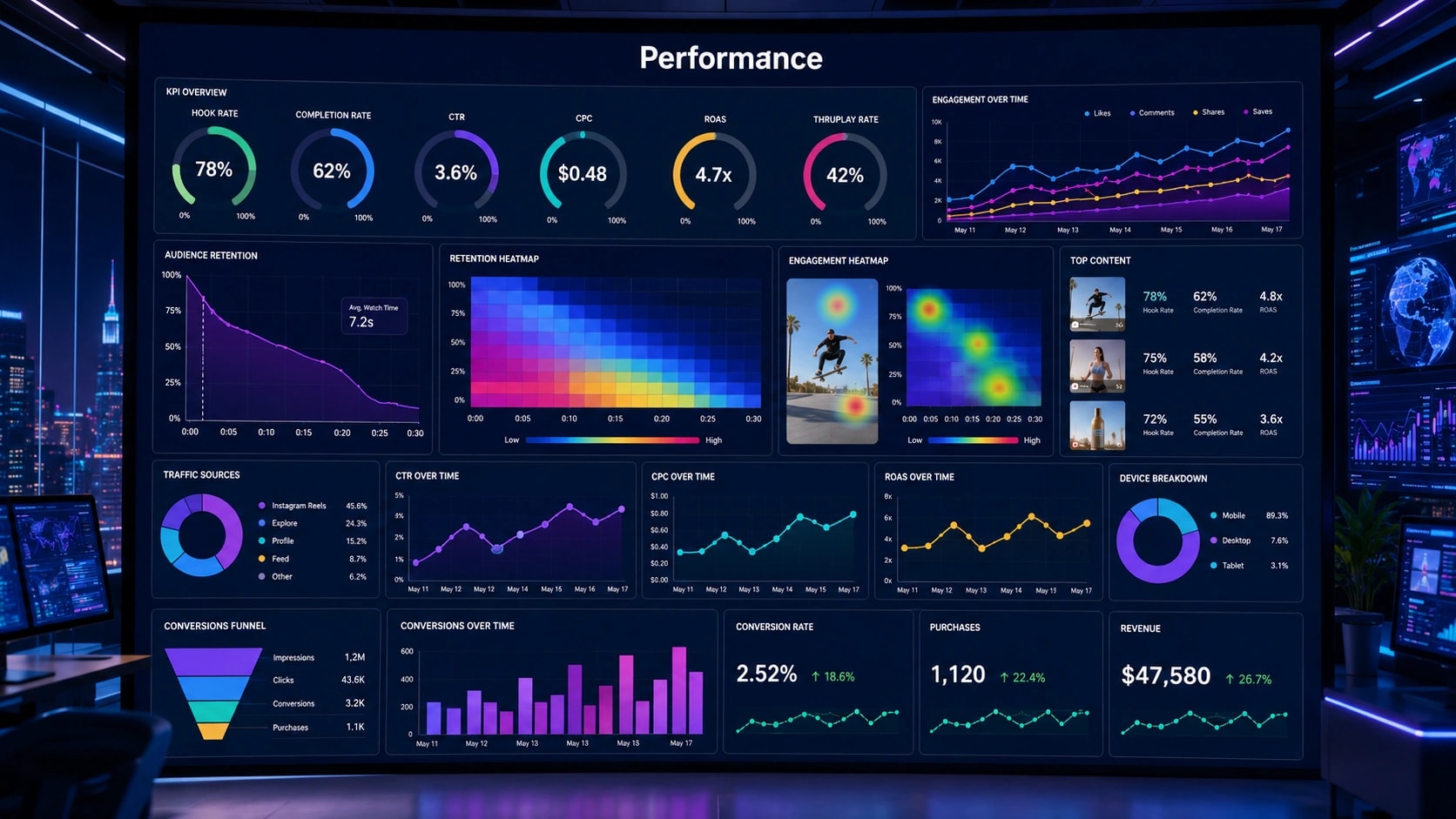
Most advertisers track the wrong metrics for Reels ads. Impressions and reach are useful context numbers, but they do not tell you whether your creative is working. The metrics below directly indicate creative health and campaign efficiency. Track them as your primary performance signals from day one.
Hook Rate: 3-second video plays divided by impressions. A rate above 30% means the opening frame is doing its job. Below 20% signals the creative needs a stronger first-second visual.
Video Completion Rate: 40 to 60% for 15-second reel ads is healthy. Below 30% suggests pacing issues or a lack of narrative tension.
Thumb-Stop Ratio: Measures how often users stop scrolling to watch, based on initial play rate relative to reach.
Cost Per ThruPlay: The cost to deliver a video view where the viewer watched at least 15 seconds or the full video if shorter.
Click-Through Rate (CTR): Outbound CTR above 1% is a healthy baseline for reels placements in most verticals.
Cost Per Click (CPC): Monitor alongside CTR to identify creative or audience efficiency issues early.
Return on Ad Spend (ROAS): The primary efficiency metric for conversion-focused Reel campaigns.
Build a custom reporting view in Meta Ads Manager to track these metrics side by side. Add the following custom columns: 3-second video plays, ThruPlays, video average play time, and outbound CTR. This dashboard gives you a full picture of how viewers engage with your Reels ads at every stage of the video, from the first frame to the CTA click.
A/B Testing Framework for Reels Ads
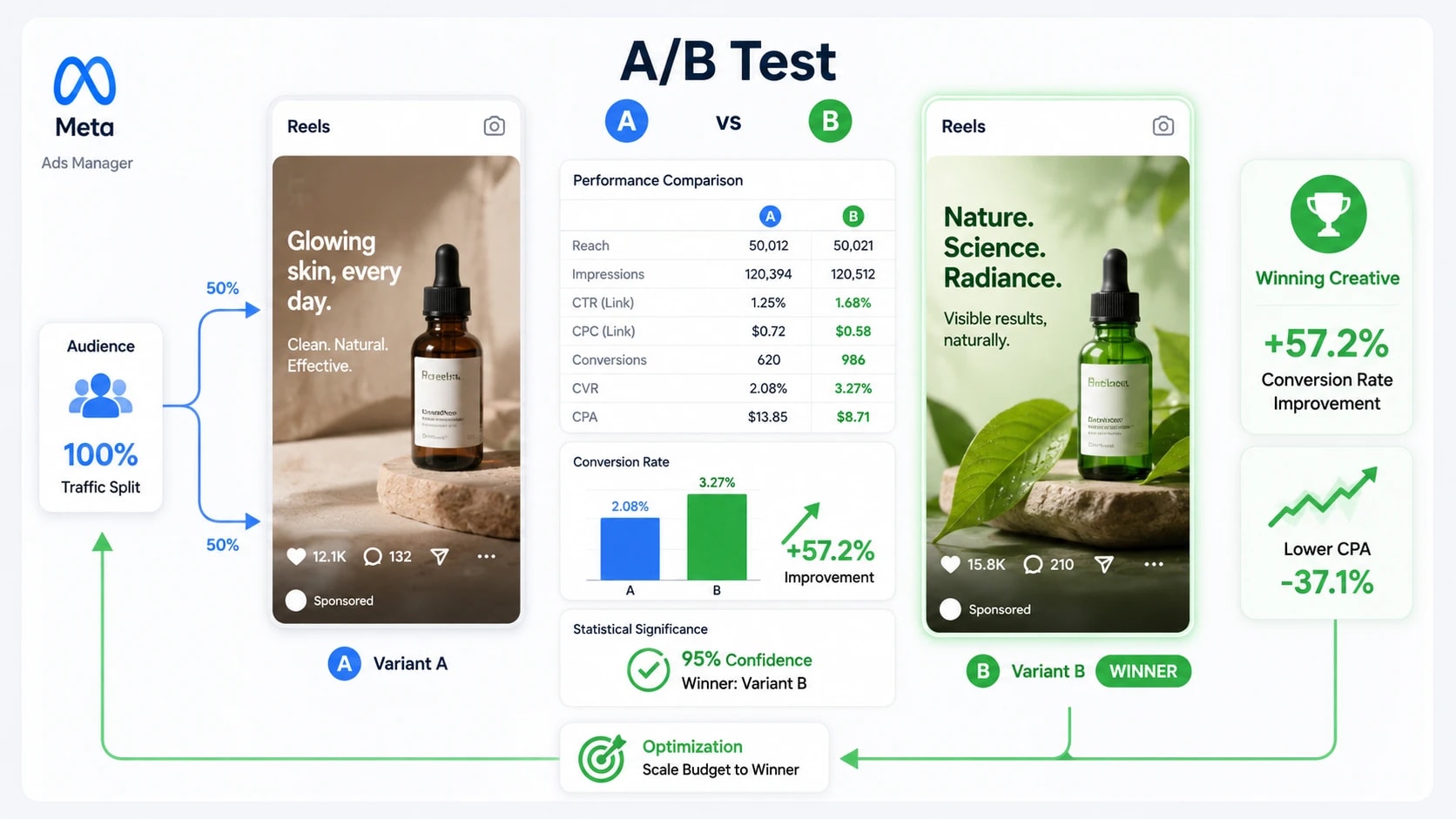
Test one variable at a time to get clean, actionable data. Testing hook against hook is more valuable than testing a hook against a different offer or a different format simultaneously. When multiple variables change at once, you cannot identify which element drove the performance difference. The priority order for testing is: creative hook first, then CTA copy, then audience targeting, then offer or pricing. Most campaign failures trace back to weak hooks, not targeting.
Use Meta’s built-in A/B Test tool rather than running duplicate ad sets manually. It ensures an even traffic split and removes statistical noise from delivery differences. Run each test for a minimum of seven days or until each variant accumulates 100 conversions, whichever comes first. Ending tests early produces statistically unreliable winners. Document every test result in a creative library. Over time, this builds a Reels ad playbook specific to your brand and audience that eliminates guesswork from future campaigns.
Common Reels Ad Mistakes That Kill Campaign Performance
Several recurring mistakes consistently undermine Reels ad performance regardless of budget size. Identifying and fixing them before launch saves significant spend.
Repurposing horizontal or square video without reformatting. Letterboxing wastes 40% of the screen and signals low-quality content to both the algorithm and the viewer.
No clear CTA within the video itself. Relying solely on the ad’s CTA button is not enough. Spoken or on-screen CTAs inside the video improve click rates significantly.
Starting with a logo or brand intro. Viewers swipe within one to two seconds if the opening frame does not create immediate curiosity or relevance. A logo maker can help you create a clean, recognizable logo that strengthens brand recognition without slowing down your video’s opening.
Using stock footage that looks like an ad. Reels perform best when creative mimics native, authentic content rather than polished broadcast-style production.
Running a single creative until it burns out. Reels ad creative fatigue typically sets in at three to five times frequency. Maintain a rotation of three to five active creative variants to prevent performance decline.
Ignoring comment moderation on Reels ads. Negative comments are public and visible to all viewers. Unaddressed negative comments directly reduce conversion rates by undermining trust at the point of decision.
How Reels Ads Support a Broader Link-Building and Brand Authority Strategy
Reels ads drive significant branded search volume. Users who see a Reels ad multiple times often search the brand name directly afterward. That branded search behavior signals authority to search engines and creates natural link acquisition opportunities. Publishers and journalists who write about trending brands frequently cite companies they have seen advertising consistently across social platforms.
High-visibility reels campaigns get noticed by bloggers, journalists, and industry writers. Earned media coverage and backlinks frequently originate from brands that maintain a strong paid social presence. Marketing Lad works with brands to build the kind of authority that compounds across both paid and organic channels. A strong backlink profile increases the landing page quality scores that reels ad traffic converts on, creating a direct connection between paid social investment and organic search performance.
Retargeting audiences built from Reels ad viewers with content-focused landing pages, including guides, original studies, and tools, creates a path to natural link acquisition.
Users who discover a brand through video are more likely to share or cite its resources in their own content. Brands running active Reels campaigns are also easier to pitch for PR and link placements. Publishers evaluate marketing investment and demonstrated audience reach when deciding which brands to partner with or feature.
Reels ad activity provides visible proof of both. Using a GIF maker can also help brands create engaging visual content that supports their video campaigns and gives publishers more shareable assets to feature.
Final Thoughts
Reels ads are one of the most cost-effective paid placements available in 2026 when creative, targeting, and measurement are handled with discipline. They punish generic, repurposed content faster than any other format.
The key takeaways from this guide are straightforward: match creative format to the reels-native experience, lead with a strong hook in the first three seconds, test variables methodically with clean split tests, track completion rate and hook rate over vanity numbers, and rotate creatives before fatigue sets in at three to five times frequency.
Reels ad success does not happen in isolation. It strengthens branded search volume, improves landing page authority, and builds the overall digital footprint that makes every other marketing channel perform better. Marketing Lad helps brands build the backlink authority and domain trust that makes paid traffic convert at higher rates.
Visit marketinglad.io to explore howlink-building supports your paid social strategy. Your next step is clear: audit your current Reels ad creative against the specs and hook framework in this guide, run one structured A/B test this week, and start tracking hook rate and completion rate as your primary performance signals.
Frequently Asked Questions
What is the minimum budget needed to run Reels ads effectively on Meta?
A daily budget of $30 to $50 per ad set is the recommended minimum for testing reels ads. This amount gives the Meta algorithm enough daily spend to gather data and exit the learning phase within five to seven days. Budgets below this threshold result in slow data accumulation, which means campaigns stay in the learning phase longer and CPMs remain artificially elevated. Once you have identified a winning creative and audience combination, you can scale the daily budget upward by 20 to 30% every few days without triggering a full learning phase reset.
Can I run Reels ads on Instagram without a business account?
No. Running reels ads through Meta Ads Manager requires a Facebook Page and, for Instagram placements, an Instagram Business or Creator account connected to that Page. Personal Instagram accounts cannot be used as the identity for paid reels ads. Setting up a Business account is free and takes only a few minutes in the Instagram app under Account Settings. Once connected to Meta Business Suite, the account becomes eligible for all reels ad placements and campaign objectives available in Ads Manager.
How long should a Reels ad be for the best conversion results?
For conversion-focused campaigns targeting purchases or lead generation, 15 to 30 seconds is the optimal range. This duration gives enough time to present a hook, deliver the core value proposition, show brief proof or demonstration, and close with a clear CTA. Videos under 15 seconds work well for brand awareness goals where cost-per-view efficiency matters more than depth of message. Avoid exceeding 30 seconds unless your product genuinely requires more explanation, and always ensure a strong hook appears within the first three seconds regardless of total length.
Why are my reels ads getting impressions but no clicks or conversions?
Low clicks despite strong impressions usually point to one of three issues. First, the creative lacks a clear and direct CTA both inside the video and as a button overlay. Second, the hook may be attracting views but failing to qualify the right audience, meaning people watch out of curiosity rather than genuine interest in the offer. Third, the landing page experience may not match the promise made in the ad, causing drop-off after the click. Check your hook rate and video completion rate in Meta Ads Manager. If completion rate is high but CTR is low, the issue is the CTA. If completion rate is low, the issue is deeper in the creative structure.
What is the difference between boosting a reel and running a Reels ad through Meta Ads Manager?
Boosting a reel from the Instagram app gives you basic reach settings with limited audience options such as broad interest categories and follower lookalikes. It does not support custom audiences, pixel-based retargeting, conversion objectives, or structured A/B testing. Running a reels ad through Meta Ads Manager gives you access to the full suite of campaign objectives, audience targeting tools including custom and lookalike audiences, pixel event optimization, placement controls, and detailed reporting with custom metrics. For any campaign with a measurable performance goal, Ads Manager is always the better choice over the Boost button.
Tags:#facebook reels ads#instagram reels ads#meta ads#short-form video advertising
Shahid Shahmiri is a digital marketer who helps online businesses grow with smart marketing tactics that improve sales and leads. He is passionate and driven to grow businesses online and is responsible for analyzing marketing, SEO, growth and managing promotional and media channels.