
On this page17
- Three essential concepts should be considered when conducting keyword research
- SEMScoop
- Review and features of SEMScoop
- 1. Related Keywords
- 2. Keyword Metrics Data
- 3. Top Search Results
- 4. Content Analysis
- 5. Social Engagement
- 6. Sort Options
- 7. Filter Options
- 8. Managing Your Project
- 9. Import External Keyword List
- 10. Save/Export Your Work Data
- 11. SEMScoop Blog
- SEMScoop pricing
- Strengths & Limitations
- Frequently Asked Questions
SEMScoop is a keyword research and difficulty tool that analyses the current search results behind each keyword. It provides search volume, CPC, related keyword ideas, difficulty scores and evidence from the live top-ten SERP.
Unlike tools that present only a difficulty number, SEMScoop shows the ranking pages and competitive evidence behind its score.
It’s best suited to bloggers, content marketers, independent SEO professionals and agencies validating which keywords they can realistically rank for.
A query can be navigational, informational, or transactional. Firstly, SEO professionals research keywords and then align web pages with them to achieve better rankings in search engines. Once a niche keyword is found, they expand on it to find similar keywords.
The objective of keyword research is to create a large number of precise terms that are highly relevant to the given input keyword. It involves brainstorming and using effective keyword research tools. Optimizing a website’s content and backlinks for the most relevant keywords is essential to achieving the best SEO results.
It is favorable for a website to target relevant keywords with low competition and a very high search volume. It makes it more manageable to achieve a higher rank in search engines, which usually results in more web traffic. The flaw in this practice is that the website is optimized for alternative keywords rather than the main keyword. It is challenging to rank the main keywords due to high competition.
Three essential concepts should be considered when conducting keyword research:
- A good keyword should be closely related to the website’s subject. Most search engines use an internal quality system to assess website relevance to specific keywords; a non-related keyword is unlikely to rank well for a website.
- Highly competitive keywords have low chances of ranking at the top. Keywords with no monthly searches are believed to generate little or no traffic, so they have little SEO value.
- Keyword stuffing on a web page should be avoided.
SEMScoop:

SEMScoop is a powerful and multifunctional keyword tool with high accuracy for keyword research. It is a great SEO tool you can use against your competitors, as it provides competitive analysis and advanced SEO metrics. To analyze a keyword, input your seed keyword in the SEMScoop keyword data analysis bar, select the right location and language, and click the search button. For example, I used the keyword ‘Marketing Lad’ and received a complete keyword analysis, as shown below.

Review and features of SEMScoop:
1. Related Keywords:
When we enter a keyword, a complete list of keyword ideas appears on the left-hand side, as shown below.

The above list shows the keywords relevant to the parent keyword,’ Marketing Lad,’ and they may also include keyword ideas you may not know existed. The keyword ideas tab shows you relevant keywords, along with an overview of metrics such as CPC, PPC, and search volume. It is essential to get related keywords in any keyword research tool.
2. Keyword Metrics Data:

The above image shows the complete keyword analysis for the keyword you plan to rank for. The keyword metrics data includes Search Volume, CPC, PPC, DA, PA, etc.
Keyword Difficulty:
It is an essential metric for any SEO tool. The data provided by the keyword difficulty feature will give you an overview of how easy or difficult it is to rank for your relevant keyword. In other words, it indicates whether a keyword will rank easily in the top 10 results of search engines. A low keyword difficulty score means more chances to rank.
The table below indicates the keyword difficulty score on a scale of 1-100.
| Keyword Difficulty Score | Keyword Competition |
| 0-10 | No competition |
| 11-20 | Extremely low competition |
| 21-30 | Low competition |
| 31-40 | Moderate competition |
| 41-50 | Somewhat high competition |
| 51-65 | Very high competition |
| 65-100 | Do not even think about it |
Average Domain Authority:
The website’s ability to rank in search engines is measured on a scale of 1-100 and is called Moz Domain Authority. If this metric’s value is low, it indicates a higher likelihood of appearing in SERPs.
Average Domain Age:
It represents the period a domain has been registered and active; the longer a domain has been registered, the more trustworthy it is to search engines, and the harder it is to rank.
Average Links:
It indicates the number of unique domains with at least one link to top-ranked search engine pages.
3. Top Search Results:
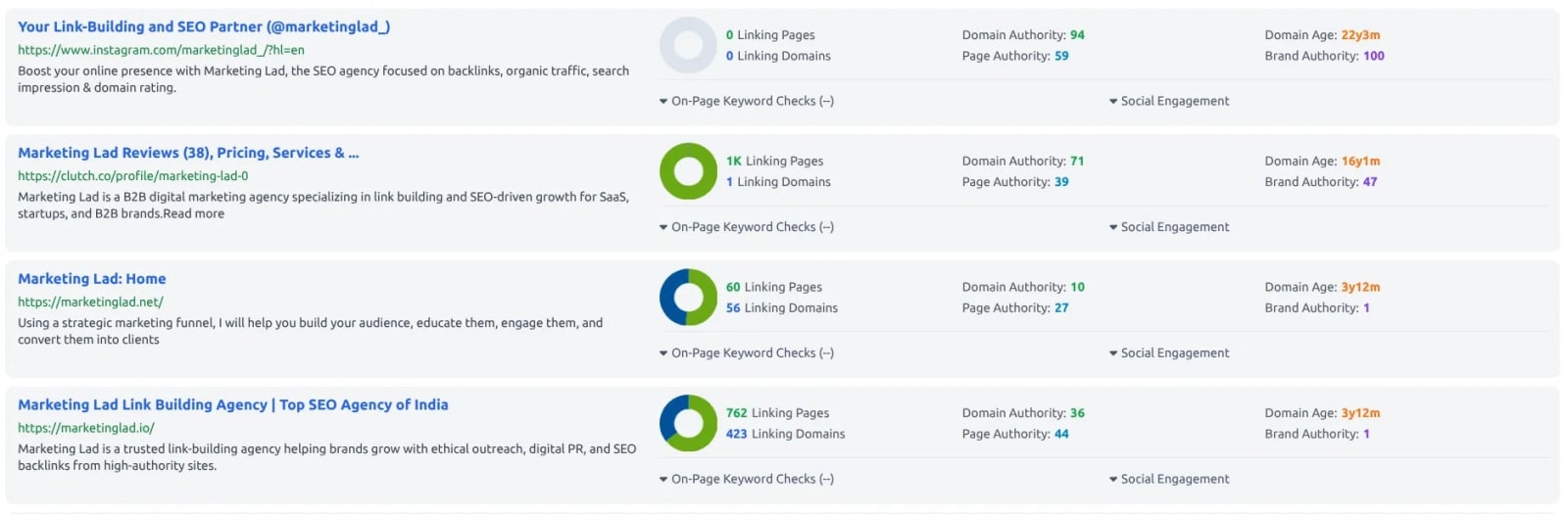
Under this tab, for the keyword ‘’Marketing Lad,’’ we have the metrics for the top search results below.
- Domain Authority: A score that tells you the ability of the website to rank for keywords on a scale of 1-100. A lower range means more chances to appear in SERPs.
- Domain Age: It represents the period a domain has been active or registered. If the domain age is higher, it is more trustworthy to search engines.
- Links vs. no-follow links: Links are the total number of links pointing to the selected page; no-follow links refer to the number of unique domains with at least one link back to the selected page.
- Page Authority: a metric that measures a page’s ability to rank in search engines on a scale of 1-100. Lower page authority means a greater chance of appearing in the SERPs.
4. Content Analysis:

This tab provides a breakdown of the page’s content. The content analysis tab will show you how to outrank your competition by implementing what they lack on their page. This tab shows you the following data:
- OnPage Score refers to how much page optimization is applied to a particular keyword or phrase. A high OnPage Score means more focused content.
5. Social Engagement:
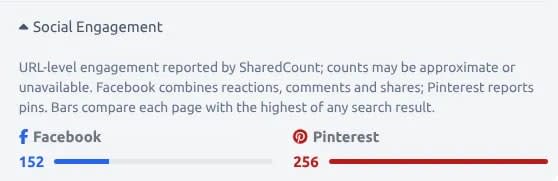
This tab shows the total number of shares, mentions, or likes this page has across different social networks. Social engagement is an essential factor in SERP rankings.
6. Sort Options:

If you want to stay organized by sorting your keywords, this ‘sort option’ will help you go through keywords easily and quickly. You can sort your keywords by volume, CPC, PPC, relevancy, and difficulty.
7. Filter Options:

This option will help you to get the data you need quickly. You can filter data as per search volume, CPC, and long-tail keywords. You can even exclude keywords using the filter option.
8. Managing Your Project:

It is essential to stay organized when you are dealing with many keywords. You can manage many keywords using the above three options: Import keywords, manage projects, and recent searches.
Manage Projects:

To stay organized, you can open, edit, rename, export, and delete your projects. The number of keywords and the creation date of a project can be checked under Manage Projects.
Recent Searches:
It shows the list of recent projects, making it easier to recall and work on past keyword searches.
9. Import External Keyword List:

You can import your keywords by typing or copying from external sources, and after importing, you can paste them under the ‘import keywords’ section.’ SEMScoop will analyze all the keywords and show you the necessary metrics. Also, you can import up to 700 keywords at a time.
10. Save/Export Your Work Data:
You can save keywords and export them once you have the required keywords. The save option lets you create new projects after you select the keywords you want to save. You can even add keywords to an existing project. Choose the Manage project option to load a previously saved project.
Exporting Keywords:
You can select the keywords you want to export to the clipboard or CSV format.
11. SEMScoop Blog:

SEMScoop blog includes a comprehensive SEO guide and a keyword tool guide. It has a complete guide that you can use to learn everything about SEO, Keyword Research and Digital Marketing.
SEMScoop pricing:
It is a ‘freemium’ tool, meaning you can use it for free or pay for it.
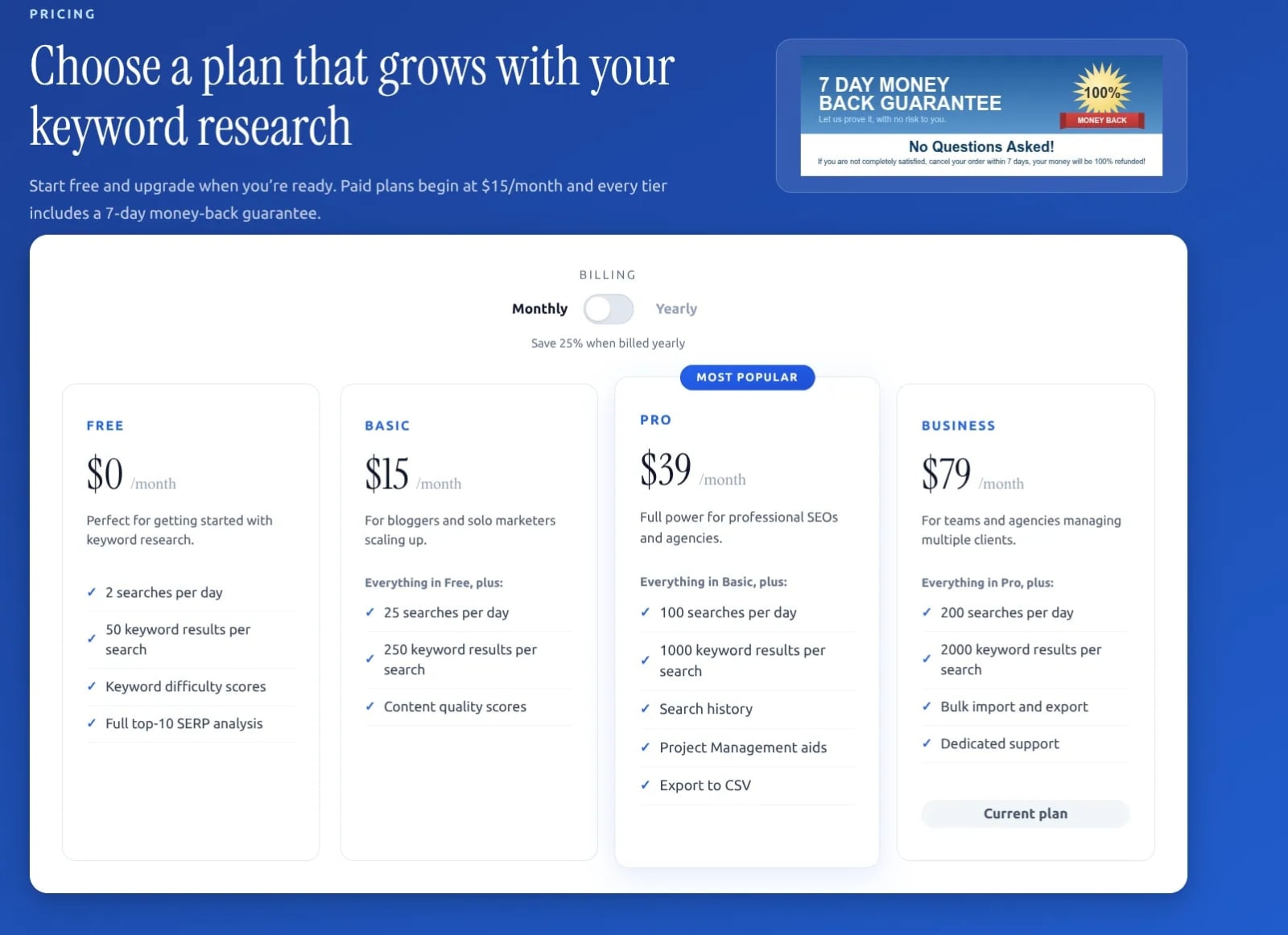
The free plan offers 2 free searches per day with no sign-up required, while the premium plans are Basic, Pro, and Business. The table below provides an overview of the monthly plans offered by SEMScoop.
| Plan | Monthly | Annual | Searches/day | Results/search | Extra features |
|---|---|---|---|---|---|
| Free | $0 | $0 | 2 | 50 | No signup required |
| Basic | $15 | $135/yr | 25 | 250 | Content-quality scores |
| Pro | $39 | $349/yr | 100 | 1,000 | History, projects, exports |
| Business | $79 | $709/yr | 200 | 2,000 | Bulk import/export, priority support |
Annual billing saves approximately 25% versus paying monthly. All paid plans include a 7-day money-back guarantee on your first payment. SEMScoop covers more than 100 geographic locations, 30+ languages, and 12,000+ users.

Strengths & Limitations:
Strengths:
- Two no-signup searches each day
- Live SERP evidence behind the difficulty score
- Volume, CPC and competitor metrics together in one view
- Country and language targeting (100+ locations, 30+ languages)
- Lower entry price than comprehensive SEO suites
Limitations:
- Free usage is deliberately limited to two searches per day
- Designed primarily for keyword research and SERP validation
- Not a complete replacement for site auditing, rank tracking or full-domain backlink intelligence
Conclusion:
SEMScoop is a focused, affordably priced keyword research and difficulty tool, used by more than 12,000 people. It’s a strong fit for anyone who wants SERP-level evidence to back up a difficulty score, though it isn’t intended as a full-suite SEO platform.
Check out our BuzzSumo Alternative Blog here!
Frequently Asked Questions
It is the process of finding and analyzing the terms customers enter into search engines and using that data for a specific purpose.
A keyword research tool helps you find ideas people are searching for on search engines like Google, Bing, etc.
There are many keyword research tools, such as Semrush, Google Search Console, and Ahrefs Keyword Explorer. You can choose any based on your needs and budget.