
On this page10
- What Are AI Citations in Bing Webmaster Tools?
- Marketing Lad AI Citation Data (3-Month Overview)
- Timeline of AI Citation Growth
- Top Pages AI Systems Referenced
- Content Patterns AI Models Prefer
- Why Marketing Lad Is Getting AI Citations
- What SEOs Can Learn From This Data
- The Future of AI-Driven Search Visibility
- The Future of AI Search Visibility
- Final Thoughts
Instead of simply displaying a list of links, modern search engines increasingly rely on AI systems to generate direct answers for users. These AI assistants analyze multiple sources across the web and compile information into summarized responses.
One example is Microsoft Copilot, which powers AI-driven experiences across Microsoft’s ecosystem. When Copilot generates answers, it often references and cites websites that contain relevant information. These references are known as AI citations, and they represent a new layer of visibility beyond traditional search rankings.
To help website owners understand how their content is used by AI systems, Microsoft Bing Webmaster Tools introduced the AI Performance report. This report reveals how frequently a website is cited by AI-powered search experiences, along with the pages referenced.
Recently, while analyzing the AI Performance data for Marketing Lad.io, I discovered something interesting.
Over the past three months, content from Marketing Lad was cited by AI systems more than 141,000 times, with over 140 pages referenced across various AI-generated responses.
This dataset provides a rare glimpse into how AI assistants identify, interpret, and use web content when generating answers.
In this case study, we will break down:
- What AI citations are and how they are measured
- The 141,000 AI citations recorded for Marketing Lad over a three-month period
- Which types of pages were most frequently referenced
- Patterns that reveal what AI systems look for when selecting sources
- Practical insights SEOs can apply to improve their content’s visibility in AI-driven search
As AI continues to reshape how people discover information online, understanding how websites become sources for these systems is becoming an important part of modern SEO.
The data from Marketing Lad offers a useful example of how informational content can surface inside AI-generated answers and what it might mean for the future of search.
Check out our latest blog on estoturf.fr: Domain Analysis, Organic Traffic & SEO Insights
What Are AI Citations in Bing Webmaster Tools?
AI-powered search experiences work differently from traditional search engines. Instead of simply ranking pages and displaying them in a list of results, AI systems analyze multiple sources and generate summarized answers for users.
When these systems pull information from a website to construct a response, they often reference the source. In Microsoft’s AI ecosystem, these references are tracked as AI citations.
Through Microsoft Bing Webmaster Tools, website owners can now monitor how their content is used within AI-generated responses powered by Microsoft Copilot.
What Is an AI Citation?
An AI citation occurs when an AI assistant references a webpage as a source while generating an answer.
For example, if a user asks:
“What are effective link building strategies for SEO?”
An AI assistant may generate a detailed response and cite a guide or article that explains those strategies. If that guide comes from your website, it will be recorded as an AI citation in Bing Webmaster Tools.
In simple terms:
AI Citation = Your webpage used as a source in an AI-generated answer.
This means your content contributed to the information provided by the AI system.
How AI Citations Differ From Traditional Search Rankings
AI citations represent a different type of visibility compared to traditional search results.
| Traditional Search | AI Citations |
|---|---|
| Users see a list of links | Users see a generated answer |
| Rankings determine visibility | AI chooses sources for answers |
| Clicks drive traffic | Content contributes to AI responses |
While search rankings focus on position in search results, AI citations measure how often your content is used as a reference by AI systems.
This makes AI citations an emerging metric that reflects how useful and authoritative a website’s content is from AI models’ perspectives.
Metrics Available in the AI Performance Report
The AI Performance report in Bing Webmaster Tools provides several key metrics that help publishers understand their visibility in AI-generated experiences.
1. Citations
This metric shows the number of times AI systems referenced pages from your website when generating answers.
A high citation count suggests that AI systems frequently rely on your content as a source.
2. Cited Pages
This metric shows how many unique pages from your website were referenced by AI systems.
If a large number of pages are cited, it indicates that your website covers topics in enough depth to be considered a broader knowledge source.
3. Daily Trends
The report also provides daily citation data, allowing publishers to identify spikes, trends, or changes in how AI systems reference their content over time.
Why AI Citations Matter for SEO
As AI-powered search continues to evolve, the concept of visibility is expanding beyond traditional rankings.
When AI assistants generate answers, they need reliable sources. Websites that publish structured, authoritative, and informative content are more likely to be referenced in these responses.
AI citations, therefore, represent an early signal of a website’s influence within AI-driven search ecosystems.
For publishers and marketers, understanding this data provides valuable insight into how AI systems interpret and use web content.
In the next section, we will examine the actual AI citation data from Marketing Lad over a three-month period and analyze what it reveals about how AI assistants use SEO content as sources.
Read More On Samsclub.com Website Ranking, Traffic and Analysis
Marketing Lad AI Citation Data (3-Month Overview)
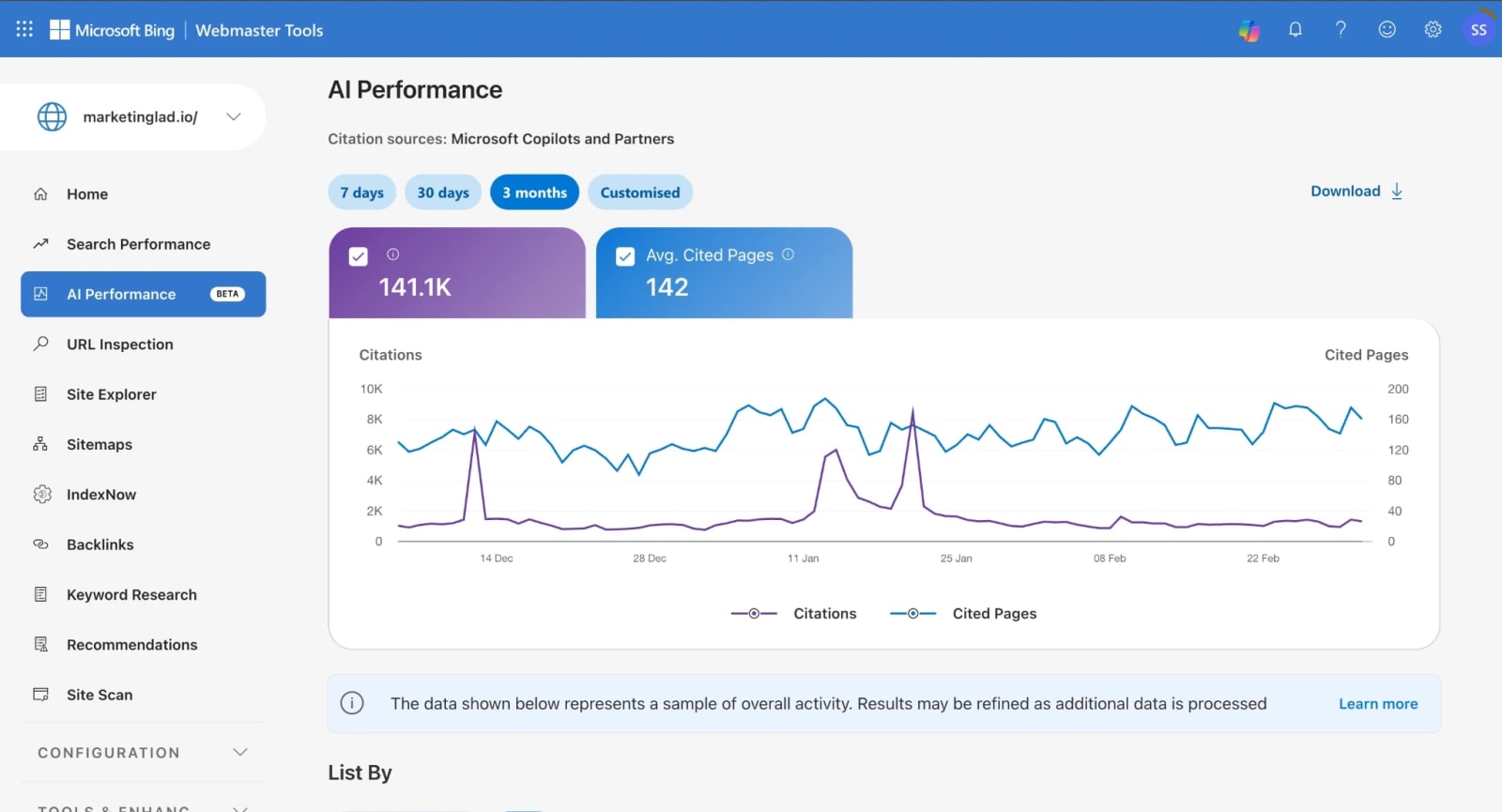
After exploring what AI citations represent, the next step is analyzing the actual data from Marketing Lad’s AI Performance report in Microsoft Bing Webmaster Tools.
Over a three-month period, the dataset revealed a substantial number of references from AI-generated answers powered by Microsoft Copilot.
Key Metrics From the Dataset
Based on the exported data, the following metrics stand out:
- Total AI Citations: 141,000+
- Average Daily Citations: 1,500–1,600
- Average Pages Referenced: 142 pages
- Data Range: Approximately 3 months of activity
These numbers indicate that AI systems frequently relied on Marketing Lad’s content when generating responses to user queries related to SEO, marketing, and link building.
What makes this dataset particularly interesting is not just the number of citations, but also the breadth of content being referenced.
Instead of relying on a small number of articles, AI systems referenced more than 140 pages across the site.
This pattern suggests that the platform is not simply pulling from a single popular article but rather viewing the site as a broader informational resource.
Average Daily AI Citations
Across the analyzed period, Marketing Lad averaged roughly 1,500 citations per day.
This means that, on a typical day, AI assistants referenced Marketing Lad content more than a thousand times while generating responses for users.
While AI citations do not necessarily translate directly into website clicks, they represent a form of content visibility within AI-generated search experiences.
In other words, Marketing Lad’s articles were actively contributing to the answers delivered by AI systems.
Unique Pages Referenced by AI
Another important metric is the number of unique pages cited by AI systems.
On average, about 142 pages from the website were referenced during the analyzed period.
This indicates that AI assistants are not relying on just a few pieces of content. Instead, they are drawing information from a wide range of articles across the site.
From an SEO perspective, this is a strong signal of topical authority.
When many pages from a website are referenced, it suggests that the site covers its subject matter comprehensively enough for AI models to consider it a reliable source.
Citation Activity Over Time
The AI Performance report also shows how citations fluctuate over time.
In this dataset, citation activity remained relatively consistent throughout the three-month period, with occasional spikes on specific days.
These spikes likely reflect periods when certain queries or topics experienced increased demand, leading AI assistants to reference related articles more frequently.
Monitoring these fluctuations can provide useful insights into how AI systems interact with web content over time.
Why This Data is Significant
Data about AI citations is still relatively new, and most publishers have not yet begun analyzing how their content is used in AI-generated responses.
The Marketing Lad dataset offers an early example of how informational content, particularly SEO and marketing guides, can become part of the knowledge sources used by AI assistants.
It highlights an emerging shift in search visibility:
Websites are no longer just competing for rankings in search results. They are also competing to become sources of information used by AI systems.
In the next section, we will examine the timeline of citation growth and identify patterns that explain when and why AI references increased during this three-month period.
Timeline of AI Citation Growth
The AI Performance report in Microsoft Bing Webmaster Tools also provides daily citation data, allowing analysis of how AI references have changed over time.
By examining the dataset from the past three months, several interesting patterns emerge in how AI systems, such as Microsoft Copilot, interact with Marketing Lad’s content.
Rather than a sudden spike followed by inactivity, the data show a consistent stream of AI citations throughout the period, with occasional surges on specific days.
Early Citation Activity
At the beginning of the dataset, Marketing Lad was already receiving AI citations daily. During this early phase, citations averaged around 900 to 1,100 per day.
This indicates that the site had already been recognized as a useful information source for certain queries before the larger spikes occurred.
At this stage, AI assistants were likely referencing core educational pages such as SEO guides, link-building tutorials, and marketing strategy articles.
Steady Growth Phase
As the weeks progressed, the daily citation numbers gradually increased.
Many days recorded over 1,500 citations, suggesting that more queries were triggering references to Marketing Lad content.
During this phase, the number of unique pages cited by AI systems also increased, indicating that additional articles across the site were being used as sources.
This pattern typically occurs when a website covers a topic area broadly enough that multiple articles become relevant for different search queries.
Major Citation Spike
One of the most noticeable events in the dataset occurred around January 21, when citations surged dramatically.
On that day:
- 8,500+ AI citations were recorded
- 153 unique pages were referenced
This represents a significant jump compared to the daily average.
While it is difficult to attribute a specific cause without internal data from search engines, spikes like this can often be linked to:
- Increased search demand around certain topics
- Updates to AI models or ranking systems
- Broader query coverage by AI assistants
Regardless of the cause, this spike demonstrates how quickly AI-generated answers can scale the use of web content.
Continued High Activity
After the spike, citation levels remained consistently high. Daily citations continued to average well above 1,500 references, with fluctuations depending on query demand.
Importantly, the number of unique pages cited remained relatively stable, suggesting that AI assistants continued to rely on a broad set of articles across the site.
This reinforces the idea that Marketing Lad is being treated not as a single resource, but as a collection of informational content covering multiple aspects of SEO and marketing.
What the Timeline Reveals
Analyzing citation activity over time highlights several important insights.
First, AI citations tend to grow gradually rather than appearing suddenly. This suggests that once AI systems recognize a site as a reliable source, they may continue referencing it consistently.
Second, spikes in citations can occur when AI systems begin applying content to a wider range of queries.
Finally, sustained citation activity indicates that consistent informational content can become part of the knowledge base used by AI assistants.
In the next section, we will examine which pages from Marketing Lad were cited most frequently and analyze what those pages have in common.
Top Pages AI Systems Referenced
One of the most revealing parts of the dataset is the page-level citation report from Microsoft Bing Webmaster Tools. This report shows exactly which pages AI systems referenced most often when generating answers.
Rather than citing only a handful of articles, the data shows that AI assistants such as Microsoft Copilot referenced a wide range of pages across Marketing Lad.
This indicates that the site is being treated as a broader knowledge resource for SEO and marketing topics, rather than relying on a single popular article.
Examples of Frequently Referenced Content
Based on the page-level report, several article types appeared frequently in AI citations.
These typically included pages covering:
- Link building strategies
- Guest posting guides
- SEO tutorials
- Marketing strategy explanations
- Digital marketing best practices
These topics are commonly searched for by marketers and business owners, increasing the likelihood that AI assistants will reference them when answering user questions.
Why These Pages Are Being Cited
When analyzing the structure and content of these articles, several common characteristics emerge.
1. Educational Content
Most of the cited pages explain marketing concepts or SEO techniques in detail. Educational content provides AI systems with clear explanations that can be summarized when generating answers.
2. Structured Headings
Articles are organized with logical headings and subheadings. This structure makes it easier for AI models to identify relevant sections and extract concise information.
3. Comprehensive Coverage
Many of the pages provide complete explanations rather than short summaries. Longer articles covering multiple aspects of a topic increase the chances that AI systems will find useful information within them.
4. Informational Intent
The cited pages are primarily informational rather than promotional. AI assistants tend to prefer content that explains a topic rather than content focused solely on selling a product or service.
The Importance of Multiple Cited Pages
One of the most important insights from the data is the number of unique pages cited by AI systems.
On average, AI-generated responses referenced around 142 distinct pages from Marketing Lad.
From an SEO perspective, this suggests that the site has achieved a certain level of topical authority within its niche.
Instead of relying on a single article to answer queries, AI systems are drawing information from many different pieces of content across the site.
This pattern typically occurs when a website publishes multiple high-quality articles on the same topic, creating a knowledge base that AI models can use as a reference.
What This Means for Content Strategy
The page-level data highlights an important shift in how visibility works in AI-driven search.
Traditional SEO often focuses on ranking a single page for a keyword. However, AI systems appear to favor websites that publish clusters of related content covering a subject in depth.
For Marketing Lad, this means that the overall library of SEO and marketing articles plays a role in how often the site is cited by AI assistants.
Content Patterns AI Models Prefer
After analyzing the pages most frequently cited by AI systems, several clear patterns begin to emerge. While the topics vary across SEO, marketing, and link building, the structure and intent of the content remain surprisingly consistent.
These patterns provide useful clues about how AI assistants, such as Microsoft Copilot, identify and select sources when generating responses.
Understanding these patterns can help publishers create content that is more likely to be referenced by AI systems.
1. Educational Guides
A large portion of the cited pages are educational guides that explain concepts step by step.
Examples include articles that explain:
- Link building strategies
- Guest posting techniques
- SEO fundamentals
- Digital marketing tactics
Educational content tends to work well because AI systems are designed to summarize and explain information. Articles that clearly define concepts and walk readers through a topic provide structured material that AI models can easily interpret.
When a user asks a question such as “How does link building work?”, AI assistants often extract explanations from these types of guides.
2. Structured Content With Clear Headings
Another common pattern is strong content structure.
Most cited pages contain clearly organized headings and subheadings, often following a logical progression such as:
- Definition of the concept
- Why it matters
- How it works
- Step-by-step implementation
This structure allows AI models to quickly identify sections that answer specific questions.
For example, if an article contains a heading like “What Is Link Building?”, AI systems can easily extract that definition to generate an answer.
Clear formatting, therefore, increases the likelihood that parts of an article will be used as reference material.
3. Comprehensive Topic Coverage
Many of the cited articles cover topics in depth rather than offering brief explanations.
Long-form content tends to include:
- background information
- examples
- methods and strategies
- practical recommendations
This type of coverage gives AI systems multiple opportunities to find relevant information within a single article.
When AI assistants search for sources, they often prefer pages that provide complete explanations rather than isolated snippets of information.
4. Informational Rather Than Promotional Content
Another noticeable trend is that the cited pages primarily serve an informational purpose.
They aim to teach, explain, or guide readers rather than promote a specific product or service.
AI assistants are designed to provide helpful answers, so they are more likely to reference content that explains a topic objectively.
Content that is heavily promotional or sales-driven is less likely to appear as a cited source in AI-generated responses.
5. Topic Clusters Instead of Isolated Articles
Finally, the dataset suggests that AI models may prefer websites that cover topics through multiple related articles.
Marketing Lad covers a wide range of content on SEO, link building, and marketing strategies. Because these topics are interconnected, AI assistants can reference different pages depending on the specific query being answered.
For example:
- A question about backlinks might reference a link-building guide.
- A question about outreach might refer to a guest-posted article.
- A question about SEO strategy might reference a broader marketing tutorial.
This cluster-based content structure increases the number of opportunities for AI systems to reference the website.
What These Patterns Reveal
The data suggests that AI assistants favor content that is:
- educational and explanatory
- well-structured with clear headings
- comprehensive in its coverage
- focused on informational value
- supported by related articles within the same topic area
These characteristics align closely with best practices for traditional SEO, but they may become even more important as AI-driven search experiences continue.
Why Marketing Lad Is Getting AI Citations
After reviewing the citation data and the types of pages being referenced, the next question becomes clear:
Why is Marketing Lad being cited so frequently by AI systems?
While AI models use complex algorithms to determine which sources to reference, the data suggests that several characteristics of the site’s content strategy are contributing to its visibility in AI-generated answers.
1. Strong Topical Authority in SEO
One of the most important factors is topical authority.
Marketing Lad publishes a large number of articles focused on SEO, link building, and digital marketing. Instead of covering many unrelated topics, the site consistently produces content within the same knowledge domain.
When AI systems analyze sources, they often evaluate whether a website demonstrates expertise in a particular subject area. Websites that publish multiple high-quality articles around the same topic are more likely to be viewed as reliable sources.
Because Marketing Lad covers SEO extensively, AI assistants frequently cite its articles when answering marketing and search optimization questions.
2. Educational and Instructional Content
Another major factor is the educational nature of the content.
Many articles on the site are written as guides that explain how something works or how to perform a specific task. Examples include tutorials on link-building strategies, guest-posting techniques, and SEO workflows.
AI assistants are designed to generate informative answers, so they naturally prefer content that explains topics clearly and step by step.
Articles that provide definitions, explanations, and practical instructions provide AI systems with structured information that can be easily summarized.
3. Clear Content Structure
Content structure plays a significant role in how AI systems interpret web pages.
Most articles on Marketing Lad follow a structured format with clear headings, subheadings, and logical sections. This organization allows AI models to quickly identify relevant sections within a page.
For example, headings that answer common questions, such as “What Is Link Building?” or “Why Guest Posting Matters,” can serve as direct sources for AI-generated explanations.
Well-structured content makes it easier for AI assistants to extract meaningful information without interpreting large blocks of text.
4. Depth of Content Library
The size of the content library also appears to be an important factor.
Since AI systems cited over 140 different pages from Marketing Lad during the analyzed period, it is clear that the platform is not relying on a single article to generate citations.
Instead, the entire collection of articles contributes to the site’s visibility within AI-generated answers.
A larger library of well-organized content increases the number of opportunities for AI systems to find relevant information for different queries.
5. Informational Intent
Most of the cited pages focus on helping readers understand marketing concepts rather than promoting specific services or products.
AI assistants tend to prefer content that provides neutral explanations and actionable insights. Informational articles are, therefore, more likely to be selected as sources when generating answers.
What This Suggests About AI Search
The citation data indicates that AI systems may treat certain websites as knowledge repositories for specific topics.
When a site consistently publishes educational content within a defined subject area, AI assistants may repeatedly reference it when answering related questions.
In this case, Marketing Lad’s focus on SEO and marketing education appears to have positioned it as a source for AI-generated responses in those domains.
What SEOs Can Learn From This Data
The AI citation data from Marketing Lad provides useful insights into how AI systems select sources when generating answers. While the ecosystem around AI-driven search is still evolving, several practical lessons already emerge from the patterns in this dataset.
For SEOs and publishers, these insights can help shape content strategies that increase the likelihood of being referenced by AI systems.
1. Focus on Educational Content
One of the clearest patterns in the dataset is the strong presence of educational articles among the cited pages.
Content that explains concepts, methods, and strategies tends to be more useful for AI assistants when constructing answers.
Articles that perform well in AI citations often include:
- definitions of key concepts
- step-by-step tutorials
- practical strategies and examples
- explanations of industry terms
When a user asks a question through an AI assistant, the system must generate an explanation. Educational articles provide the type of material needed to construct those explanations.
2. Use Clear Headings and Structured Content
Content structure appears to play an important role in how AI models interpret webpages.
Articles that include clearly defined sections, such as introductions, definitions, methods, and examples, allow AI systems to quickly identify the most relevant information.
For example, headings such as:
- “What Is Link Building?”
- “How Guest Posting Works”
- “Benefits of SEO for Businesses”
make it easier for AI systems to extract concise answers from the page.
Well-structured articles, therefore, increase the chances that specific sections will be referenced in AI-generated responses.
3. Build Topic Clusters Instead of Single Articles
Another key insight is the importance of publishing multiple articles on the same topic.
The Marketing Lad dataset shows that AI assistants referenced more than 140 different pages during the analyzed period. This indicates that AI systems are not relying on a single article but drawing information from a broader collection of related content.
Instead of focusing on a single “pillar article,” publishers may benefit from building content clusters that cover various aspects of a topic.
For example, a topic cluster around SEO might include:
- link building strategies
- technical SEO fundamentals
- guest posting guides
- keyword research tutorials
This approach creates a deeper knowledge base that AI systems can reference for diverse queries.
4. Prioritize Informational Intent
Many of the cited pages in this dataset focus primarily on helping readers understand a concept rather than promoting products or services.
AI assistants are designed to answer questions and provide useful information. As a result, they often prefer informational content rather than purely promotional content.
Articles that aim to educate readers, rather than sell to them, are more likely to be used as sources in AI-generated responses.
5. Consistency Matters
One of the most interesting findings from the dataset is the consistent flow of citations across multiple months.
This suggests that once AI systems begin referencing a website as a source, they may continue to do so as long as the content remains relevant and useful.
Publishing content consistently within a specific topic area may therefore increase the likelihood that a website will become part of the reference pool used by AI assistants.
6. Monitor AI Visibility
Another important takeaway is the value of monitoring AI-related metrics.
Through Microsoft Bing Webmaster Tools, publishers can now track how often their content is referenced by AI-powered experiences such as Microsoft Copilot.
This data provides a new layer of insight into how search engines interpret and use web content.
As AI-driven search continues to expand, monitoring these metrics may become an important part of understanding a website’s overall visibility.
The Future of AI-Driven Search Visibility
The emergence of AI citations highlights a broader shift in how information is discovered online.
Instead of simply ranking pages in search results, AI assistants are increasingly synthesizing information from multiple sources to generate answers.
For publishers, this means that success in search may no longer depend solely on rankings and clicks. It may also depend on whether their content becomes part of the knowledge sources used by AI systems.
Understanding how AI assistants interpret and reference web content will likely become an increasingly important part of modern SEO strategies.
The Future of AI Search Visibility
The data from Marketing Lad’s AI citation report highlights an important shift in how information is being discovered online. Traditional search engines have historically relied on ranked lists of links, but AI-powered search experiences are beginning to change that model.
With tools like Microsoft Copilot, users are increasingly receiving generated answers rather than a simple list of websites. These answers are constructed by analyzing multiple sources across the web and synthesizing the information into a single response.
As a result, the role of websites is gradually expanding from serving as search results to serving as information sources used by AI systems.
A New Layer of Search Visibility
For many years, SEO success has been measured primarily through metrics such as:
- keyword rankings
- organic traffic
- click-through rates
AI-powered search introduces an additional dimension: citation visibility.
When AI systems reference a webpage while generating an answer, the page becomes part of the knowledge base used to inform that response. Even if a user does not immediately click the link, the website still contributes to the information delivered by the AI assistant.
This means that websites may gain influence in search ecosystems not only through rankings but also through how frequently their content is used as a source.
Content as a Knowledge Source
The Marketing Lad dataset illustrates how informational content can become part of this emerging ecosystem.
Rather than relying on a single article, AI assistants referenced more than 140 pages across the website, suggesting that they view the site as a broader repository of SEO and marketing knowledge.
This type of visibility is likely to become more common as AI systems continue to improve their ability to understand and synthesize information from web content.
Implications for Publishers and Marketers
For publishers, the shift toward AI-generated answers introduces new considerations for content strategy.
Content that is:
- clearly structured
- educational in nature
- comprehensive in its coverage
may have a greater chance of being referenced by AI systems.
Websites that build strong topical authority in a particular subject area may also be more likely to appear as sources when AI assistants generate answers on those topics.
The Importance of Monitoring AI Metrics
As AI-powered search continues to evolve, tracking how content is used by these systems may become an important part of SEO analysis.
Tools like Microsoft Bing Webmaster Tools already provide insights into AI citations, helping publishers understand how their content contributes to AI-generated responses.
Monitoring these metrics can help website owners identify which types of content are most frequently referenced and refine their content strategies accordingly.
A Changing Search Landscape
The emergence of AI citations signals that the search ecosystem is expanding beyond traditional ranking systems.
Websites are no longer competing solely for positions in search results. They are also competing to become trusted sources of information used by AI assistants.
For publishers and marketers, adapting to this evolving landscape may require focusing not only on rankings but also on creating content that AI systems can understand, summarize, and reference effectively.
Before we wrap up, it’s worth understanding how apple seo shows the shift toward authority-based ranking instead of traditional keyword-heavy optimization.
Final Thoughts
The analysis of Marketing Lad’s AI citation data offers an early glimpse into how websites can become sources within AI-driven search experiences.
Over a three-month period, content from the site was cited more than 141,000 times, with over 140 pages referenced across AI-generated responses. This demonstrates how