
On this page14
- Key AI Job Displacement Statistics (2026)
- How Many Jobs Has AI Replaced in 2026?
- Original Analysis: The 2026 AI Layoff Wave in Numbers
- AI Job Losses in the Tech Industry
- Entry-Level and Young Workers: Where Displacement Shows Up First
- What the Broader Labor Market Data Shows
- AI Job Displacement Forecasts: 2026 to 2030
- How Workers Feel About AI and Their Jobs
- AI Adoption at Work: Augmentation vs Automation
- Why AI Job Statistics Disagree
- Frequently Asked Questions
- How to Cite This Page
- Methodology
- Sources
Artificial intelligence was named as the reason for 121,401 announced US job cuts in the first ten months of 2026, according to outplacement firm Challenger, Gray & Christmas. That is more than double the 54,836 cuts blamed on AI in all of 2025, making 2026 the biggest year for AI-attributed layoffs since Challenger started tracking the reason in 2023.
But the headline number hides the most important finding of the year. Almost all of those cuts were announced between March and July. By October, employers cited AI for just 1,265 cuts, the lowest monthly figure of 2026, and "market and economic conditions" had overtaken AI as the top reason for layoffs this year.
Meanwhile, the broadest labor-market studies (Yale's Budget Lab, Stanford's Digital Economy Lab) still find no economy-wide displacement, while the same Stanford research shows a sharp and widening hiring gap for workers aged 22 to 25 in AI-exposed jobs.
This page brings together the most reliable AI job displacement statistics available as of November 2026: announced layoffs, payroll research, employer surveys, worker sentiment, and the major long-range forecasts. Every number links to its primary source, and the charts and derived figures are free to reuse with attribution (see How to Cite This Page).
Key AI Job Displacement Statistics (2026)
121,401 announced US job cuts cited AI from January to October 2026, about 20% of all cuts (Challenger, Gray & Christmas).
That is 2.2x the 54,836 AI-cited cuts recorded in all of 2025.
May 2026 set the monthly record: 38,579 AI-cited cuts, roughly 40% of that month's total.
October 2026 fell to 1,265 AI-cited cuts, the lowest month of the year and 97% below the May peak (Marketing Lad calculation).
84% of 2026's AI-cited cuts were announced in the first half of the year; only 7% came between August and October (Marketing Lad calculation from Challenger data).
AI has been cited in 193,226 US job cuts since 2023. 63% of them were announced in 2026.
Workers aged 22 to 25 in the most AI-exposed occupations now earn about 19% less than peers in less-exposed jobs, up from 15% a year earlier.
Yale's Budget Lab still finds no clear economy-wide labor market effect from AI.
41% of employers worldwide plan to reduce headcount where AI can automate work by 2030, while 77% plan to reskill staff.
Goldman Sachs estimates AI could displace 6% to 7% of US workers (about 11 million people) over the full adoption period.
71% of US adults now expect AI to mean fewer jobs over the next 20 years, up from 64% in 2024; among adults under 30 it is 73% (Pew Research Center).
18% of US employees think their job is likely to be eliminated by AI or automation within five years; 23% in organizations that have adopted AI.
How Many Jobs Has AI Replaced in 2026?
The most widely cited count of AI-related layoffs comes from Challenger, Gray & Christmas, which records the reason employers give when they announce job cuts. Through October 2026, US employers attributed 121,401 announced cuts to artificial intelligence, approximately 20% of the 617,189 total cuts announced so far this year.
The month-by-month data shows a clear wave rather than a steady climb:
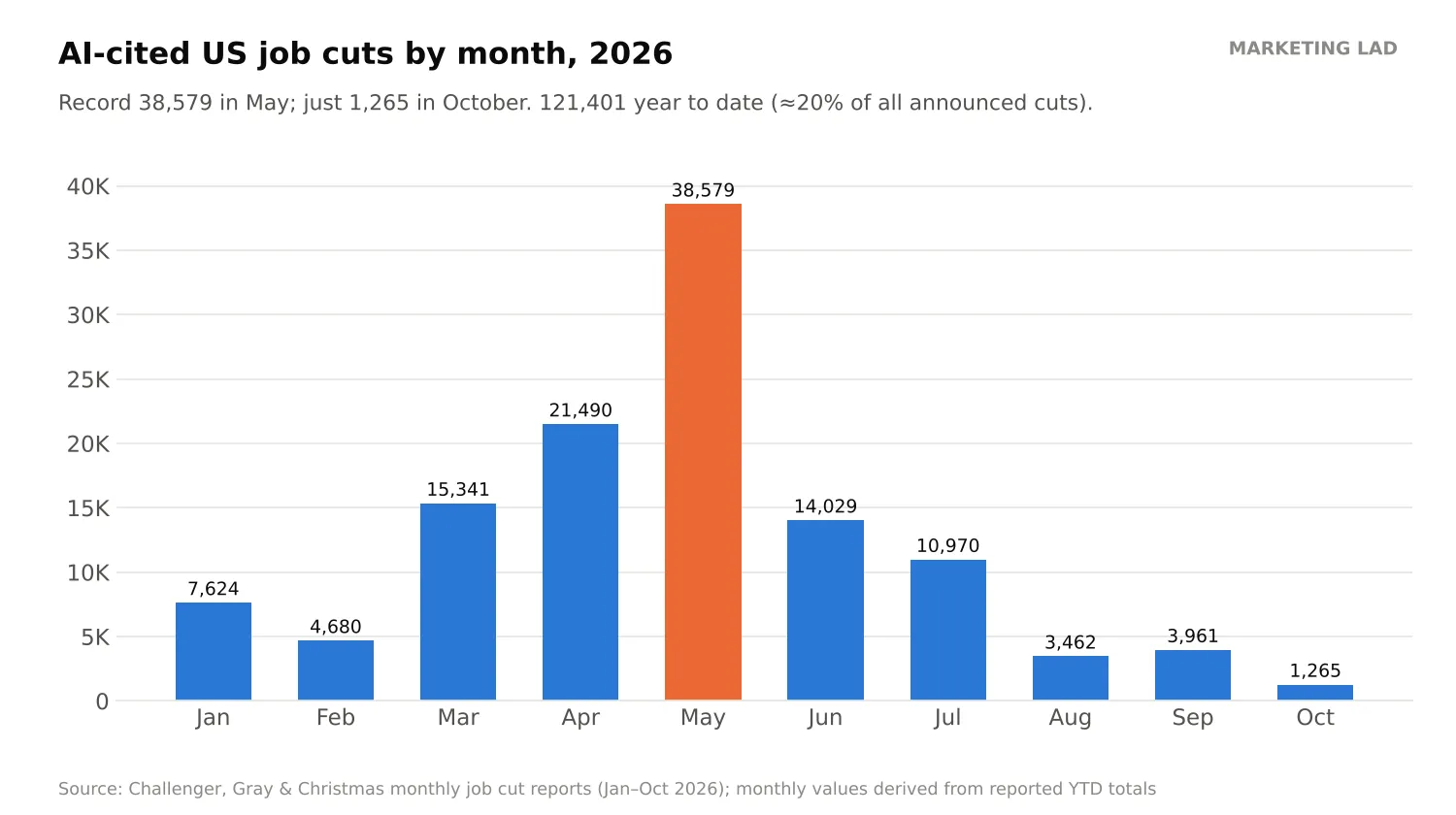
AI-cited US job cuts by month, January to October 2026. Monthly values are derived from Challenger's reported year-to-date totals.
Month (2026) | AI-cited cuts | Cumulative YTD |
|---|---|---|
January | 7,624 | 7,624 |
February | 4,680 | 12,304 |
March | 15,341 | 27,645 |
April | 21,490 | 49,135 |
May | 38,579 | 87,714 |
June | 14,029 | 101,743 |
July | 10,970 | 112,713 |
August | 3,462 | 116,175 |
September | 3,961 | 120,136 |
October | 1,265 | 121,401 |
Source: Challenger, Gray & Christmas monthly reports; cumulative series as compiled by HR Executive.
Three patterns stand out:
AI led all reasons for five straight months. From March through July, AI was the single most-cited reason for job cuts. In June, it accounted for 31% of all cuts, and in July, 33%.
The wave broke in August. AI accounted for under 10% of monthly cuts in both August and September and fell to fifth place among reasons in September.
Economic conditions are now the top reason for 2026. "Market and economic conditions" reached 130,531 cuts year to date in October, passing AI as the leading stated reason for the year.
AI-attributed layoffs by year
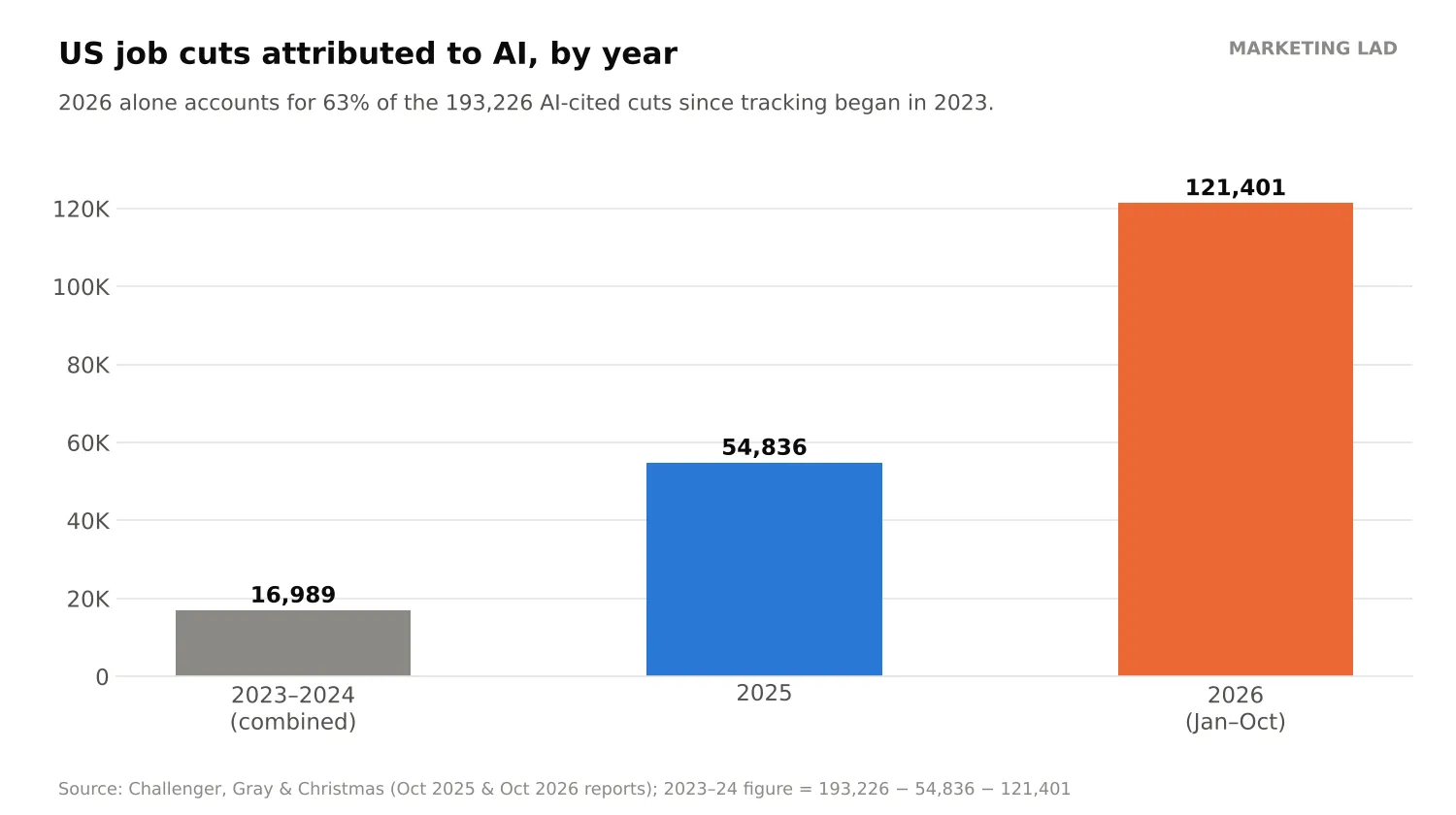
US job cuts attributed to AI by year. The 2023-2024 figure is the remainder of Challenger's all-time total of 193,226.
Since Challenger began tracking AI as a distinct reason in 2023, it has been cited in 193,226 job cuts. Subtracting 2025 (54,836) and 2026 to date (121,401) leaves 16,989 for 2023 and 2024 combined. In other words, the AI layoff story is overwhelmingly a 2026 story.
Original Analysis: The 2026 AI Layoff Wave in Numbers
The following figures are Marketing Lad calculations from Challenger, Gray & Christmas's published year-to-date totals. You may cite them with a link to this page.
84% of AI-cited job cuts in 2026 (101,743 of 121,401) were announced in January to June.
32% of the entire year's AI-cited cuts were announced in a single month: May.
83% fell in the five-month window from March to July, when AI was the leading reason every month.
Only 7% (8,688 cuts) were announced across August, September and October combined.
October's AI-cited total was 97% lower than May's.
The average month in 2026 saw about 12,140 AI-cited cuts, but only four months (March through June) were above that average.
What it means: announced AI layoffs in 2026 behaved as a wave of corporate restructuring announcements concentrated in the spring, not a steadily accelerating trend. Anyone citing "121,401 jobs lost to AI" should also note that the monthly pace has since collapsed.
AI Job Losses in the Tech Industry
US technology companies announced 171,501 job cuts through October 2026, up 21% year over year, and still the leading sector for 2026. October's 5,576 tech cuts were the sector's lowest monthly total.
Through July, tech cuts were up 67% year over year (149,023 vs 89,251), showing how front-loaded the year was.
Globally, Layoffs.fyi recorded 128,536 tech employees laid off at 299 companies between January 1 and September 10, 2026, already more than the 122,606 counted for all of 2025.
Microsoft's voluntary exit offers to roughly 60,000 employees are not included in Challenger's October total, because they are offers rather than announced cuts.
Note that tech layoffs and AI-cited layoffs are different numbers. Many tech cuts are attributed to restructuring, cost-cutting or market conditions, and many AI-cited cuts happen outside tech.
Entry-Level and Young Workers: Where Displacement Shows Up First
If AI is displacing workers anywhere, the strongest evidence so far points to the bottom rung of the career ladder.
Employment for workers aged 22 to 25 in the most AI-exposed occupations is about 19% below where it would be if it had kept pace with similar workers in less-exposed occupations, up from 15% a year earlier. The shortfall appears to come mainly from reduced hiring, not more firing, using ADP payroll data)
The original 2025 version of the same study found a 13% relative decline for this group, and employment for young software developers was down nearly 20% from its late-2022 peak by July 2025.
Experienced workers in the same exposed occupations show no comparable decline, and occupations where AI mostly augments work have seen employment growth.
Caution from the authors themselves: with stricter controls, the decline becomes statistically significant only from 2024 onward, and part of the timing likely reflects factors other than AI.
The unemployment rate for recent US college graduates (ages 22 to 27) reached about 5.6% at the end of 2025, above the 4.2% rate for all workers, and remained high into 2026. Computer engineering graduates posted one of the highest unemployment rates of any major, at 7.8%.
What the Broader Labor Market Data Shows
Announced layoffs are only one lens. Researchers who look at the whole labor market reach a more cautious conclusion.
Yale Budget Lab: its ongoing tracker, which compares AI-exposed and unexposed occupations using monthly Census survey microdata, finds no clear evidence of AI effects on the labor market so far, while noting this could change quickly. Its updates through early 2026 have consistently reached the same conclusion.
"AI-washing": Yale Budget Lab executive director Martha Gimbel has suggested that some companies attribute layoffs to AI rather than to harder-to-explain pressures such as tariffs, immigration changes and policy uncertainty.
Hiring, not firing: the US labor market in 2026 is widely described as "low hire, low fire." Employers added 165,000 jobs in October 2026 and the unemployment rate was 4.1%.
Bottom line: both things are true at once. Companies have publicly blamed AI for six-figure layoffs, and economy-wide statistics still show no mass displacement. The measurable effect so far is concentrated in fewer entry-level hires in exposed jobs.
AI Job Displacement Forecasts: 2026 to 2030
Forecasts are where the biggest and scariest numbers come from, and also where most misquoting happens. The key distinction is between exposure (tasks AI could affect) and displacement (jobs actually lost).
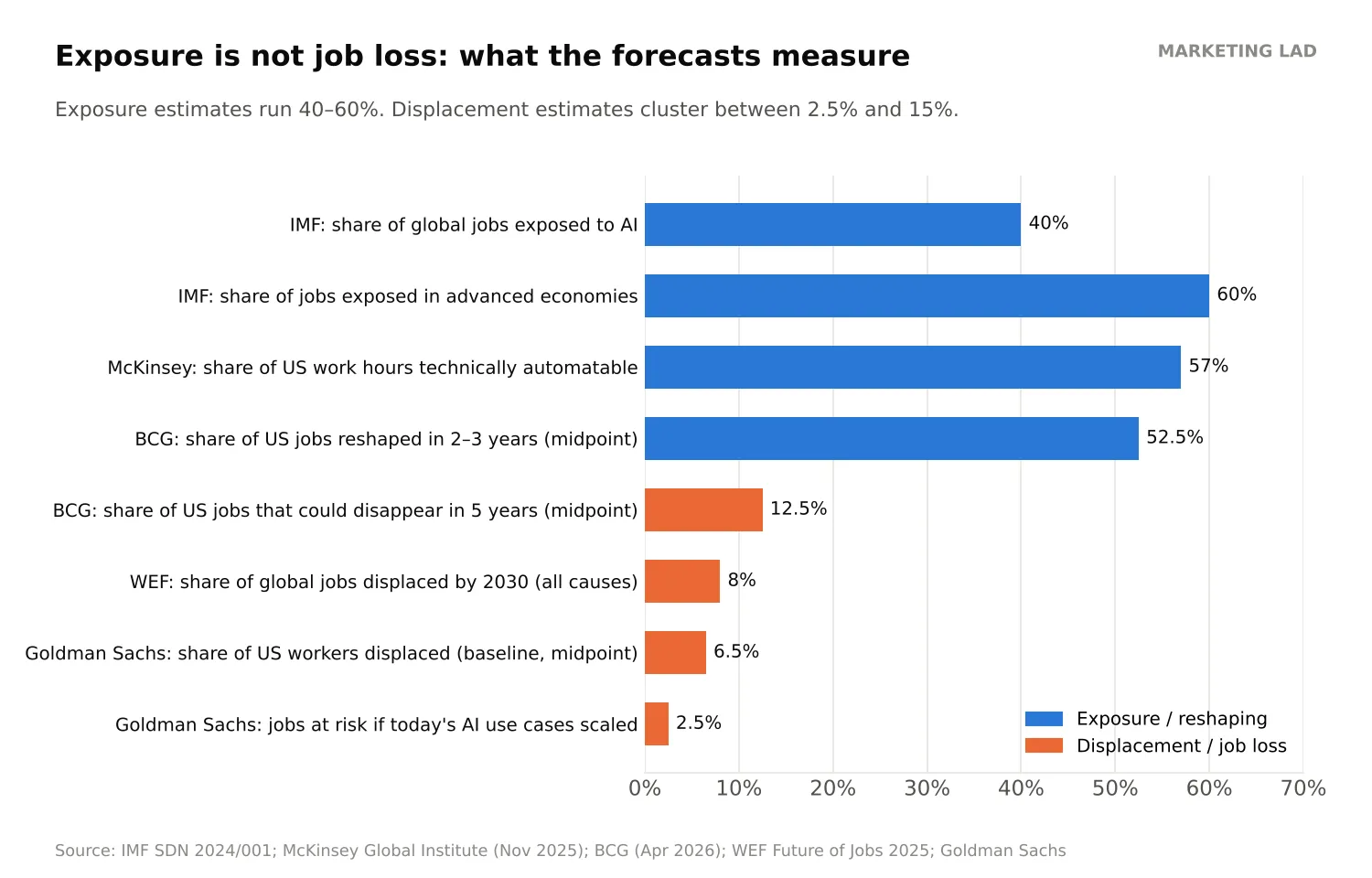
Exposure estimates (blue) versus displacement estimates (orange) from the major forecasts. Ranges are shown at their midpoint.
Source | Headline estimate | What it measures |
|---|---|---|
170M jobs created, 92M displaced, 78M net gain by 2030 | All drivers of job change, not AI alone; 92M equals 8% of employment | |
50% to 55% of US jobs reshaped in 2 to 3 years; 10% to 15% could disappear within 5 years | Role-level model of 165M US jobs | |
Goldman Sachs | 6% to 7% of US workers displaced (about 11M); 2.5% if today's use cases scaled | Displacement over the full adoption period, roughly a decade |
57% of US work hours technically automatable (44% by agents, 13% by robots) | Technical potential, explicitly not a job-loss forecast | |
40% of global jobs exposed; 60% in advanced economies; 26% in low-income countries | Exposure: about half of exposed jobs may benefit |
Forecast details worth knowing
WEF: 41% of employers plan to downsize where AI can replicate work, but 77% plan to upskill workers, and 47% plan to move affected staff into other roles. Postal clerks, executive secretaries and payroll clerks are among the fastest-declining roles; graphic designers and legal secretaries appeared near the top-10 declining list for the first time.
BCG: only about 12% of US jobs fall into its "substituted" category, where AI directly replaces core tasks and demand is limited (examples include call center roles).
Goldman Sachs: in its central scenario, US unemployment rises by a little over half a percentage point at the peak of the transition, and roughly 60% of today's US workers are in occupations that did not exist in 1940. A later Goldman note warned that displaced workers can face years of income "scarring," especially if job losses coincide with a recession.
McKinsey: AI agents and robots could unlock about $2.9 trillion in annual US economic value by 2030 if organizations redesign workflows.
How Workers Feel About AI and Their Jobs
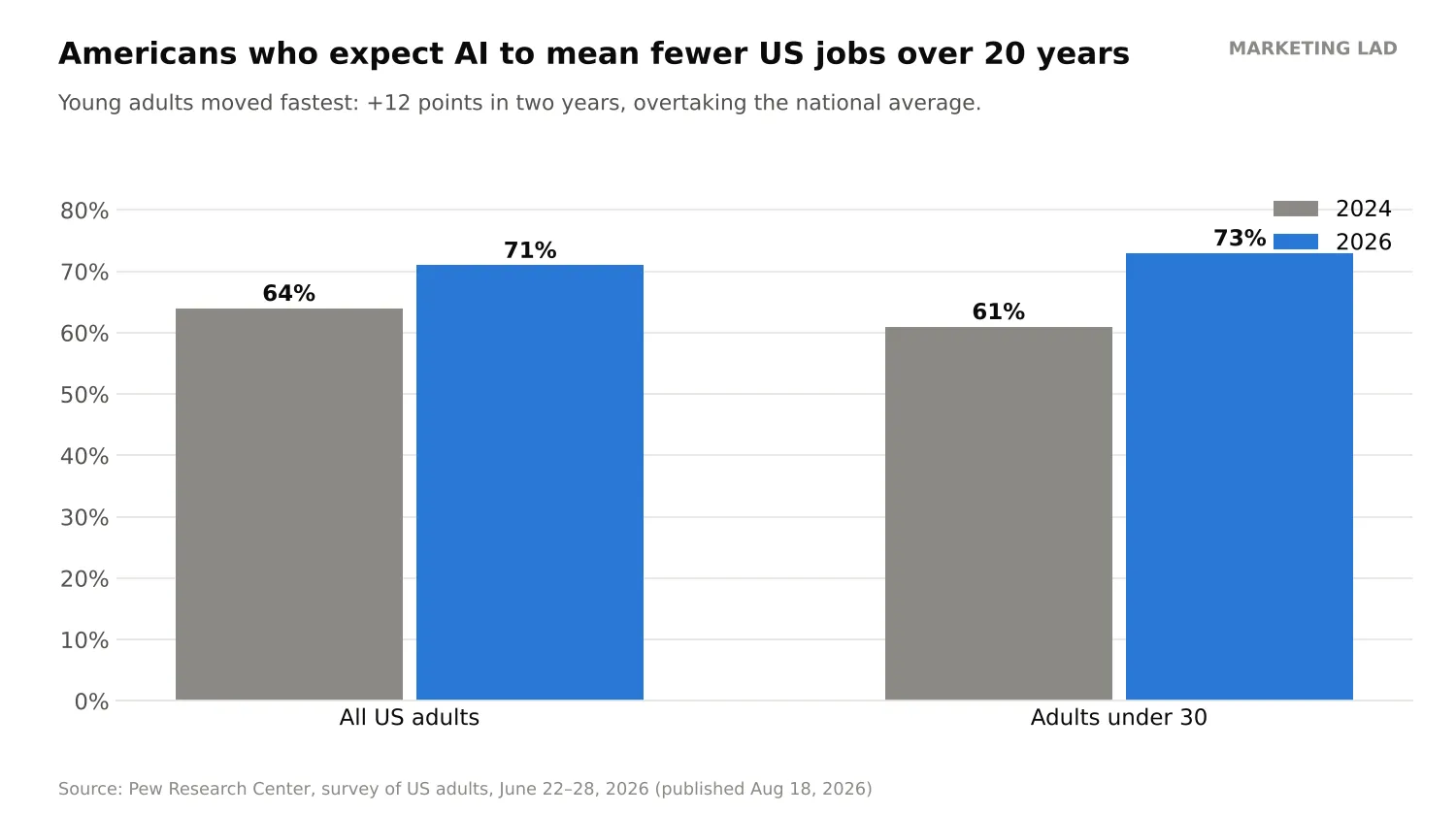
Share of Americans who expect AI to lead to fewer US jobs over the next 20 years, 2024 vs 2026.
71% of US adults expect AI to result in fewer jobs over the next 20 years, up from 64% in 2024. Only 5% expect more jobs.
Among adults under 30, that share jumped from 61% to 73%, and for the first time a majority (55%) say they are more concerned than excited about AI.
Globally, people in 34 of 37 countries are more likely to expect AI to cause job losses than job gains. In the US, Australia and South Korea, around seven in ten adults or more expect job losses.
AI Adoption at Work: Augmentation vs Automation
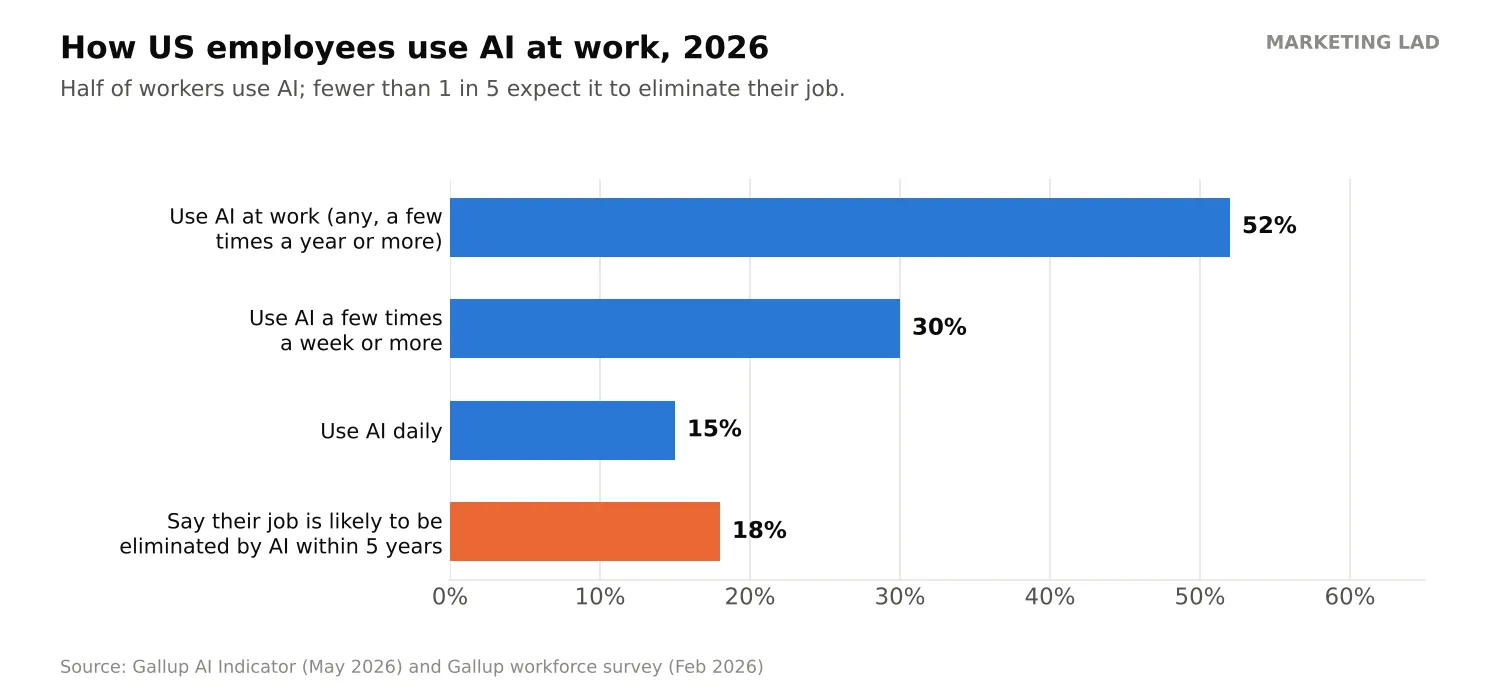
AI use at work among US employees, and expected job elimination, 2026.As of May 2026,
52% of US employees use AI at work at least a few times a year, 30% a few times a week or more, and 15% daily.
Daily use is highest in technology (42%), finance (27%) and professional services (22%).
65% of employees in AI-adopting organizations say AI has improved their productivity, but only 14% strongly agree it has transformed how work gets done.
In Anthropic's analysis of Claude conversations, 52% of interactions were augmentation (the user iterates, learns or gets feedback) and 45% were automation. The same report found 49% of jobs can now use AI for at least a quarter of their tasks, up from 36% in early 2025.
Why AI Job Statistics Disagree
Announced vs actual cuts. Challenger counts what employers announce and the reason they give. Employers can revise announcements, phase them over years, or never fully execute them.
Stated reason vs true cause. An employer citing AI makes a claim, not a causal claim. Researchers have flagged possible "AI-washing."
US vs global. Challenger covers US-based employers; Layoffs.fyi covers tech companies worldwide; WEF and IMF are global.
Exposure vs displacement. "60% of jobs exposed" (IMF) and "6% to 7% displaced" (Goldman Sachs) are answers to different questions, not contradictory forecasts.
Stocks vs flows. Payroll studies measure employment levels; layoff trackers count events. Reduced hiring, the main channel Stanford identifies, never appears in layoff counts at all.
Frequently Asked Questions
How many jobs has AI replaced in 2026?
US employers cited AI in 121,401 announced job cuts from January to October 2026, according to Challenger, Gray & Christmas. That is the best available count of AI-attributed layoffs, though it reflects employers' stated reasons rather than verified causation.
Are AI layoffs increasing?
Not currently. AI-cited cuts peaked at 38,579 in May 2026 and fell to 1,265 in October, the lowest month of the year. Economic conditions became the top reason for 2026 layoffs, overtaking AI.
How many jobs will AI replace by 2030?
The WEF projects 92 million jobs displaced and 170 million created globally by 2030 from all drivers, including AI. Goldman Sachs estimates 6% to 7% of US workers could be displaced over the full AI adoption period, and BCG estimates 10% to 15% of US jobs could disappear within five years.
Which workers are most affected by AI?
Early-career workers aged 22 to 25 in highly exposed occupations, such as software development and customer service, show the clearest effect: employment about 19% below comparable peers, driven mostly by reduced hiring (Stanford Digital Economy Lab).
Is AI causing higher unemployment?
Not at the economy-wide level so far. Yale's Budget Lab finds no clear relationship between AI exposure and labor market outcomes, and US unemployment was 4.1% in October 2026.
How to Cite This Page
Journalists, researchers and writers are welcome to use the statistics, charts and original calculations on this page. Please credit and link to the source:
Marketing Lad. "AI Job Displacement Statistics 2026." Updated November 12, 2026. https://marketinglad.io/ai-job-displacement-statistics/
Embed-ready charts (Figures 1 to 5) may be republished unchanged with a link back to this page. This page is updated monthly after each Challenger report.
Methodology
We compiled statistics from primary sources published between January 2024 and November 2026, prioritizing government data, academic research, and established research firms. Monthly AI-cited cut figures were derived by differencing Challenger, Gray & Christmas's published year-to-date totals. Ranges in Figure 3 are plotted at their midpoint. Where a figure comes from secondary reporting of a primary source, the reporting outlet is linked.
Sources
