
On this page19
- 1. Google Search Generative Experience (SGE)
- 2. Higher E-A-T (Now E-E-A-T) and Brand Building Requirements for SEO
- 3. The Growing Dominance of Voice Search
- 4. Core Web Vitals as Ranking Factors
- 5. Regularly Update Your Existing Content
- 6. The Growing Importance of Semantic Search
- 7. Mobile-First Indexing Takes Center Stage
- 8. Enhanced AI connectivity
- 9. Link building
- 10. User Experience (UX) As a Key Factor
- 11. Local SEO Continues to Grow
- 12. Optimize Based on the User’s Search Intent
- 13. Video Content Optimization
- 14. Zero-Click Search
- 15. Image Optimization
- 16. Featured Snippets
- 17. The Power of Artificial Intelligence
- 18. Content Is Still King
- FAQs
SEO is constantly changing as search engines like Google refine their algorithms and online technology advances. Staying up to date on the latest SEO trends is crucial for websites and digital marketers seeking to rank high and attract relevant, organic traffic.
Several essential SEO trends and best practices will be crucial for websites to stay visible and competitive. Integrating voice search optimization and quality, authority-building strategies will drive significant innovation and change.
This blog post uncovers the essential trends that will shape SEO.
1. Google Search Generative Experience (SGE)
Search Generative Experience (SGE) is Google’s AI-powered feature that offers AI-generated results for various queries, appearing at the top of search engine results pages (SERPs).
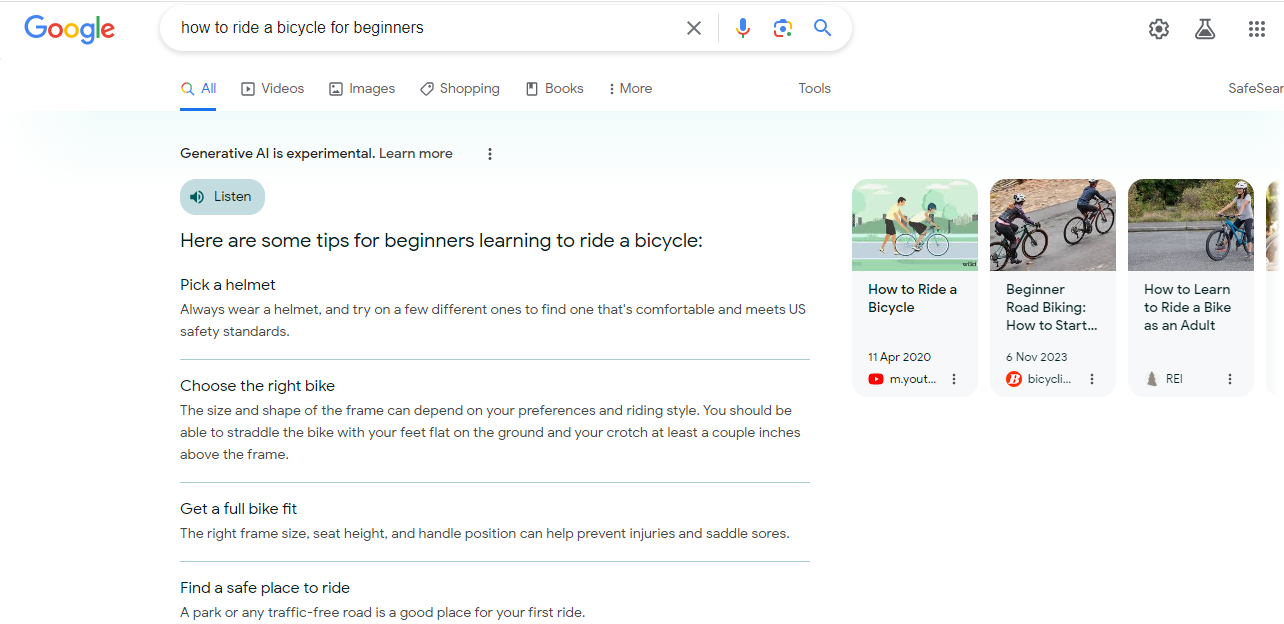
As it gains popularity, it is likely to alter how consumers interact with search engines. It will also affect how websites are optimized to produce impressions and traffic.
SGE enhances user interactions by delivering clear,d concise responses to search queries. It also offers pertinent graphics and a conversational engagement model.
This is not a chatbot like ChatGPT; when you do a Google search, an AI-powered result displays. For brands, this shift means that AI visibility is now a critical metric to track, as websites must position themselves to be discovered and referenced by these AI-generated responses rather than relying solely on traditional ranking positions.
This acceleration in search is expected to disrupt groups' presence and data collection processes, potentially altering platform dynamics.
Search success depends on being detected by generative AI and seizing any opportunity to showcase your brand to users. Despite AI breakthroughs, humans will remain indispensable in developing efficient SEO strategies in the emerging AI landscape, and this reliance is expected to continue for the foreseeable future.
2. Higher E-A-T (Now E-E-A-T) and Brand Building Requirements for SEO

Websites that Google considers E-A-T-rich are more likely to rank higher in SERPs. The relevance of E-A-T has increased in recent years, while still supporting Google’s goal of providing customers with high-quality, relevant, and trustworthy information.
Certain guidelines must be followed when creating web page content, including authoritativeness, trustworthiness, and expertise. Additionally, providing links and information from reputable websites will give you a competitive advantage.
But now, the new “E” has been added, resulting in “EEAT” – Experience, Expertise, Authority, and Trust! Google will now prioritize the creator’s experience when evaluating content quality and ranking it on search engine results pages (SERPs).
Experience includes the practical knowledge and direct experience the content producer, founder, or author has with the topic they are addressing. Websites must thoroughly examine their content providers' credentials. If the creator lacks authority in a particular topic or field, their content may be considered of low quality.
3. The Growing Dominance of Voice Search

The growing popularity of smart devices like Amazon Echo and Google Home, along with advancements in mobile technology, has brought voice search to the forefront of the online experience. The rise in voice-activated searches requires changes to traditional SEO strategies.
Voice search is gaining popularity, with predictions that it will account for 50% of all searches. Voice search optimization focuses on natural language and long-tail keywords. This reflects how people speak rather than type, increasing the likelihood that voice assistants will recognize your content.
4. Core Web Vitals as Ranking Factors
These vitals, which include loading speed, interactivity, and visual stability, offer insight into a website’s user experience quality. To stay ahead of the SEO curve, firms must focus on four key areas of their websites. Ensuring your website loads quickly, offers a smooth navigation experience, and avoids unexpected layout changes is crucial to improving your website’s ranking.
Google’s focus on Core Web Vitals highlights the importance of a positive user experience in SEO strategy. A website that performs well in these areas not only provides a better user experience but also has a better chance of ranking higher in search results. As a result, firms must review their current SEO strategy and make any necessary adjustments to meet the new standards.
5. Regularly Update Your Existing Content

Search engines sort information based on the most recent, trending, and relevant content for users. That is why updating and refreshing your material is one of the best things you can do. When updating existing content, ensure that the article includes the most recent information and data.
Also, even if the content is appropriate, you may need to edit the image. A link to an out-of-date report or an old image may not help boost web visitors’ confidence. Bonus read for marketers and businesses: Stay ahead of the curve and keep up with these content marketing trends to ensure success.
6. The Growing Importance of Semantic Search
Semantic search is rapidly gaining popularity in SEO. Rather than relying just on exact keyword matches, the emphasis is now on the intent and context around those words. This represents a significant shift in SEO practice, as search engines aim to deliver more relevant, precise results by understanding the contextual meaning of queries.
Structured data is another important aspect of semantic search optimization. Structured data, also known as schema markup, helps search engines better understand your website's content and context. This is particularly useful for increasing your website’s presence in rich snippets, knowledge panels, and other search features that rely heavily on semantic understanding.
7. Mobile-First Indexing Takes Center Stage

Today’s primary SEO trend is ensuring your organization’s website functions seamlessly on all mobile devices. Almost the majority of us use smartphones or tablets to do internet searches, so the web design of the mobile site will eventually determine the rankings.
Mobile internet usage is expected to continue outpacing desktop usage, confirming the shift in user behavior towards mobile devices. This shift means that Google will rank and index websites only based on their mobile versions.
8. Enhanced AI connectivity
AI has become an integral part of every SEO and marketing workflow. AI is now an expectation rather than an exception in our lives, both in the goods we consume and in how we generate and manage content.
Driven by a competitive landscape and client expectations, AI emerged in 2023 as a supplement to hundreds of SEO and martech goods and tools. According to a recent Mailchimp survey, “88% of marketers believe their marketing organization must increase the use of automation and AI to meet customer expectations and stay competitive.”
We can expect this trend to continue and become even more advanced. The early versions of popular generative AI focused on showcasing this new technology and its capabilities.
AI summaries and picture producers are now commonplace. However, after the initial fire sale, companies that had strong marketing and SEO structures in place before generative AI's popularity emerged are now best positioned to take advantage of today's tools.
9. Link building

Link building remains the cornerstone of SEO strategies, but rules have shifted. It is no longer about the number of links, but the quality. A single link from an authoritative site can now outweigh many links from less credible ones.
This SEO trend is important because it directs users to fresh web pages on your site or to SEO blog entries. This also helps determine the legitimacy of your content. Additionally, it helps establish your web pages' rankings on SERPs and has become an important SEO marketing strategy.
Google’s enhanced link structure, combined with powerful AI, can now detect spammy link-building strategies. Quality will dominate quantity, and each link should be like a great wine: well-aged, relevant, and lasting.
10. User Experience (UX) As a Key Factor
The user experience remains an important aspect of SEO and will continue to be a top priority for SEO professionals. Google often evaluates your website’s speed, responsiveness, and visual stability to decide its ranking on search results pages.
Creating an intuitive, mobile-friendly, and fast-loading website is essential for success in this field. By doing so, Google is more likely to prioritize your company’s website, recognizing your commitment to providing an excellent user experience
The ultimate goal of any organization should be to improve the user experience. UX is important to an organization's success. With the latest SEO advancements, user experience significantly impacts SEO rankings. When viewing a website, various factors contribute to the user experience, including smooth navigation, accessibility, usability, accuracy, security, efficiency, and user-friendly URLs, among others.
11. Local SEO Continues to Grow
Local SEO is expected to become increasingly important in the rapidly changing. The increased reliance on search engines to find nearby companies or services means any company seeking to remain competitive must use local SEO. A successful local SEO strategy includes several components.
First, your business must be listed properly and consistently in local directories. This comprises not only the company’s name, but also its address, phone number, and other relevant details. This information must be consistent across all platforms, as any differences can cause confusion and reduce your visibility in local search results.
Second, thoroughly optimize your Google My Business (GMB) profile. Google mainly relies on GMB data to deliver local search results. An optimized GMB profile has correct business information, positive customer reviews, relevant keywords, and high-quality photos. Actively monitoring your GMB page and encouraging customers to submit positive reviews can greatly improve your local search rankings.
Finally, incorporating local keywords into your website content can make a significant difference. These are the terms and phrases that people in your area are most likely to use while looking for your products or services. By strategically combining these local keywords into your website’s meta tags, headers, and content, you may increase your visibility to a local audience.
While local SEO may be just one element of the broader SEO puzzle, its impact is undeniable. A comprehensive, well-executed local SEO plan can increase visibility and success in the local market.
12. Optimize Based on the User’s Search Intent
In upcoming SEO trends, there will be greater emphasis on understanding and adapting to user search intent. This method involves determining a user’s intended objective by identifying one of three basic types of intent: informative, navigational, or transactional.
Informational intent refers to content that educates and provides in-depth knowledge on a specific subject. Next, navigational intent helps users find a specific website that contains the required information. Finally, the transactional objective refers to specific actions such as purchasing, signing up, or subscribing to a newsletter.
So, if you need to create appealing content based on user intent, the initial essential step is to understand your customers. desired outcome. As a result, you can produce content that aligns with your specific purpose and optimize your website accordingly.
13. Video Content Optimization
Make video content optimization an essential part of your SEO strategy. Video content is extremely engaging and provides a dynamic alternative to text-based content.
By optimizing your videos, you’re more likely to increase user engagement and the amount of time users spend on your site, which sends positive signals to search engines.
In line with this, video marketing services help refine video strategy and optimization, ensuring your content reaches the right audience, drives higher engagement, and supports stronger search rankings.
Begin by using relevant keywords in your video titles, descriptions, and tags. This helps search engines understand your videos and index them correctly.
Transcripts and captions are also important components of video optimization. Transcripts provide a text version of your video that search engines can crawl and index, helping them categorize your content effectively. This not only helps to improve your SEO but also makes your content more accessible to users who prefer or require text over
Hosting your videos on popular platforms such as YouTube, in addition to your website, can significantly boost your visibility. YouTube, the world’s second-largest search engine, provides an excellent opportunity to reach a wide audience. However, include a link to your website in your video descriptions to direct attention back to it.
14. Zero-Click Search
Zero-click searches, expected to be the most popular SEO trend, involve users accessing information directly from the search engine results page (SERP) rather than visiting external websites.
Google’s SERP features, such as highlighted snippets, often referred to as “position zero,” Local Pack for location-specific questions, recipe carousels, and expanded Google Shopping features, will account for a significant portion of zero-click searches.
A highlighted snippet, which appears at the top of the page in larger type, often delivers a succinct solution to a search query derived from an organic result.
15. Image Optimization
Images have always been a crucial component of delivering high-quality content to web visitors. Optimizing photos is the next trend, and audits should be part of the content strategy. Today, skilled web admins understand the need to properly tag/label photos.
Captions, file names, and alt text are required to improve the content’s accessibility and diversity. This type of image improvement helps you target keywords and attract traffic from images.
16. Featured Snippets
Featured snippets are small sections of text that appear at the top of search results to respond to a query as quickly as feasible. These small snippets are highlighted to provide an immediate response to the user’s search query. This particular SEO trend is displayed using bullet points, numbered lists, or a single paragraph. Featured snippets help relevant facts display when people search for information.
17. The Power of Artificial Intelligence
Artificial intelligence (AI) is expected to have a big impact on SEO. Pioneering AI algorithms, such as Google’s RankBrain, analyze user activity patterns to produce more relevant and personalized search results. Businesses that incorporate AI into their SEO strategy may gain a deeper understanding of consumer behavior.
This data can be used to predict user behavior, personalize content that appeals to their desires, and improve search rankings.
Thus, using AI in SEO can improve online visibility and strengthen the effectiveness of digital marketing operations. So, if you’re planning an SEO strategy, now is the time to understand AI’s potential and explore how you can use it to your advantage.
18. Content Is Still King
Despite technological improvements and changes in consumer behavior, the importance of great content cannot be overstated. The foundation of any successful SEO strategy is creating content that is interesting, distinctive, and high-quality.
As we look ahead to SEO trends, content will remain a valuable resource for users. This involves creating content that effectively addresses the user’s questions and provides them with smart, practical knowledge. Superior content will consistently attract and retain users, boosting your rankings and helping you stand out in a competitive digital environment.
The phrase ‘Content is King’ remains as relevant as ever in the constantly changing world of SEO.
Conclusion
As search engines evolve and user behavior changes, businesses will need to stay on top of SEO trends. By focusing on optimizing for featured snippets, improving page experience scores, and leveraging voice search optimization, brands can help ensure their content ranks highly and effectively reaches their target audiences.
Instead of chasing minor algorithm updates, brands should focus on understanding user intent and delivering highly relevant, thoughtful content. At the same time, they must balance keyword targeting with readability and ensure information is accessible across all devices.
Finally, to improve your website’s ranking in search results, you must first understand the latest SEO trends and how they can benefit your goals and objectives.
FAQs
AI-generated content is taking over the internet. While some marketers may utilize AI to generate drafts, quality and authority indicators, such as backlinks and brand signals, will remain crucial. Google tries to deliver high-quality search results from trusted sources. Strive for excellent content that satisfies both quality and authority signals.
The popularity of question keywords is clear. Users need answers, and providing useful responses may boost your rankings. Consider creating material that directly addresses common questions in your niche or business.
This question examines the significance of voice search optimization in the era of voice-activated devices and virtual assistants, highlighting the necessity for businesses to adapt their SEO strategies to accommodate natural language searches.