
On this page10
- What is Link Exchanges?
- Is Link Exchange Good or Bad for SEO?
- As per John Mueller,
- Steps You Can Follow To Get Backlinks Instead of Link Exchanges
- A. Look for Link Prospects
- B. Formulate your Outreach Email
- C. Find Contact Details of your Prospects
- Final Steps
- Is It Okay To Do a Link Swap/Exchange?
- When Should You Do Exchanges?
What is Link Exchanges?
Technically, Link exchange is an alliance of websites that work like a web ring. The website owners register their sites with a central organization that runs the exchange and, in turn, get HTML code from the exchange, which they insert into their web pages.
In a web ring, the HTML code creates a circular ring navigation, while in a link exchange, the HTML code displays banner advertisements for other exchange members’ websites.
In simple terms, link exchange is a deal between two or more websites to exchange links. Brands engage in link exchanges to quickly create links and boost their authority, improve rankings, and moreSS.
People refer to them as reciprocal links, link exchanges, and link swaps. Brands engage in these exchanges to quickly generate links, boost their authority, improve rankings, and more.
Is Link Exchange Good or Bad for SEO?
Link exchange has both advantages and disadvantages for those using the web for marketing purposes. They can be advantageous by bringing a highly targeted readership and increasing a website’s ‘ link popularity ‘, a stable hyperlinking method.
They can be disadvantageous as they can distract visitors to other sites before they have entirely explored the site. Link exchanges or paid linking activity is discouraged by Google.
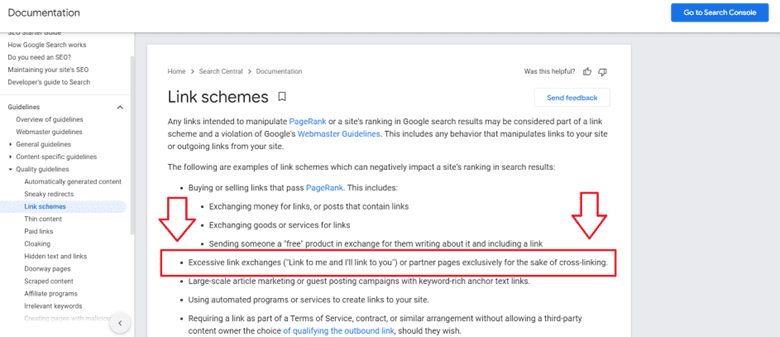
It is highly discouraged for website owners seeking to increase search engine rankings. According to Google, excessive link exchanges and ‘link schemes’ can suppress a linked site in SERPs or block it altogether.
As per John Mueller,
‘’A Link Exchange which involves ‘Link to me and I’ll link to you is against our webmaster guidelines and our algorithms would look at that and try to understand what is happening here and try to ignore those links and the web spam team will also find it not okay. If the majority of the links to your website are built via link exchanges, then they will apply manual action to it, so this is something that you should avoid.’’
If web admins want to avoid getting banned by Google.
It is a good practice to avoid spammy link schemes, as they are a short-term solution to a long-term problem.
Steps You Can Follow To Get Backlinks Instead of Link Exchanges:
There are many better ways to obtain backlinks than focusing on unethical methods like link exchanges.
According to Google’s quality guidelines, asking for links from other sites is not a good practice.
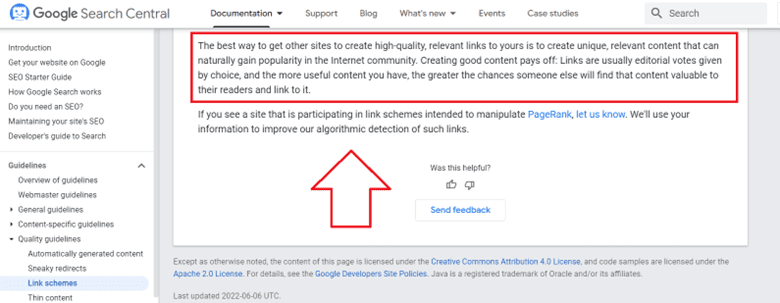
Instead, you should create unique content that will automatically prompt website owners to link back to it as mentioned in the quality guidelines below:
We will highlight some steps we follow in our content promotion outreach campaign, rather than directly asking other brands for links.
A. Look for Link Prospects
Link Prospecting is the process of finding pages from which you want to get a link.
You can search for new links in hundreds of places, like Google search results, your competitor’s backlinks, or your competitor’s link targets.
Firstly, we will find link prospects who find our content relevant and meaningful.
For example, we want to promote our blog, Digital Marketing Guide For Beginners: Simple & Extensive, as it’s one of the best resources.

We can promote it once we have strong content, following our established outreach process. Therefore, we will identify bloggers who have written Digital Marketing content and require related studies. We will identify numerous opportunities to maximize our chances of acquiring the various types of links we desire for our content.
B. Formulate your Outreach Email
After identifying the prospects, the next step is to formulate an outreach email.
Here is the email outreach screenshot:
The first part of the cold outreach email is essential, as you can review critical elements such as the subject line, opening line, and sign-off at this stage.
C. Find Contact Details of your Prospects

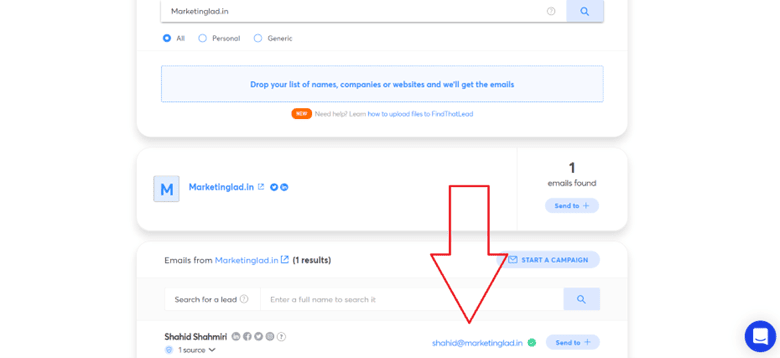
We use a tool called ‘FindThatLead’ to find email addresses and LinkedIn profiles for any web domain. You can easily research for a lead, verify their email address and send them a direct message.
In the screenshot below, we are searching for the email address of Marketing Lad. We are getting their verified email address using the Find That Lead tool.
Final Steps
Our final step is to personalize the outreach email for each individual prospect.
Personalizing your emails may include adding the prospect’s first name, address, company name, and other relevant details.
It will indicate that you’ve done your research and that our outreach campaign is successful.
We make sure to record all the minute details in Google Sheets, as shown in the screenshot below:

This brings us to the end of a successful content promotion campaign!
Conclusion
Link exchanges can negatively impact your site’s ranking in the SERPs if done excessively.
It is better to adopt white-hat and ethical link-building approaches to build backlinks and increase traffic to your website.
We have also given an overview of our outreach process. You can follow them to obtain backlinks instead of engaging in link exchanges.
Is It Okay To Do a Link Swap/Exchange?
Generally speaking, there is no good or bad in link exchanges.
In the link-building industry, we have seen big brands engage in link exchanges, as well as brands that employ alternative strategies for building links. Remember, you can build strong authority and drive traffic to your site if you do it right.
We, as an agency, consider this tactic to be grey-hat SEO. Some agencies use this tactic, and honestly, they have never been penalized by Search Engines. We say this because of our experience working with agencies.
We are not promoting link exchange tactics because Google is not happy with them. Google prefers a natural and earned link. Do you think we have not seen a single site that was penalized?
How about there is always the first time, and if you do it, you get a penalty?
Since Google is a machine, you can benefit from that and do exchanges until you are doing it publicly, and reciprocal links are widespread.
When Should You Do Exchanges?
You can engage in link exchanges if you have multiple websites. That way, it could be challenging for search engines to determine the exchanges. You can engage in exchanges to some extent; however, overdoing it is always wrong and could lead to penalties. Always prioritize relevancy over sites that are completely outside your niche.