
On this page6
Naked links are often misunderstood in link-building discussions. Some marketers see them as neutral citations, while others treat them as a safety mechanism against anchor text penalties.
The real answer sits somewhere in between. Naked links can support a healthy backlink profile, but only when used strategically and in proportion.
This guide explains how naked links work, when they help, when they do not and how to integrate them into a structured SEO strategy without weakening keyword relevance.
Read More On Offshore SEO Services: Scale Rankings, Traffic & Leads Faster
What Is a Naked Link in SEO?
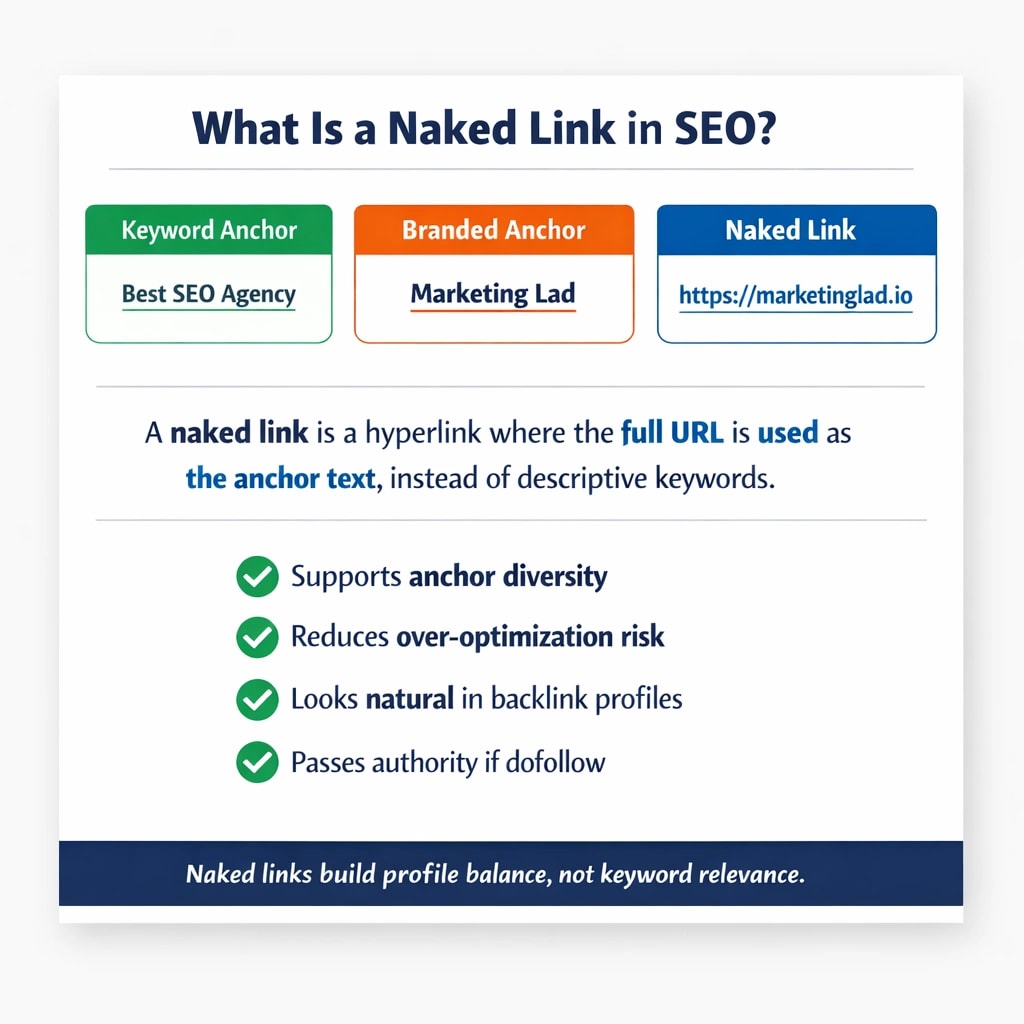
A naked link is a hyperlink where the full URL is used as the anchor text instead of descriptive text.
Example:
https://marketinglad.io
Instead of using anchor text like “SEO services” or “best link building agency,” the raw URL itself becomes clickable. There is no keyword signal embedded in the anchor. The link is visible exactly as typed.
From a technical perspective, search engines treat naked links like any other hyperlink. If the link is crawlable, dofollow and placed on an indexed page, it can pass authority.
However, anchor text contributes contextual signals. With naked links, that keyword relevance component is minimal because the anchor does not contain descriptive terms.
Naked links commonly appear in:
- Editorial citations
- Resource lists
- Forums and community discussions
- Press mentions
- Business directories
- Social media bios
They often reflect natural linking behavior. When someone references a website casually, they paste the URL instead of crafting optimized anchor text. That behavior creates authenticity patterns that search engines expect to see.
From an algorithmic standpoint, naked links contribute to anchor text diversity. A backlink profile consisting only of commercial anchors such as “buy SEO services” appears manipulative.
A profile containing branded anchors, partial matches, generic anchors and naked links signals organic growth.
The value of naked links is therefore structural rather than keyword-driven. They support trust signals and reduce over-optimization risk.
Check out our latest blog on 75+ Home Improvement Guest Posting Sites (2026 Updated List)
Do Naked Links Help or Hurt Rankings?
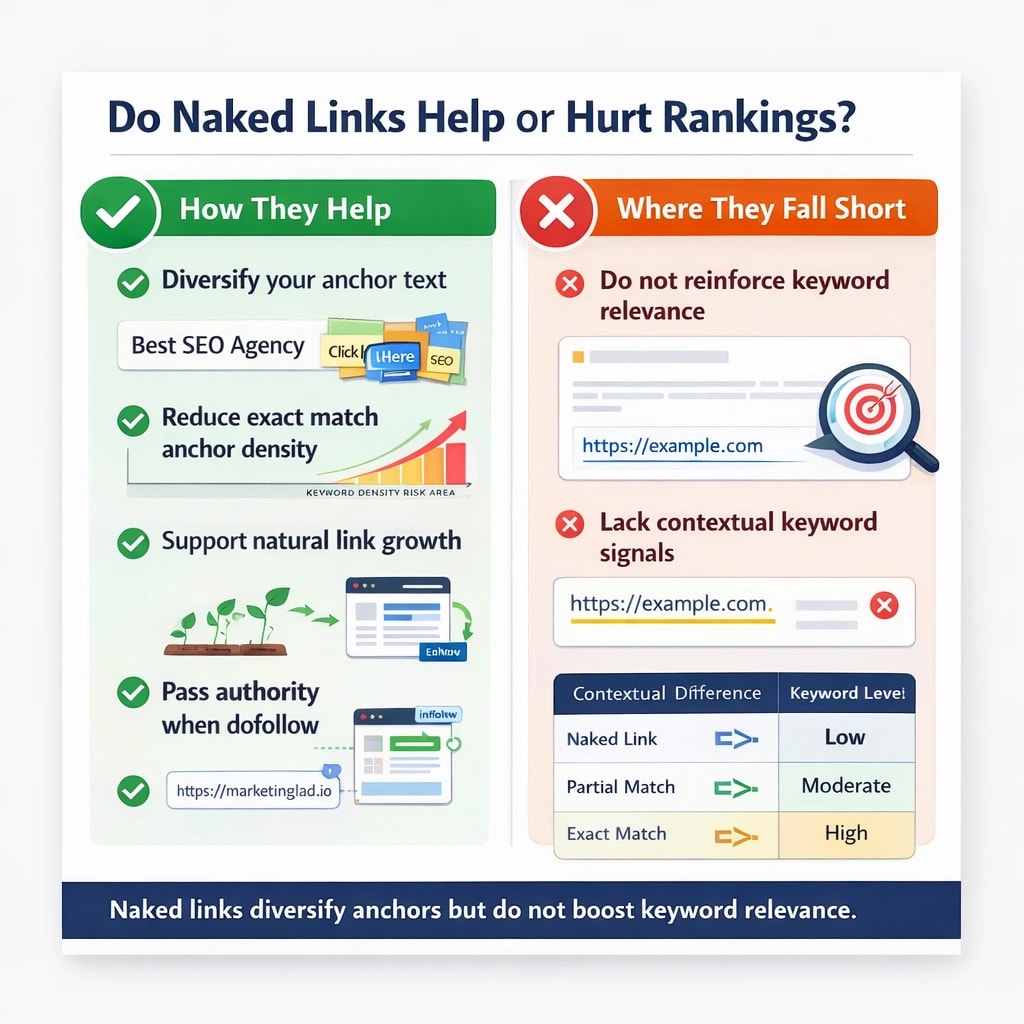
Naked links neither guarantee ranking improvements nor cause ranking drops on their own. Their impact depends on context, placement and distribution.
How They Help
- They diversify anchor text distribution
- They reduce the exact match anchor concentration
- They support natural link growth patterns
- They pass authority when dofollow
If a website has 70 percent exact match anchors, it increases algorithmic risk. Introducing naked links dilutes that pattern and improves profile balance.
Read More On Hyper Local SEO Services for Google Maps & Local Rankings
Where They Fall Short
Naked links do not reinforce keyword themes directly. If you are targeting “enterprise SEO services,” a naked link such as https://example.com does not tell search engines what that page represents.
Compare the contextual difference:
| Anchor Type | Keyword Relevance | Natural Appearance | Risk Level |
|---|---|---|---|
| Exact Match | High | Medium | Higher if overused |
| Partial Match | Moderate | High | Low |
| Branded | Low to Moderate | Very High | Very Low |
| Naked Link | Low | Very High | Very Low |
From a ranking perspective, naked links support authority transfer but not topical reinforcement. That makes them supportive, not primary drivers.
They can hurt rankings only if acquired through spam networks, irrelevant directories, or low-quality placements. In those cases, the problem is the source, not the anchor type.
The conclusion is clear: naked links help stabilize a backlink profile but should not replace strategic anchor text.
When Should You Use Naked Links?
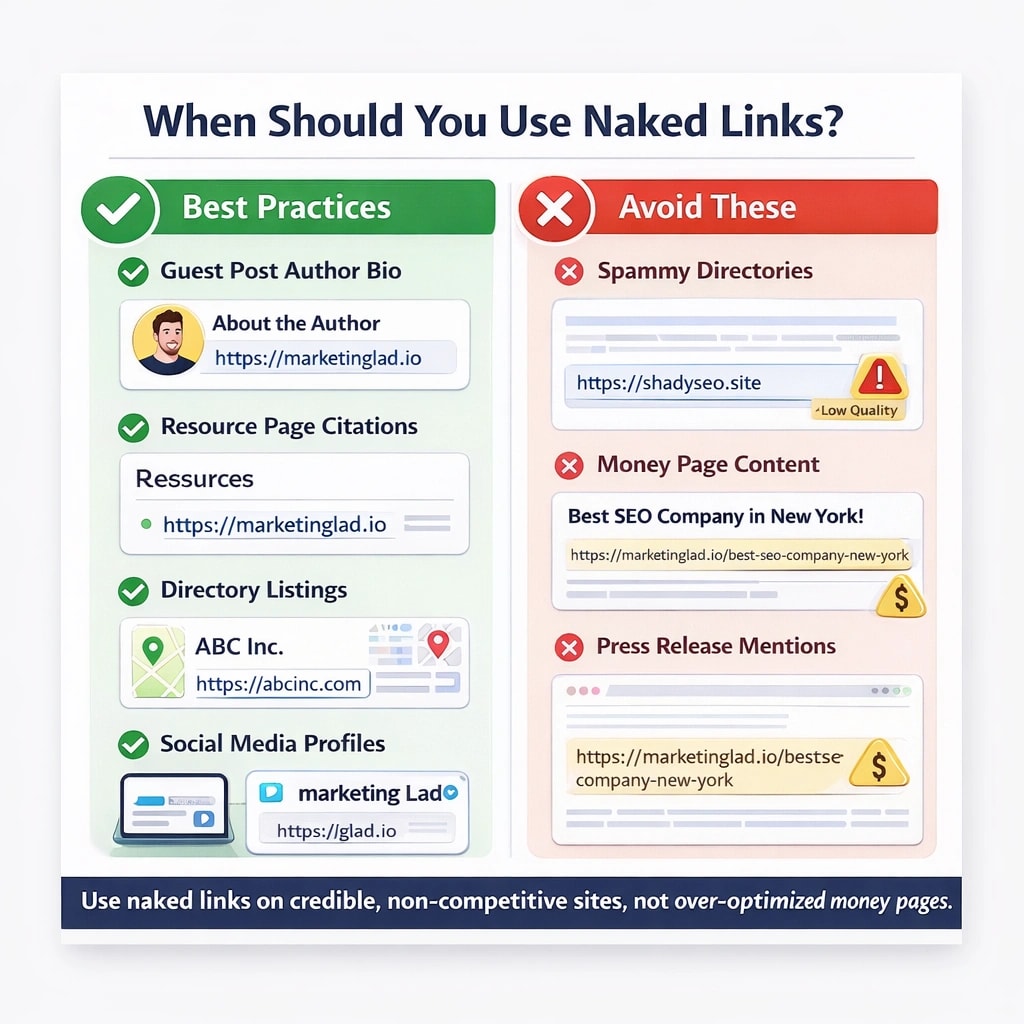
Naked links work best in environments where natural citation is expected. For example:
- Referencing your homepage in a guest article
- Citing a tool or research source
- Listing resources in a blog post
- Publishing press coverage
- Building foundational links in early SEO stages
They are particularly useful during brand-building phases. When a domain is new, branded anchors and naked links create trust before aggressive keyword anchors are introduced.
A structured approach looks like this:
Early Stage Website
- 40 percent branded anchors
- 30 percent naked links
- 20 percent generic anchors
- 10 percent partial match
Established Website
- 30 percent branded
- 20 percent naked
- 30 percent partial match
- 20 percent exact match
This balance avoids manipulation signals while preserving ranking momentum.
Use naked links strategically in:
- Author bios
- Media mentions
- Resource roundups
- Local citations
- Social profiles
Avoid relying on them inside heavily optimized guest posts where contextual anchor text could add topical clarity.
The goal is alignment. Naked links protect profile health. Keyword anchors build topical authority. Both must work together.
Naked Links vs Keyword Anchors: Strategic Comparison

To decide whether naked links are good for SEO, you must compare them against keyword-focused anchors within a performance framework.
Strategic Comparison Table
| Factor | Naked Links | Keyword Anchors |
|---|---|---|
| Keyword Signal | Minimal | Strong |
| Natural Pattern | Very High | Moderate |
| Risk of Over-Optimization | Very Low | Higher if misused |
| Brand Reinforcement | Moderate | Low unless branded |
| Authority Transfer | Yes | Yes |
| Use in Editorial Content | High | High |
Keyword anchors drive thematic clarity. They tell search engines what the linked page is about. However, aggressive use increases the risk of manual actions or algorithmic suppression.
Naked links behave like neutral trust signals. They pass link equity but do not manipulate anchor signals.
A balanced backlink strategy includes:
- Contextual keyword anchors inside content
- Branded anchors in natural references
- Naked links in citations and bios
- Limited generic anchors
SEO performance is rarely driven by one anchor type alone. It is the pattern across the entire domain that influences rankings.
If your backlink audit shows no naked links, the profile may appear artificially engineered. If it shows only naked links, you are likely missing keyword reinforcement.
Before we wrap up, it’s worth understanding how apple seo shows the shift toward authority-based ranking instead of traditional keyword-heavy optimization.
Final Thoughts
Are naked links good for SEO? Yes, when used strategically and proportionally.
They support anchor text diversity, reduce over-optimization risk and pass authority like any standard link. However, they do not replace contextual keyword anchors in building topical relevance.
An effective link-building strategy combines:
- Naked links for authenticity
- Branded anchors for identity
- Partial matches for relevance
- Controlled exact matches for competitive terms
The objective is not to choose one anchor type, but to engineer a backlink profile that mirrors organic linking behavior while supporting ranking goals.
Balance protects rankings. Structure drives growth.
You can also explore how modern AI systems cite and reference content in our guide on AI Citations.
Frequently Asked Questions
Yes. If the link is dofollow and placed on an indexed page, it passes authority. The difference lies in anchor text relevance, not equity transfer.
Generally yes. Naked links carry lower over-optimization risk because they do not aggressively target keywords.
There is no fixed number. Most natural profiles contain 15 to 30 percent naked links, depending on industry and brand strength.
Not directly. They support authority growth, which can improve rankings, but they do not provide strong keyword signals.
No. Replace imbalance, not anchors. A strong SEO strategy requires both for sustainable performance.