
While maintaining an online presence, the relationship between website performance and search engine exposure substantially impacts a company’s online success.
Server-side rendering (SSR) is an important component of a website’s Search Engine Optimization (SEO) strategy.
SSR significantly impacts a website’s position on search engine result pages (SERPs) by impacting its load speeds and content accessibility to search engine crawlers.
Server-side rendering enables search engine bots to access a website’s information more easily, while also enhancing page performance. Both of these factors are important in a site’s search ranking and user experience.
Let’s begin the server-side rendering trip.
What is Server Side Rendering?
Server-side rendering (SSR) creates and delivers web pages directly from the server in response to client requests. Unlike Client-Side Rendering (CSR), which renders a webpage’s content largely on the client’s browser using JavaScript, SSR does this process on the server before providing the pre-assembled HTML to the client device.
a. Improved Page Load Speed: SSR improves initial load speeds by delivering pre-rendered HTML content to users. This technology decreases processing time on the client side, resulting in quicker and more instantaneous page displays. Faster load times improve the user experience and engagement.
b. SEO-friendly content: SSR has a huge impact on search engine optimization. By sending pre-rendered HTML content straight from the server, SSR makes the material more accessible to search engine crawlers. This makes it easier for search engines to index content, which improves a website’s search engine ranking.
c. Enhanced Crawlability and Indexing: SSR design allows search engine bots to scan website information more effectively, increasing its visibility on search engine results pages. Pre-rendering HTML information server-side makes the site more accessible and SEO-friendly, increasing its chances of being indexed.
d. Dynamic Data Accessibility: SSR excels at managing dynamic data by displaying it immediately on the server before transmitting it to the client. This capability enables the presentation of user-specific material without compromising load speed, resulting in dynamic content delivery with minimal latency. In modern web development, SSR is often combined with a headless CMS like Hygraph. This setup allows content to be managed independently of the presentation layer while still rendering server-side. As a result, websites benefit from greater flexibility, faster performance, and improved SEO.

Server-side rendering (SSR) is a crucial strategy for web developers and organizations seeking to optimize page load times and enhance SEO. To reach the same or higher SERPs, you may seek support from an SEO services provider to give you a seamless user experience. The ability to pre-render HTML content on the server has a significant impact on user happiness and discoverability.
Best Practices for Server-Side Rendering & SEO
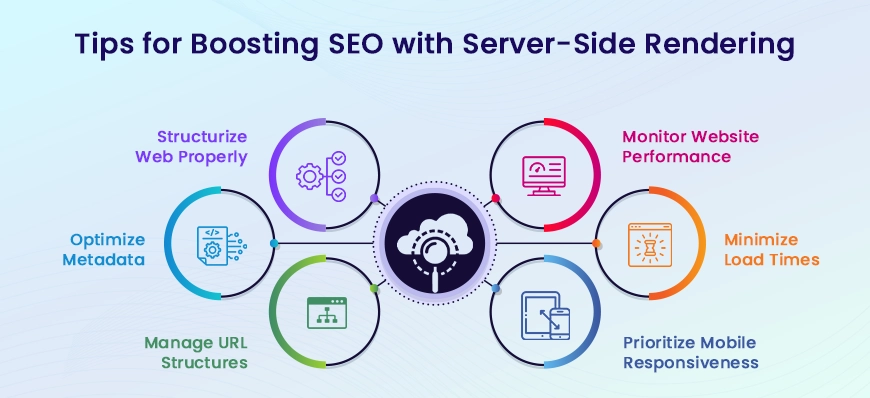
Server-side rendering (SSR) is crucial for optimizing websites for both search engine visibility and user experience. Various SSR best practices can dramatically improve websites’ SEO performance.
a. Structuring Web Properly
A website’s structural base is important in achieving optimal SEO performance. Structured website design is inextricably linked to good SEO methods.
Server-side rendering (SSR) considerably impacts the structural arrangement of web content, influencing its visibility and accessibility to search engines.
Implementing Server-Side Rendering (SSR) involves more than just rendering web pages; it also requires a suitable site structure. SSR considerably impacts the content structure, affecting search engine visibility and user experience.
By arranging your website properly, you will boost your SEO potential and provide consumers with a more seamless trip through your information, resulting in a win-win situation.
b. Optimize Metadata
Metadata is critical to a website’s visibility in search engine results. Properly optimized metadata significantly impacts a site’s SEO and visibility. Server-side rendering (SSR) is crucial in optimizing metadata for improved search engine visibility.
SSR enables the dynamic production and optimization of essential metadata, including title tags and meta descriptions. It allows you to verify that these components appropriately reflect the page’s content.
This helps to optimize material for rich snippets, which are improved search results that appear in SERPs.
SSR helps to ensure that metadata is optimized for mobile devices. With mobile-first indexing becoming increasingly important in search engine results, SSR facilitates the development of mobile-friendly metadata. By partnering with experienced Java development services that specialize in SSR, you can ensure your website remains competitive in the mobile-first era.
c. Manage URL Structure
SSR helps you create clear, legible URLs that are both user-friendly and search-engine-friendly. Instead of complicated query parameters or cryptic text, SSR generates descriptive and comprehensible URLs.
URL structure is an important part of a website’s overall SEO strategy. Properly maintained URL architectures considerably improve a site’s exposure and accessibility to search engines. Server-side rendering (SSR) is critical for maintaining and modifying URL structures.
d. Minimize Load Times
Page loading speed greatly impacts user engagement and search engine rankings. Optimizing images, leveraging caching methods, and utilizing Content Delivery Networks (CDNs) are crucial for reducing load times and enhancing overall site performance.
Efforts to reduce load times substantially influence user experience and SEO performance. Optimizing a website’s loading speed enhances user engagement and satisfaction, ultimately leading to improved search engine rankings and increased exposure.
e. Monitor Website Performance
To maintain an optimal online presence, website performance must be continuously monitored and analyzed. Regular reviews and updates based on performance measurements keep the website competitive in the digital marketplace, meeting user expectations and search engine criteria.
These important best practices are the foundation for a good server-side rendering and SEO approach. By implementing these techniques, websites can dramatically improve their search engine visibility and user experience, ensuring they meet the changing needs of both search engines and users.
Continuously monitoring and improving these procedures will help to maintain high-performance, SEO-optimized websites.
Conclusion
Understanding the relationship between SEO and SSR is about more than just ranking high in search engines; it’s also about enhancing user experience and maintaining a competitive edge in the digital landscape.
You may apply search engine-friendly strategies by concentrating on page load speed, crawlability, and dynamic content delivery.
On the other hand, if you want to take advantage of Server-Side Rendering’s benefits for optimal SEO performance, our organization has years of expertise in implementing and optimizing these strategies. We specialize in custom solutions tailored to your company’s specific needs.
Contact us today to discover how our expertise can enhance your website’s SEO and overall online presence.
FAQs
1. What are the benefits of using server-side rendering for SEO vs client-side rendering?
a. Pre-generated HTML material: SSR delivers pre-generated HTML material, which improves user experience by allowing pages to load quickly.
b. Better Crawlability and Indexing: SSR guarantees that search engines can easily access material for ranking, which improves a website’s search exposure and user engagement.
c. Improved User Experience: SSR’s quicker load times improve the overall user experience, which benefits SEO metrics.
2. How does Server-Side Rendering influence the SEO performance of JavaScript-heavy web applications?
a. Improved JavaScript Execution: SSR pre-renders web pages on the server, allowing for more efficient JavaScript execution while boosting user experience and SEO analytics.
b. Optimized Indexing and Ranking: This strategy improves a website’s indexing and ranking on search engine result pages (SERPs) by increasing visibility and user experience.
c. Increased User Engagement: By improving user experience and making the material more accessible, SSR indirectly boosts user engagement, resulting in better SEO performance.
3. How does server-side rendering affect mobile SEO and user experience?
a. Enhanced Mobile Page Loading: SSR accelerates mobile page loading by supplying pre-generated content to mobile devices.
b. Better Performance: This optimization greatly influences SEO by increasing a site’s ranking in mobile search results.
c. Seamless User Experience: SSR provides a consistent user experience across devices, increasing user engagement and enhancing SEO metrics.