
On this page19
- What Are Social Backlinks?
- Do Social Backlinks Help SEO?
- Why Most Social Backlinks Are Nofollow
- The Real SEO Value of Social Media Backlinks
- Social Backlinks vs Editorial Backlinks
- Best Platforms for Social Backlinks
- How to Use Social Backlinks for Better SEO
- Common Myths About Social Backlinks
- Google’s Shift Toward Entity-Based SEO
- Google’s Nofollow Hint Update Changed Everything
- Social Signals and Branded Search Growth
- User Engagement Signals Matter More Than Ever
- Do Social Backlinks Help Indexing?
- Best Social Backlink Strategies for 2026
- Social Backlinks vs Guest Posts
- Can Social Backlinks Hurt SEO?
- How AI Is Changing Social Link Building
- Final Thoughts
- Frequently Asked Questions
Social backlinks remain one of the most debated topics in SEO.
Some marketers claim social media backlinks directly improve Google rankings. Others argue they are completely useless because most social links are nofollow. Both views oversimplify how modern SEO actually works.
Social backlinks do not pass strong PageRank like editorial backlinks from authority websites. However, dismissing them entirely ignores how Google evaluates visibility, entities, brand authority, user engagement, and content discovery in modern search.
The real value of social backlinks is not direct link equity.
It is amplification.
Social platforms help distribute content to audiences capable of creating the backlinks that actually influence rankings. In many cases, social media becomes the first step in the SEO funnel that leads to editorial links, branded searches, and long-term authority growth.
That is why some of the highest-ranking content online spreads through social media before earning powerful backlinks from publishers, blogs, journalists, and industry websites.
Understanding this distinction is what separates strategic SEO from outdated link-building myths.
Read our latest blog on CarMax: Everything in SEO You Need to Know
What Are Social Backlinks?

Social backlinks are links pointing to your website from social media platforms, online communities, and user-generated content websites.
Examples include links from:
- LinkedIn posts
- Reddit threads
- Quora answers
- Facebook pages
- Twitter/X posts
- YouTube descriptions
- Pinterest pins
- Discord communities
- Telegram channels
- Medium articles
Whenever someone shares your website URL on one of these platforms, it creates a social backlink.
Unlike editorial backlinks, social backlinks are usually user-generated and publicly accessible.
| Platform | Link Attribute |
|---|---|
| Nofollow | |
| UGC/Nofollow | |
| Twitter/X | Nofollow |
| Nofollow | |
| Quora | Nofollow |
| YouTube | Nofollow |
| Nofollow |
Because most social backlinks are nofollow, many SEO beginners incorrectly assume they have zero value.
That is no longer accurate.
Do Social Backlinks Help SEO?
Yes, but not in the way most people think.
Social backlinks rarely improve rankings directly through traditional PageRank transfer. Their real SEO value comes from indirect ranking signals that influence visibility, trust, engagement, and editorial link acquisition.
Google itself has repeatedly explained that social shares are not direct ranking factors.

However, modern SEO is no longer based only on raw backlinks.
Google increasingly evaluates:
- Brand authority
- Entity recognition
- User engagement
- Content popularity
- Search demand
- Content discovery
- Reputation signals
Social media directly influences many of these areas.
The Modern Social SEO Funnel
This is how social backlinks actually contribute to rankings:
| Stage | SEO Impact |
|---|---|
| Social Shares | Content visibility |
| Referral Traffic | User engagement |
| Brand Exposure | Entity recognition |
| Editorial Discovery | Natural backlinks |
| Branded Searches | Authority signals |
| Editorial Links | Ranking growth |
This is why viral content often ranks faster.
The social backlinks themselves are not the primary ranking signal.
The visibility created by social distribution attracts the signals Google actually values most.
Why Most Social Backlinks Are Nofollow
Most social platforms automatically add:
- rel=”nofollow”
- rel=”ugc”
- rel=”sponsored”
to outbound links.
These attributes reduce spam and prevent large-scale manipulation of search rankings.
Without nofollow restrictions, social platforms would become massive SEO spam networks filled with automated link schemes.
However, one important detail changed in Google’s algorithm.
In 2019, Google announced that nofollow links would become “hints” rather than strict directives.
That means Google may still use nofollow links for:
- discovery
- crawling
- contextual understanding
- entity relationships
This update significantly changed how SEO professionals view social backlinks.
While nofollow links still pass limited direct authority, Google can still analyze them for broader ranking signals.
The Real SEO Value of Social Media Backlinks
The biggest misunderstanding about social backlinks is assuming their purpose is direct PageRank transfer.
That is not where their real power comes from.
Social media acts as a distribution engine for content.
Without visibility, even high-quality content can remain invisible.
Social Backlinks Accelerate Content Discovery

Search engines discover content faster when it spreads across:
- Twitter/X
- YouTube
- niche communities
Popular content also attracts:
- bloggers
- journalists
- publishers
- newsletter creators
- industry websites
These people create the editorial backlinks that directly impact rankings.
Social Media Builds Brand Authority
Google increasingly relies on entity-based SEO.
Strong brands naturally generate:
- mentions
- searches
- citations
- engagement
- discussions
A website consistently mentioned across social platforms often develops stronger entity recognition over time.
This contributes to:
- trust
- authority
- relevance
- brand visibility
Modern SEO is no longer link building.
It is authority building.
Social Backlinks vs Editorial Backlinks
This distinction matters enormously.
| Factor | Social Backlinks | Editorial Backlinks |
|---|---|---|
| Direct PageRank | Low | High |
| Referral Traffic | High | Medium |
| Visibility | Strong | Medium |
| Trust Transfer | Limited | Strong |
| Brand Exposure | High | Medium |
| Ranking Influence | Indirect | Direct |
| Acquisition Difficulty | Easy | Difficult |
Editorial backlinks remain far more powerful for direct ranking improvements.
However, social backlinks often help generate those editorial links in the first place.
That is why smart SEO strategies combine:
- content marketing
- digital PR
- social amplification
- editorial outreach
instead of relying on one tactic alone.
Best Platforms for Social Backlinks
Not all social platforms provide equal SEO value.
Some generate stronger visibility, engagement, and editorial discovery opportunities than others.

LinkedIn is extremely valuable for:
- B2B SEO
- SaaS marketing
- founder branding
- thought leadership
Well-performing LinkedIn posts often reach journalists, editors, and decision makers.
Reddit can generate massive visibility spikes.
A single viral thread can:
- drive thousands of visits
- create discussions
- attract backlinks
- increase branded searches
Google also indexes Reddit aggressively.
Quora
Quora works well for:
- evergreen traffic
- question-based SEO
- educational content
- niche authority
High-ranking answers can send referral traffic for years.
YouTube
YouTube descriptions generate social backlinks while also increasing:
- video visibility
- brand searches
- audience growth
Video content also improves content diversification.
Pinterest performs particularly well in:
- visual industries
- infographics
- lifestyle niches
- tutorials
Pins can continue driving traffic long after publishing.
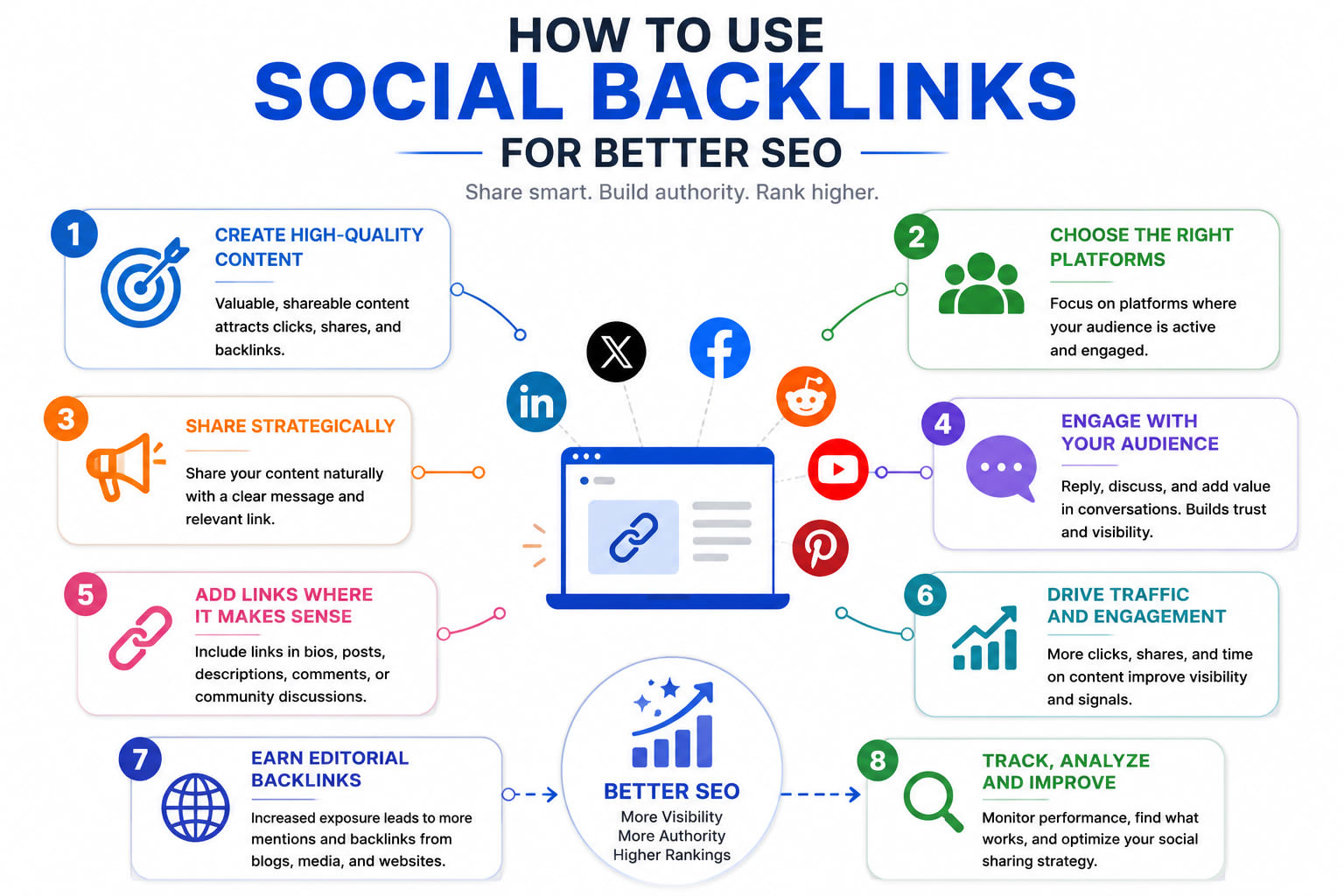
How to Use Social Backlinks for Better SEO
Most businesses use social media incorrectly.
Dropping random links rarely creates SEO value.
The real objective is strategic amplification.
Create Linkable Assets
The best content for social SEO includes:
- original research
- statistics
- case studies
- infographics
- controversial opinions
- industry reports
- tutorials
These formats naturally attract editorial citations.
Repurpose Content Across Platforms
One article can become:
- LinkedIn posts
- Reddit discussions
- Twitter threads
- Quora answers
- short videos
- infographics
This increases reach without constantly creating new content.
Prioritize Engagement Over Spam
Social algorithms reward:
- comments
- saves
- discussions
- shares
- watch time
Real engagement improves visibility significantly more than mass posting links.
Build Brand Search Demand
The strongest brands in SEO generate branded searches consistently.
Social visibility increases:
- brand familiarity
- repeat exposure
- audience trust
- direct traffic
Google increasingly recognizes these patterns.
Common Myths About Social Backlinks
Myth 1: Social Backlinks Directly Improve Rankings
Most social links are nofollow and pass minimal direct PageRank.
Myth 2: Social Signals Are Useless
False.
Social visibility strongly influences:
- discovery
- traffic
- engagement
- brand authority
- editorial backlinks
Myth 3: More Shares Automatically Mean Better Rankings
Viral content still needs:
- quality
- backlinks
- relevance
- authority
to sustain rankings.
Myth 4: Automated Social Link Building Works
Automation creates low-quality signals and weak engagement.
Authentic visibility matters far more.
Google’s Shift Toward Entity-Based SEO
Google no longer evaluates websites only through links and keywords.
Its algorithms now understand:
- brands
- people
- organizations
- products
- topics
through entity recognition.
This is part of Google’s Knowledge Graph and semantic search systems.
When a brand consistently appears across:
- YouTube
- Quora
- X/Twitter
- industry communities
Google gains a stronger contextual understanding of that entity.
This creates:
- stronger trust signals
- better topical relevance
- Higher authority recognition
- increased search visibility
Social platforms help reinforce these entity relationships.
That is one reason established brands often rank faster, even with fewer backlinks.
Google’s Nofollow Hint Update Changed Everything
For years, SEO professionals believed nofollow links passed absolutely zero value.
That changed in 2019.
Google announced that nofollow links would become “hints” rather than strict directives.
This means Google may still use nofollow links for:
- discovery
- crawling
- contextual analysis
- spam evaluation
- entity understanding
Most social backlinks remain nofollow, but Google can still analyze them as part of broader ranking systems.
This is extremely important in modern SEO.
A Reddit thread discussing your website may not transfer PageRank directly, but it can still:
- expose content to publishers
- increase branded searches
- create engagement signals
- improve entity visibility
- attract editorial backlinks
This indirect influence is where social backlinks become valuable.
Social Signals and Branded Search Growth
One of the strongest indirect SEO benefits from social media is branded search growth.
When users repeatedly encounter a brand across social platforms, they often begin searching for that brand directly in Google.
Examples:
- “Ahrefs SEO tools”
- “HubSpot CRM”
- “Semrush keyword tool”
Google understands these branded searches as trust and popularity signals.
Strong brands naturally attract:
- more clicks
- more mentions
- more backlinks
- more engagement
- more direct traffic
Social visibility accelerates this process.
That is why many companies invest heavily in:
- founder branding
- LinkedIn visibility
- YouTube content
- Twitter/X engagement
- podcast appearances
They are building entity authority, not just social followers.
User Engagement Signals Matter More Than Ever
Google increasingly measures content quality through user interaction patterns.
While Google does not directly use likes or shares as ranking factors, social traffic can improve:
- click-through rates
- repeat visits
- dwell time
- brand recall
- engagement
For example:
- A Reddit discussion may drive highly engaged visitors
- A LinkedIn post may attract industry professionals
- A YouTube mention may create brand familiarity
These interactions strengthen overall visibility and authority.
Modern SEO is no longer isolated from broader digital presence.
The strongest rankings usually belong to brands that dominate multiple channels simultaneously.
Do Social Backlinks Help Indexing?
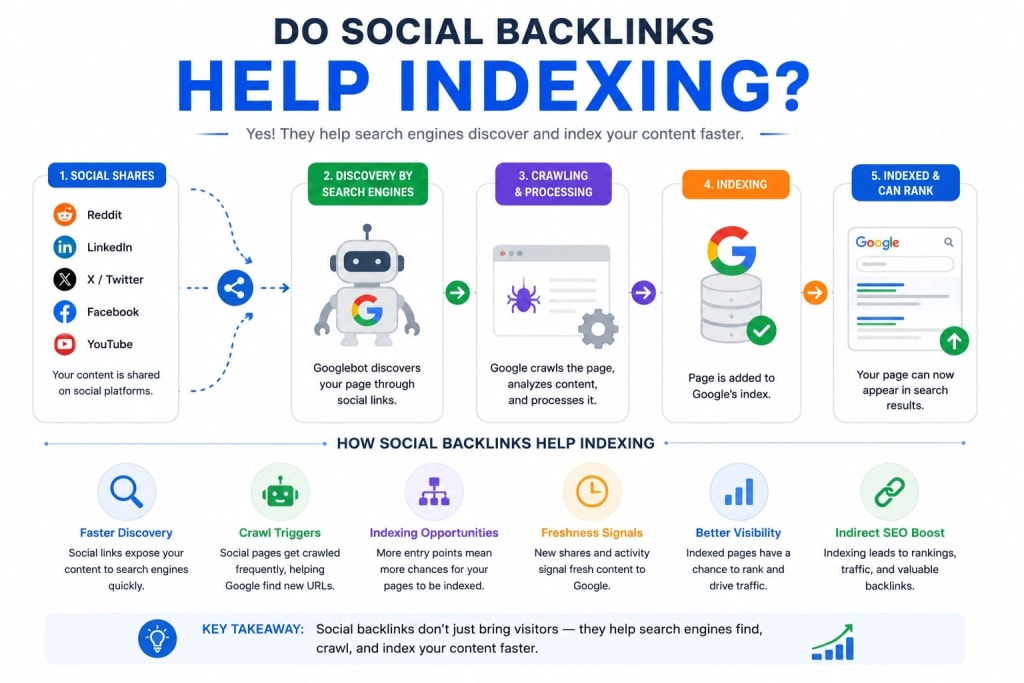
Yes, social backlinks can help search engines discover and index content faster.
This is one of the most overlooked benefits of social media in SEO.
Many websites struggle with indexing because Googlebot does not discover new URLs quickly enough. Social sharing can accelerate that discovery process significantly.
How Social Media Accelerates Crawling
When content spreads through:
- X/Twitter
- YouTube
- niche communities
Google often discovers those URLs faster.
This happens because:
- Social platforms are crawled frequently
- active pages receive regular indexing attention
- Viral discussions attract crawl activity
Although social backlinks usually pass minimal PageRank, they still help expose URLs to Googlebot.
This is especially useful for:
- new websites
- fresh content
- trending topics
- breaking news
- time-sensitive articles
Reddit Is Particularly Powerful for Indexing
Google heavily crawls Reddit.
Pages discussed in active Reddit communities are often indexed quickly because:
- Reddit has enormous authority
- Google trusts Reddit content
- Threads generate constant crawl activity
Many SEO professionals intentionally use Reddit for:
- content discovery
- indexing acceleration
- visibility testing
However, spam posting rarely works long-term.
The discussion itself matters more than simply dropping links.
Freshness Signals and Social Activity
Google’s freshness systems prioritize rapidly discussed content.
When a page suddenly receives:
- social shares
- mentions
- discussions
- referral traffic
Google may interpret this as a sign of emerging relevance.
This is common in:
- tech news
- crypto
- AI
- sports
- finance
- trending events
Social activity can help search engines identify content worth revisiting more frequently.
Read More On Where to Buy Sport Backlinks: Safe & Effective Guide (2026)
Social Backlinks and Crawl Budget
For large websites, crawl budget becomes extremely important.
Social distribution can indirectly influence crawl behavior by increasing:
- visibility
- internal engagement
- URL discovery
- external mentions
Pages receiving external attention are more likely to attract repeated crawling.
While social backlinks alone do not guarantee indexing, they often support faster discovery and refresh cycles.
Best Social Backlink Strategies for 2026
Most social backlink strategies fail because they focus on quantity instead of visibility and engagement.
Modern SEO rewards amplification, not spam.
The objective is not creating thousands of low-quality social links.
The objective is to generate:
- discovery
- engagement
- editorial attention
- branded searches
- authority signals
LinkedIn Authority Strategy
LinkedIn is one of the strongest platforms for B2B SEO.
Instead of posting links directly:
- create insight-driven posts
- share original opinions
- publish mini case studies
- summarize article takeaways
Then naturally reference your content.
This improves:
- reach
- engagement
- visibility
- authority perception
LinkedIn works especially well for:
- SaaS
- SEO
- marketing
- finance
- AI
- consulting
Reddit Discussion Strategy
Reddit users aggressively reject spam.
Successful Reddit SEO requires:
- genuine participation
- thoughtful answers
- community value
- relevant discussion
The best strategy is to contribute useful insights first and link only when it genuinely supports the discussion.
A successful Reddit thread can:
- drive massive traffic
- create backlinks
- increase searches
- generate visibility spikes
Quora SEO Strategy
Quora still performs well for long-tail search visibility.
The best approach:
- answer highly targeted questions
- provide real expertise
- include examples
- use natural references
High-quality Quora answers can generate:
- evergreen traffic
- referral visits
- authority signals
Twitter/X Content Amplification
Twitter/X works best for:
- rapid distribution
- networking
- influencer visibility
- trend participation
Thread-based content performs particularly well because it:
- increases dwell time
- improves engagement
- encourages shares
Strong Twitter visibility often leads to:
- newsletter mentions
- podcast invitations
- editorial references
YouTube SEO Amplification
YouTube indirectly supports SEO through:
- brand visibility
- search demand
- referral traffic
- video indexing
Google heavily integrates YouTube into search results.
Video content also increases:
- engagement
- audience trust
- multi-platform visibility
Social Backlinks vs Guest Posts
Both strategies support SEO, but they work differently.
| Factor | Social Backlinks | Guest Posts |
|---|---|---|
| Direct Authority | Low | High |
| Scalability | High | Medium |
| Traffic Potential | High | Medium |
| Brand Exposure | High | Medium |
| Editorial Control | Limited | Strong |
| Cost | Low | Often expensive |
| Link Equity | Weak | Strong |
Guest posts remain stronger for direct ranking improvements because they usually pass editorial authority.
However, social backlinks are:
- faster
- cheaper
- easier to scale
- stronger for visibility
The most effective SEO strategies combine both.
Social media amplifies content visibility while guest posts strengthen authority and link equity.
Can Social Backlinks Hurt SEO?
Social backlinks themselves rarely hurt rankings.
However, spammy social link-building tactics can create weak quality signals.
Dangerous Social SEO Tactics
Avoid:
- automated social bookmarking
- fake engagement bots
- mass account creation
- spam comment links
- low-quality profile links
- artificial shares
These tactics create:
- low trust signals
- poor engagement
- spam footprints
Google’s spam systems have become extremely advanced at identifying manipulation patterns.
Quality Matters More Than Volume
One highly engaged Reddit discussion is more valuable than:
- 5,000 fake shares
- automated bookmarking spam
- bot-generated tweets
Modern SEO prioritizes:
- authenticity
- authority
- relevance
- engagement quality
Not raw link quantity.
How AI Is Changing Social Link Building
AI is transforming social SEO rapidly.
Both positive and negative changes are happening simultaneously.
AI Content Amplification

AI tools now help marketers:
- repurpose articles
- create social snippets
- generate video scripts
- scale content distribution
This increases efficiency dramatically.
One article can instantly become:
- LinkedIn posts
- Twitter threads
- YouTube scripts
- Quora answers
- infographics
This improves multi-platform visibility.
The Rise of AI Spam
At the same time, AI has created enormous amounts of:
- fake engagement
- low-quality posts
- automated comments
- synthetic shares
Google and social platforms are aggressively filtering low-quality AI spam.
This means genuine expertise matters even more.
Authenticity Becomes the Competitive Advantage
As AI-generated content floods social platforms, brands with:
- real expertise
- unique insights
- original data
- authentic engagement
will gain stronger visibility.
The future of social SEO belongs to authoritative brands, not automated spam systems.
Final Thoughts
Social backlinks are not powerful ranking links by themselves.
But treating them as useless is one of the biggest mistakes in modern SEO.
The real SEO value of social backlinks comes from:
- amplification
- visibility
- discovery
- engagement
- brand authority
- editorial backlink generation
Google’s algorithms increasingly reward recognizable entities and trusted brands.
Social media helps create those signals at scale.
The websites dominating competitive search results rarely rely on backlinks alone.
They combine:
- strong content
- editorial links
- brand visibility
- social distribution
- audience engagement
- entity authority
That is where social backlinks become genuinely valuable.
Frequently Asked Questions
Mostly indirectly. Social backlinks improve visibility, referral traffic, brand awareness, and editorial backlink opportunities.
Most social media backlinks are nofollow or UGC links.
Not directly, but they can increase visibility and attract editorial backlinks that improve rankings.
LinkedIn, Reddit, Quora, and YouTube are among the strongest platforms for SEO visibility and referral traffic.
Yes, especially when combined with strong content marketing and digital PR strategies.