
On this page22
- Acquisition Starts the Relationship, but Retention Develops It
- The First Purchase Should Not Be the Finish Line
- Retention Can Increase Customer Lifetime Value
- Strong Acquisition Numbers Can Hide Retention Problems
- Retention Can Make Marketing Investment More Efficient
- Customer Experience Is Part of Retention Marketing
- Trust Is Often Built When Something Goes Wrong
- Personalization Can Strengthen Existing Customer Relationships
- Good Onboarding Can Improve Early Retention
- Customer Loyalty Is Built Through Consistency
- Retained Customers Can Support Customer Acquisition
- Customer Feedback Can Reveal Retention Problems
- Different Customers Need Different Retention Strategies
- Retention Performance Needs to Be Measured
- Acquisition and Retention Should Share Data
- Retention Does Not Mean Keeping Every Customer
- Retention Marketing Goes Beyond Loyalty Programs
- Technology Can Help Businesses Scale Retention
- Strong Retention Can Make Growth More Predictable
- Acquisition and Retention Work Best Together
- Building a More Balanced Marketing Strategy
- Conclusion

Businesses naturally put significant resources into attracting new customers. Marketing teams invest in paid advertising, SEO, content, social media, partnerships, digital PR, and other channels designed to introduce brands to new audiences. Sales teams are measured by leads and conversions, while leadership often sees a growing customer count as an important indicator of business performance.
Customer acquisition deserves this attention because every growing business needs new customers. However, attracting someone for the first time is only one part of creating sustainable growth. What happens after that person buys a product, starts a subscription, or signs a contract can be just as important as the campaign that originally brought them to the business.
Retention marketing focuses on developing those existing customer relationships. It includes onboarding, useful communication, customer service, personalization, loyalty initiatives, product education, renewals, and the wider post-purchase experience. Rather than treating conversion as the end of marketing, retention looks at how a business can continue providing enough value for customers to want to stay.
A healthy marketing strategy therefore needs both sides. Acquisition expands the customer base, while retention helps businesses generate greater value from the relationships they have already invested in creating.
Acquisition Starts the Relationship, but Retention Develops It
Customer acquisition covers the activities used to turn prospective buyers into paying customers. Depending on the industry, businesses may use search marketing, advertising, social media, referrals, content, events, partnerships, digital PR, or direct sales to accomplish this.
These channels are essential for reaching people who have never purchased from the company before. The problem begins when businesses treat the first conversion as the ultimate measure of whether those efforts succeeded.
Imagine a company acquiring 1,000 customers through a successful campaign. The acquisition numbers may initially look impressive, but their long-term value depends heavily on what happens afterward. If most of those customers purchase once and disappear, the company must continually find another large group of customers simply to maintain momentum.
Strong retention can change that dynamic by encouraging customers to remain active after the first conversion.
This may involve:
- Making repeat purchases over time
- Renewing subscriptions or service agreements
- Upgrading to higher-value products or plans
- Purchasing complementary products or services
- Staying engaged with the brand between transactions
- Recommending the business to other potential customers
When retention is stronger, new acquisition adds customers to a more stable existing base rather than simply replacing those who have left. This can make growth more sustainable and reduce the pressure on marketing teams to constantly generate enough new business to offset customer churn.
As a company grows, this balance becomes increasingly important. Businesses should not only ask how efficiently they can attract customers, but also whether they are creating an experience that gives the right customers meaningful reasons to stay.
The First Purchase Should Not Be the Finish Line
Businesses spend enormous amounts of time improving the journey toward a customer’s first conversion. Landing pages are tested, advertisements are optimized, calls to action are refined, and checkout processes are simplified to remove anything that might prevent a purchase.
Once the sale happens, marketing attention can decline quickly. That is a missed opportunity because the first transaction changes the nature of the relationship. The customer already knows the company, understands at least part of its offering, and has demonstrated enough trust to spend money.
The next stage should reinforce that decision. Clear order information, realistic expectations, helpful onboarding, dependable delivery, and accessible customer service can demonstrate that the promises made before the sale continue afterward.
Poor post-purchase experiences can do the opposite. Customers may quickly reconsider their decision when communication disappears after payment, support becomes difficult to reach, or the experience does not match what marketing originally promised.
Retention marketing recognizes this transition and adjusts communication accordingly. Instead of continuing to persuade customers that the company is worth trying, the focus shifts toward proving that continuing the relationship is worthwhile.
Retention Can Increase Customer Lifetime Value
A customer’s value should not always be measured by a single purchase. Customer lifetime value considers the value generated throughout the entire relationship, which can produce a very different understanding of marketing performance.
A customer making a relatively modest first purchase but returning regularly for several years may ultimately be worth considerably more than someone who makes one expensive purchase and never returns. This is why repeat behavior deserves attention alongside initial conversion value.
Retention can create additional value through repeat purchases, subscriptions, renewals, upgrades, complementary products, and expanded services. The exact opportunity depends on the business model, but the underlying principle remains the same: a customer relationship can become more valuable over time.
Ethan Richardson, CMO of Exquisite Timepieces, believes that repeat purchases also give businesses a stronger indication of what customers genuinely value.
“A first purchase tells you that you successfully created interest. Repeat purchases tell you something much more useful: the customer found enough value to choose you again. That distinction should influence how businesses think about both marketing and inventory,” says Richardson.
This information can influence more than promotional decisions. Understanding which products customers return for and which customer groups remain active can help businesses make better decisions about inventory, merchandising, service, and future marketing investment.
Strong Acquisition Numbers Can Hide Retention Problems
A business can appear to be growing while simultaneously losing a significant number of existing customers. Aggressive acquisition sometimes hides this problem because new customers enter faster than existing customers leave.
Consider a subscription company that loses hundreds of accounts every month but consistently acquires slightly more than it loses. The overall customer count continues to rise, suggesting healthy growth. Underneath those numbers, however, the company is spending substantial resources replacing customers it previously paid to acquire.
Warning signs of a retention problem can include:
- High customer churn despite steady new sign-ups
- Rising acquisition costs with little improvement in long-term revenue
- A large gap between first-time and repeat purchases
- Customers canceling shortly after onboarding
- Heavy dependence on paid channels to maintain growth
- Low renewal or repeat purchase rates
- Acquisition campaigns that generate volume but weak lifetime value
That approach becomes more vulnerable when acquisition conditions change. Advertising prices can increase, competitors can become more aggressive, search visibility may decline, and individual marketing channels can lose effectiveness.
Retention reduces some of that pressure by allowing a higher percentage of acquired customers to remain with the business. Acquisition can then contribute more directly to expansion rather than constantly compensating for churn.
Businesses should therefore evaluate acquisition performance alongside what customers do after converting. The number of customers generated by a campaign is useful, but the quality and durability of those relationships provide important additional context.
Retention Can Make Marketing Investment More Efficient
Customer acquisition frequently involves multiple interactions before a sale takes place. A prospective customer may see an advertisement, visit a website, read several pieces of content, compare competitors, join an email list, and return days or weeks later before finally making a purchase.
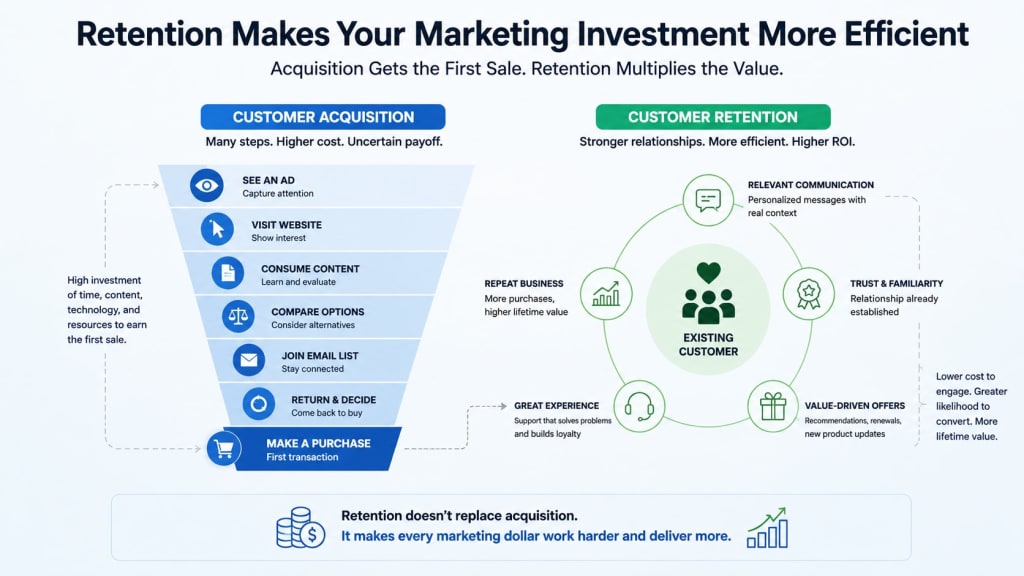
Each interaction requires resources. If the customer disappears immediately after the first transaction, the business has a relatively short window to generate value from that acquisition investment.
Existing customers start from a different position because much of the introductory work has already been done. They know the company and have direct experience with its products or services. A relevant recommendation, useful reminder, renewal notice, or new product announcement may therefore have more context than the same communication sent to a stranger.
Retention marketing still requires investment in people, technology, content, service, and customer experience. Its value lies in allowing companies to continue developing relationships they have already worked hard to establish, rather than rebuilding familiarity and trust from scratch for every sale.
Customer Experience Is Part of Retention Marketing
Retention is sometimes treated primarily as an email or loyalty-program responsibility. In practice, customers form their opinions based on many parts of the business that sit outside the marketing department.
A customer may love a company’s advertising but decide not to purchase again because an order arrived late. Another may appreciate the product but leave because getting support was unnecessarily difficult. Billing problems, confusing return policies, inconsistent service, and poor communication can all influence retention.
Greg McRoberts, Founder and CMO at Verde Fulfillment USA, sees fulfillment as an important extension of the customer experience.
“You can spend heavily creating a polished customer acquisition experience, but customers remember what happens after they pay. If the order is wrong, late, damaged, or difficult to track, that becomes part of their perception of the brand. Retention is influenced by operations more than many marketing teams realize,” says McRoberts.
Businesses should consequently look beyond promotional activity when examining retention. Onboarding, fulfillment, customer service, billing, account management, returns, product reliability, and complaint handling all contribute to whether customers want to continue the relationship.
Marketing can establish expectations, but the wider organization ultimately has to deliver on them.
Trust Is Often Built When Something Goes Wrong
Consistency is important for retention, but businesses should also consider how they behave when the customer experience does not go as planned. Delays, service interruptions, mistakes, and unexpected problems occur in almost every industry.
The response can become an important moment in the customer relationship. Businesses that disappear, provide vague information, or force customers to repeatedly chase updates can turn a manageable problem into a reason to leave.
Sharon Amos, Director at Air Ambulance 1, emphasizes the role communication plays when circumstances become difficult.
“Customers do not expect every situation to be perfect, but they do notice how an organization responds when something becomes difficult. Clear updates, realistic expectations, and responsive communication can preserve trust during moments when uncertainty is high,” says Amos.
The lesson applies well beyond any single industry. When something goes wrong, customers generally want to understand what happened, what is being done, and what they should expect next. Clear communication cannot solve every problem, but it can prevent uncertainty from making the experience worse.
Personalization Can Strengthen Existing Customer Relationships
Businesses often know more about existing customers than prospective ones. Purchase history, product preferences, previous interactions, account activity, and engagement patterns can provide useful context for future communication.
Used responsibly, this information can make marketing more relevant. An eCommerce retailer might recommend products related to previous purchases, while a software provider could send tutorials based on features the customer actually uses. A service company might communicate differently with a long-standing client than with someone who joined a week ago.
Businesses can personalize retention marketing in several practical ways:
- Recommend products based on previous purchases or interests
- Send educational content related to features a customer actually uses
- Adjust communication based on where someone is in the customer journey
- Provide relevant reminders for renewals, subscriptions, or replenishment
- Recognize loyal or long-term customers with appropriate benefits
- Re-engage inactive customers with messages based on previous activity
- Allow customers to control their communication preferences
Effective personalization is not simply inserting someone’s first name into every email. Its real value comes from reducing irrelevant communication and providing information that reflects the customer’s needs, preferences, and existing relationship with the business.
Businesses should also avoid turning personalization into excessive messaging. Having more customer data does not automatically justify sending more emails, notifications, or offers. The objective should be to make each interaction more useful and timely rather than simply creating more opportunities to sell something.
Good Onboarding Can Improve Early Retention

The period immediately following acquisition can have a major influence on whether a customer stays. A purchase represents an initial commitment, but the customer may still be deciding whether the product or service was the right choice.
For software companies, customers may need help understanding features and incorporating the product into their workflow. An eCommerce customer may be evaluating shipping communication, packaging, product quality, and the ease of getting help. Service clients may pay particular attention to responsiveness and clarity during the first few weeks.
Good onboarding reduces unnecessary uncertainty by explaining what happens next and helping customers receive value quickly. Welcome messages, setup instructions, tutorials, knowledge bases, delivery updates, product guides, and personal introductions can all contribute.
Jake Wardle, Founder of EV Cable Hub, points out that useful education can continue well beyond the initial onboarding stage.
“Not every customer needs another sales message after buying. Sometimes the most valuable follow-up is helping them understand what they bought, how to use it properly, and what they may need later. If you stay useful between purchases, you give customers a reason to remember your business when the next need comes up,” says Wardle.
This is especially relevant for products with longer purchase cycles. Retention does not always mean persuading customers to buy again immediately. Maintaining a useful relationship can be equally valuable when the customer’s next natural purchasing need may be months or years away.
Customer Loyalty Is Built Through Consistency
Promotions, loyalty points, rewards, and exclusive offers can encourage repeat purchases, but incentives alone rarely create a durable customer relationship. Long-term loyalty is more closely connected to whether businesses consistently deliver the experience customers expect.
Products need to perform as promised, pricing should be understandable, communication should remain clear, and customers should be able to access support when they need it. These everyday interactions may receive less attention than major marketing campaigns, but they shape how customers perceive the business over time.
Consistency gives customers confidence about what they will receive when they return. Loyalty programs can strengthen that relationship, but they work best when the underlying experience already gives customers a genuine reason to stay.
Retained Customers Can Support Customer Acquisition
Retention does more than generate additional business from existing customers. Satisfied customers can also contribute to acquisition through referrals, reviews, testimonials, recommendations, case studies, and everyday word-of-mouth.
This matters because prospective customers often want evidence beyond a company’s own marketing claims. Seeing positive experiences from existing customers can reduce uncertainty, particularly when someone is comparing several unfamiliar brands.
Retained customers can support acquisition in several ways:
- Referrals: Loyal customers may refer the business to friends, colleagues, or others in their network.
- Online reviews: Positive reviews can provide prospective buyers with firsthand evidence of the customer experience.
- Word of mouth: Customers may naturally mention products or services in relevant conversations.
- Testimonials and case studies: Long-term customers can provide credible examples of how a product or service delivers value.
- Social proof: Repeat customers and positive experiences can strengthen the reputation prospective buyers encounter during their research.
- Organic brand mentions: Satisfied customers may discuss or recommend a company in online communities and social conversations.
A business with strong retention can gradually develop a group of customers who understand the product well enough to speak credibly about it. Their experiences can serve as an important source of social proof for people who have not yet purchased.
Companies can encourage advocacy by creating straightforward referral programs, requesting reviews at appropriate moments, and giving customers opportunities to provide feedback. These efforts work best when recommendations grow from a genuinely positive experience rather than pressure or excessive incentives.
Retention can therefore support acquisition as part of a continuing cycle. Customers who stay because they consistently receive value may eventually introduce the company to new potential buyers, helping the business grow through both existing relationships and new ones.
Customer Feedback Can Reveal Retention Problems

Existing customers can provide valuable information about weaknesses that may not be obvious internally. Support conversations, reviews, surveys, interviews, cancellation forms, account-manager notes, and usage patterns can all reveal why customers remain satisfied or begin disengaging.
The important part is not simply collecting feedback but identifying recurring patterns and acting on them. If many customers mention confusing onboarding, slow support, unclear billing, or difficulty getting information, those concerns may indicate a broader problem rather than isolated complaints.
This is why customer feedback should reach more than the marketing department. Product, operations, sales, service, and leadership teams can all benefit from understanding where customers encounter unnecessary difficulty.
Different Customers Need Different Retention Strategies
A customer who made a first purchase yesterday does not necessarily need the same communication as someone who has purchased regularly for five years. Customers at different stages of the relationship have different levels of familiarity, needs, and expectations.
Segmentation allows businesses to account for these differences. Customers can be grouped according to factors such as purchase frequency, product category, engagement, account value, subscription status, or time since the last transaction.
New customers might receive onboarding and educational information, while regular buyers may appreciate early access to relevant products or services. Customers who have become inactive could receive a carefully timed reminder, while valuable long-term accounts may benefit from more personal communication.
The goal is not to create dozens of complicated segments. A useful segmentation strategy simply prevents businesses from treating everyone in the customer database as though their relationship with the company were identical.
When retention communication reflects the customer’s current stage and needs, it is more likely to be perceived as useful rather than intrusive.
Retention Performance Needs to Be Measured
Marketing teams frequently have detailed acquisition dashboards covering website traffic, cost per click, lead volume, conversion rates, and customer acquisition cost. Retention deserves similar attention because businesses need to understand what happens to customers after conversion.
The right metrics depend on the business model. Subscription companies may focus on churn, renewal rates, and recurring revenue. Retailers and eCommerce businesses may examine repeat purchase rates, purchase frequency, and the time between transactions. B2B companies may look more closely at client tenure, contract renewals, account expansion, and revenue retention.
Cohort analysis can add another layer of understanding by comparing groups of customers acquired through different channels or during different periods. This helps businesses determine whether certain acquisition sources consistently produce customers who stay longer or purchase more frequently.
Retention metrics become particularly valuable when paired with acquisition data because the cheapest customer to acquire is not necessarily the most valuable to retain.
Acquisition and Retention Should Share Data
Acquisition teams naturally want to understand which campaigns generate conversions, but conversion cost alone can provide an incomplete picture. A marketing channel that generates inexpensive first purchases may appear highly effective even when those customers rarely return.
Connecting acquisition and retention data gives businesses a clearer understanding of what happens after the initial conversion. Instead of evaluating channels only by how many customers they generate, marketing teams can compare factors such as:
- Customer acquisition cost across different channels
- Repeat purchase rates among acquired customers
- Customer lifetime value by acquisition source
- Churn and cancellation rates
- Subscription or contract renewal rates
- Average order value among returning customers
- Time between first and subsequent purchases
- Revenue generated from different customer groups over time
Connecting this information can change how marketing budgets are allocated. A channel with a somewhat higher initial acquisition cost may ultimately yield better results if its customers purchase repeatedly, remain subscribed for much longer, or become higher-value accounts.
This allows businesses to think about customer quality alongside customer quantity. Instead of optimizing every campaign around the lowest possible acquisition cost, marketers can identify which channels attract customers who continue generating value after the first conversion.
Over time, this shared data can also improve targeting. When companies understand where their strongest long-term customers come from, they can use those insights to refine and focus resources on audiences and channels that drive sustainable growth.
Retention Does Not Mean Keeping Every Customer
Strong retention does not mean a company should attempt to keep every customer indefinitely. Customers may no longer need the product, or others may discover that another solution is better suited to their requirements.
Trying to retain every customer regardless of fit can consume resources and create unnecessary pressure on service teams. Businesses should instead understand why customers leave and distinguish natural turnover from preventable churn.
If customers repeatedly leave because of confusing pricing, poor onboarding, unreliable service, weak product quality, or inadequate communication, those patterns deserve attention. If a customer leaves because their needs have genuinely changed, aggressive retention efforts may provide little value.
Healthy retention is therefore about maintaining strong relationships with customers who continue receiving value from the business while using customer loss as an opportunity to identify weaknesses that can be improved.
Retention Marketing Goes Beyond Loyalty Programs
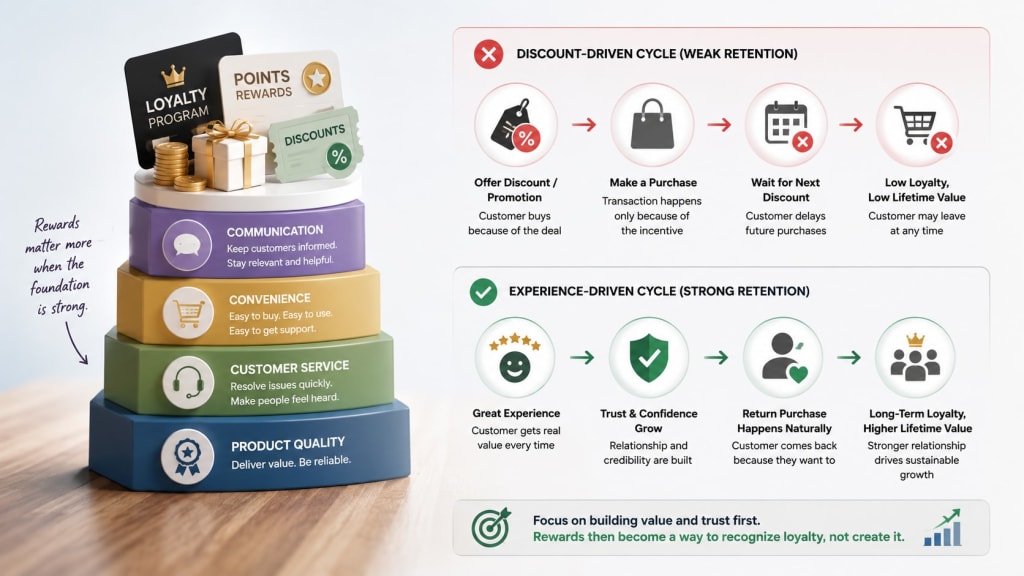
Loyalty programs are among the most recognizable retention tactics, but points and discounts should not be mistaken for a complete retention strategy. Incentives can encourage customers to purchase again, yet they cannot compensate indefinitely for poor service or an unreliable product.
Businesses should first ensure that customers have meaningful reasons to return without a reward. Product quality, convenience, trust, communication, and customer service should form the foundation of the relationship.
A loyalty program can then provide additional value by recognizing customers who purchase frequently or maintain a long-term relationship with the business. This is more sustainable than relying constantly on discounts to generate another transaction.
Excessive promotions can even create undesirable behavior if customers learn to delay purchases until another discount appears. Retention should strengthen the perceived value of the relationship rather than continually reducing the price required to maintain it.
Technology Can Help Businesses Scale Retention
As the number of customers increases, manually managing every relationship becomes difficult. Technology can help businesses recognize important moments in the customer lifecycle and communicate more consistently.
Marketing automation platforms can support welcome sequences, renewal reminders, product education, replenishment messages, and re-engagement campaigns. Customer relationship management systems can give teams a clearer view of previous interactions, while analytics tools can identify patterns associated with repeat purchases or churn.
Technology is most useful when it improves timing and relevance. Automation should not simply give companies the ability to send more messages. It should help customers receive appropriate information without unnecessary effort.
Automated campaigns should also be reviewed regularly. Customer behavior changes, products evolve, and workflows that made sense a year ago may no longer reflect the current experience.
The strongest retention systems combine automation with human judgment, allowing technology to handle routine communication while people remain available for situations that require context, empathy, or more complicated decisions.
Strong Retention Can Make Growth More Predictable
A reliable base of returning customers can give businesses a clearer picture of future demand. When companies understand how frequently customers purchase, how long accounts remain active, and how often subscriptions renew, forecasting becomes easier.
This predictability can support decisions throughout the organization. Marketing budgets can be planned more confidently, inventory can reflect expected repeat demand, and hiring decisions can be based on a more realistic view of future revenue. Businesses that rely almost entirely on new customer acquisition can be more exposed to sudden changes. Advertising prices can rise, competitors can become more aggressive, search rankings may shift, and social platforms can change how content is distributed.
Strong retention does not remove these risks, but it can reduce the company’s dependence on constantly finding new customers to generate future revenue. Returning customers create an additional layer of stability while acquisition continues expanding the overall customer base.
Acquisition and Retention Work Best Together
Acquisition and retention are most effective when treated as connected parts of the same customer lifecycle. Acquisition introduces new customers to the business, while retention determines how those relationships develop and how much long-term value they can create. Strong retention can eventually support acquisition through referrals, reviews, recommendations, and a stronger overall reputation.
When both strategies work together, businesses can:
- Attract customers who are more likely to be a good long-term fit
- Turn first-time buyers into repeat customers
- Use retention data to improve acquisition targeting
- Identify marketing channels that produce higher-value customers
- Build stronger customer relationships after conversion
- Generate referrals, reviews, and recommendations from satisfied customers
- Reduce reliance on constantly replacing customers who leave
This connection means marketing should be designed around the complete customer relationship rather than individual conversions. Before launching a major acquisition campaign, businesses should consider whether their onboarding, service, fulfillment, and support systems are prepared to deliver the experience being promised.
After conversion, customer behavior can provide information that improves future marketing decisions. Businesses can learn which acquisition sources produce valuable long-term customers, which expectations matter most, and where unnecessary friction is causing customers to disengage.
When those insights flow back into acquisition strategy, marketing becomes a continuous cycle. Each new customer provides information that can improve retention, while stronger retention helps businesses understand which audiences, channels, and experiences are most valuable for future growth.
Building a More Balanced Marketing Strategy
There is no universal formula for how much a company should invest in acquisition compared with retention. The right balance depends on the business model, growth stage, industry, competitive environment, and size of the existing customer base.
A young company may naturally invest heavily in acquisition because it needs to establish a customer base. A mature subscription business may discover that reducing churn creates substantial value. An eCommerce company could focus on converting first-time buyers into repeat customers while continuing to reach new audiences.
Businesses can begin by mapping the customer journey after conversion and identifying the moments where people commonly need support, information, or reassurance. Customer feedback and retention data can then reveal where customers disengage and which experiences encourage them to remain.
Acquisition data should ultimately be connected with those findings. Instead of simply asking which campaign generated the most customers, businesses can examine which campaigns generated customers who stayed, purchased again, recommended the brand, or developed into valuable long-term relationships.
Conclusion
Customer acquisition remains essential because every growing business needs to reach new audiences and establish new customer relationships. However, counting first-time purchases without understanding what happens afterward provides an incomplete picture of marketing success.
Retention marketing helps businesses generate greater value from relationships they have already invested in creating. Strong retention can support customer lifetime value, improve marketing efficiency, generate referrals, provide useful customer insights, and create greater stability when acquisition becomes more challenging.
The strongest strategies connect the two disciplines rather than forcing businesses to choose between them. Marketing attracts customers who are a good fit, while product quality, communication, service, education, and customer experience give those customers meaningful reasons to continue the relationship.
Over time, this creates a healthier model for growth. Instead of spending an increasing amount of money simply replacing customers who leave, businesses can continue attracting new people while building a growing base of customers who understand the brand, receive value from it, and have genuine reasons to return.